-
Use Cases
-
Resources
-
Pricing
The history of nuclear weapons spans from the scientific discoveries of the early 20th century through the Manhattan Project's development of the first atomic bombs during World War II, their use against Japan in 1945, the devastating Cold War arms race between the United States and the Soviet Union, the hydrogen bomb era, international efforts at arms control such as the Non-Proliferation Treaty, and ongoing debates over proliferation and disarmament. More Less
Dec 1938
% complete
German chemists Otto Hahn and Fritz Strassmann, working with physicist Lise Meitner's theoretical interpretation, discovered nuclear fission by bombarding uranium with neutrons. This breakthrough revealed that splitting heavy atomic nuclei released enormous energy, laying the scientific foundation for the development of nuclear weapons.
Image source: Discovery of nuclear fission
Aug 2, 1939
% complete
Physicists Albert Einstein and Leó Szilárd wrote a letter to President Franklin D. Roosevelt warning that Nazi Germany might develop atomic weapons. The letter prompted Roosevelt to establish the Advisory Committee on Uranium, marking the beginning of American government involvement in nuclear research.
Image source: Einstein–Szilard letter
Jul 1941
% complete
The British MAUD Committee concluded that an atomic bomb was feasible and could be built within two years. Its findings influenced both the British Tube Alloys program and helped convince American officials to pursue a full-scale atomic weapons effort.
Image source: MAUD Committee
Aug 13, 1942
% complete
The United States formally launched the Manhattan Project, a massive secret research and engineering program led by General Leslie Groves with scientific direction from J. Robert Oppenheimer, to develop the first atomic bombs before Nazi Germany could do so.
Image source: Manhattan Project
Dec 2, 1942
% complete
Under the leadership of Enrico Fermi, scientists achieved the first controlled, self-sustaining nuclear chain reaction beneath the Stagg Field bleachers at the University of Chicago. This milestone proved that nuclear reactions could be sustained, a critical step toward building both reactors and atomic bombs.
Image source: Chicago Pile-1
Aug 19, 1943
% complete
Winston Churchill and Franklin D. Roosevelt signed the Quebec Agreement, combining British and American nuclear research under the Manhattan Project. British scientists, including James Chadwick and Klaus Fuchs, joined the American effort, accelerating bomb development.
Image source: Quebec Agreement
Jul 16, 1945
% complete
The Manhattan Project detonated 'the Gadget,' a plutonium implosion bomb, in the New Mexico desert near Alamogordo. The Trinity test produced an explosive yield of about 20 kilotons, confirming the feasibility of nuclear weapons and ushering in the atomic age.
Aug 6, 1945
% complete
The US B-29 bomber Enola Gay dropped the uranium gun-type bomb 'Little Boy' on Hiroshima, Japan, killing approximately 70,000 people instantly and tens of thousands more from radiation and injuries. It was the first use of a nuclear weapon in warfare.
Image source: Atomic bombings of Hiroshima and Nagasaki
Aug 9, 1945
% complete
Three days after Hiroshima, the US dropped the plutonium bomb 'Fat Man' on Nagasaki, killing roughly 40,000 people immediately. Japan announced its surrender days later, ending World War II and demonstrating the devastating power of nuclear arms.
Jun 14, 1946
% complete
US representative Bernard Baruch proposed to the newly formed United Nations Atomic Energy Commission a plan for international control of atomic energy, including the elimination of national arsenals. The Soviet Union rejected it, and the plan failed, foreshadowing decades of nuclear rivalry.
Aug 5, 1963
% complete
The United States, Soviet Union, and United Kingdom signed the Limited Test Ban Treaty, prohibiting nuclear explosions in the atmosphere, outer space, and underwater. It did not ban underground testing but significantly reduced radioactive fallout worldwide.
Image source: Partial Nuclear Test Ban Treaty
Jul 1, 1968
% complete
The Treaty on the Non-Proliferation of Nuclear Weapons (NPT) opened for signature, committing non-nuclear states to forgo nuclear weapons in exchange for peaceful nuclear technology, while recognized nuclear states pledged disarmament negotiations. It became the cornerstone of the global nonproliferation regime.
Image source: Treaty on the Non-Proliferation of Nuclear Weapons
Nov 25, 1969
% complete
President Nixon's administration undertook major strategic reviews that reshaped US nuclear policy, including the shift toward flexible response and eventual arms control engagement with Moscow, setting the stage for détente-era agreements limiting strategic arsenals.
Image source: Amrom Harry Katz
May 26, 1972
% complete
Richard Nixon and Leonid Brezhnev signed the SALT I agreement and the Anti-Ballistic Missile Treaty in Moscow, freezing the number of strategic ballistic missile launchers and restricting missile defenses—the first major accords capping the superpowers' nuclear arsenals.
Image source: Strategic Arms Limitation Talks
Dec 8, 1987
% complete
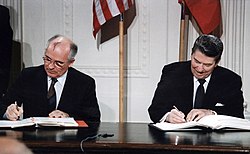
Ronald Reagan and Mikhail Gorbachev signed the Intermediate-Range Nuclear Forces Treaty, eliminating all ground-launched ballistic and cruise missiles with ranges between 500 and 5,500 kilometers. It was the first treaty to abolish an entire class of nuclear weapons.
Image source: Intermediate-Range Nuclear Forces Treaty
Mar 1990 - 1991
% complete
South Africa became the first nation to voluntarily build and then dismantle its own nuclear weapons, destroying six devices before joining the NPT in 1991. The rollback set a unique precedent for nuclear disarmament by a former proliferator.
Image source: South Africa and weapons of mass destruction
Sep 24, 1996
% complete
The UN General Assembly adopted the Comprehensive Nuclear-Test-Ban Treaty, banning all nuclear explosions for any purpose. While it has never entered into legal force due to key holdout states, most nations observe a de facto moratorium on nuclear testing.
Image source: Comprehensive Nuclear-Test-Ban Treaty
Jan 10, 2003
% complete
North Korea announced its withdrawal from the Non-Proliferation Treaty, citing US hostility, and expelled international inspectors. The move began a prolonged crisis over Pyongyang's nuclear ambitions, leading to multiple rounds of diplomacy, sanctions, and escalating provocations.
Image source: North Korea and weapons of mass destruction
Apr 8, 2010
% complete
Presidents Barack Obama and Dmitry Medvedev signed New START, capping deployed strategic warheads at 1,550 each and restoring mutual inspections. The treaty represented the most significant bilateral arms reduction since the Cold War and was extended into the 2020s.
Image source: New START
Jul 1, 1946 - Aug 25, 1946
% complete
The United States conducted a pair of nuclear tests at Bikini Atoll in the Pacific to assess the effects of atomic weapons on warships. The tests, involving over 90 target vessels, revealed lingering radiation hazards and marked the beginning of large-scale atmospheric testing programs.
Image source: Operation Crossroads
Nov 1, 1952
% complete
The United States detonated Ivy Mike on Enewetak Atoll, the first full-scale test of a thermonuclear (hydrogen) weapon. With a yield of about 10.4 megatons—hundreds of times more powerful than the Hiroshima bomb—it vaporized the island of Elugelab and opened the era of megaton-class weapons.
Image source: Ivy Mike
Mar 1, 1954
% complete
The US Castle Bravo test at Bikini Atoll yielded 15 megatons, far exceeding predictions due to an unexpected lithium reaction. Massive radioactive fallout contaminated nearby islands and a Japanese fishing boat, the Daigo Fukuryū Maru, sparking international outrage over atmospheric testing.
Image source: Castle Bravo
Oct 30, 1961
% complete
The Soviet Union detonated Tsar Bomba over Novaya Zemlya, producing an estimated 50-megaton explosion—the most powerful nuclear device ever tested. The blast's shockwave circled the Earth three times, and its sheer scale prompted even superpower leaders to reconsider unlimited testing.
Image source: Tsar Bomba
May 18, 1974
% complete
India detonated a plutonium device codenamed Smiling Buddha at Pokhran, describing it as a 'peaceful nuclear explosive.' The test made India the sixth nuclear power and prompted the creation of the Nuclear Suppliers Group to restrict sensitive technology exports.
Image source: Smiling Buddha
Oct 5, 1986
% complete
Former Israeli technician Mordechai Vanunu revealed details and photographs of Israel's Dimona reactor to the British press, providing strong evidence that Israel possessed a substantial nuclear arsenal. Israel maintains a policy of ambiguity, neither confirming nor denying its nuclear weapons.
Image source: Mordechai Vanunu
May 28, 1998
% complete
Weeks after India's second round of tests, Pakistan detonated five nuclear devices at Chagai in Balochistan, publicly declaring itself a nuclear power. The reciprocal tests triggered international sanctions and entrenched a dangerous nuclear rivalry in South Asia.
Image source: Chagai-I
Aug 29, 1949
% complete
The Soviet Union detonated RDS-1 ('First Lightning') at Semipalatinsk, Kazakhstan, becoming the second nuclear power years ahead of Western estimates. Accelerated partly by espionage, including intelligence from Klaus Fuchs, the test shattered the American nuclear monopoly and intensified Cold War tensions.
Image source: RDS-1
Oct 3, 1952
% complete
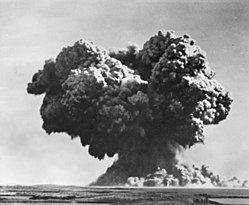
Britain tested its first atomic device, codenamed Hurricane, aboard a ship off the Monte Bello Islands in Australia. The test made the United Kingdom the world's third nuclear power and affirmed its status as a major independent military force.
Image source: Operation Hurricane
Aug 12, 1953
% complete
The Soviet Union detonated RDS-6s ('Joe 4'), a boosted fission design developed under Andrei Sakharov, at Semipalatinsk. Though not a true staged thermonuclear weapon, it demonstrated Soviet progress toward hydrogen bombs and escalated the superpower arms race.
Feb 13, 1960
% complete
France conducted its first nuclear test, Gerboise Bleue, in the Algerian Sahara desert. With a yield of about 60 kilotons, it made France the fourth nation to possess nuclear weapons and reflected President de Gaulle's pursuit of an independent force de frappe.
Image source: Gerboise Bleue (nuclear test)
Oct 16, 1962 - Oct 28, 1962
% complete
A thirteen-day confrontation erupted after US reconnaissance discovered Soviet nuclear missiles being deployed in Cuba. President Kennedy imposed a naval quarantine while Premier Khrushchev considered escalation. The crisis ended with a negotiated withdrawal but left both superpowers deeply shaken, spurring later arms control efforts.
Image source: Cuban Missile Crisis
Oct 16, 1964
% complete
China conducted its first nuclear test, Project 596, at Lop Nur, detonating a uranium-based device. Becoming the fifth nuclear power, China declared a no-first-use policy and dramatically altered the strategic balance in Asia.
Image source: Project 596
Or browse the full history timeline directory, with more than 2,000 topics.
This History of Nuclear Weapons timeline was generated with the help of AI, using information found on the internet.
We work hard to keep these timelines accurate, but mistakes do get through. If you spot one, email us at [email protected] and we'll fix it for future visitors.
Generate yours with AI or build it from scratch, for free.
Export your timeline, add your own events, edit or remove AI-generated events, and much more
No credit card required.
Cancel anytime.
Cancel anytime.
You can create an unlimited number of timelines with up to 10 events on each one, customize how they look, export them to PDF, PNG, PowerPoint, CSV, and Excel, and share them with a link. Paid plans raise the event limit and add features like spreadsheet imports and collaborators.
Yes. You can cancel your subscription from your account page at any time, and you will not be charged again. Your subscription stays active for the rest of the period you already paid for.
Yes. We will email you a reminder before the annual renewal, and we will also email you a receipt.
Yes. You can email us within 15 days of any payment, and we will issue you a full refund.
Check out our pricing docs or send us an email anytime: [email protected].