-
Use Cases
-
Resources
-
Pricing
The history of nuclear power traces humanity's journey from discovering atomic fission in the 1930s through the development of the first reactors during World War II, the rapid expansion of commercial nuclear energy in the 1950s-1970s, major accidents like Chernobyl and Fukushima, and ongoing efforts toward safer, cleaner nuclear energy including fusion research. More Less
1932
% complete
Physicists John Cockcroft, Ernest Walton, and Ernest Rutherford discovered that when lithium atoms were 'split' by protons from a proton accelerator, immense amounts of energy were released in accordance with the principle of mass–energy equivalence.
Image source: Nuclear power
1934
% complete
Experiments bombarding materials with neutrons led Frédéric and Irène Joliot-Curie to discover induced radioactivity in 1934, which allowed the creation of radium-like elements.
1938
% complete
German chemists Otto Hahn and Fritz Strassmann, along with Austrian physicist Lise Meitner and her nephew Otto Robert Frisch, conducted experiments with the products of neutron-bombarded uranium, further investigating Fermi's claims.
Image source: Nuclear fission
1939
% complete
Once nuclear fission was experimentally confirmed and announced by Frédéric Joliot-Curie in 1939, scientists in many countries including the United States, the United Kingdom, France, Germany, and the Soviet Union petitioned their governments for support of nuclear fission research for the development of a nuclear weapon, just on the cusp of World War II.
Dec 2, 1942
% complete
In the United States, where Fermi and Szilárd had both emigrated, the discovery of the nuclear chain reaction led to the creation of the first man-made reactor, the research reactor known as Chicago Pile-1, which achieved criticality on 2 December 1942.
Image source: Chicago Pile-1
Jul 1945 - Aug 1945
% complete
The United States tested the first nuclear weapon in July 1945, the Trinity test, with the atomic bombings of Hiroshima and Nagasaki taking place the following month.
Image source: Trinity (nuclear test)
Aug 1945
% complete
In August 1945, the first widely distributed account of nuclear energy, the pocketbook The Atomic Age, was released.
Image source: Atomic Age
Dec 25, 1946
% complete
The first self-sustaining nuclear chain reaction in Europe was achieved on 25 December 1946 by the F-1 ('First Physical Reactor'), a research reactor operated by the Kurchatov Institute in Moscow, USSR.
Image source: F-1 (nuclear reactor)
Dec 20, 1951
% complete
Electricity was generated for the first time by a nuclear reactor on 20 December 1951, at the EBR-I experimental station near Arco, Idaho, which initially produced about 100 kW.
Image source: Experimental Breeder Reactor I
Jan 1954
% complete
The first nuclear-powered submarine, USS Nautilus, was put to sea in January 1954.
Image source: USS Nautilus (SSN-571)
1953
% complete
American President Dwight Eisenhower gave his 'Atoms for Peace' speech at the United Nations, emphasizing the need to develop 'peaceful' uses of nuclear power quickly.
Image source: Atoms for Peace
1954
% complete
The U.S. Army Nuclear Power Program formally commenced in 1954 to develop nuclear reactors for military applications.
1954
% complete
The Atomic Energy Act of 1954 allowed rapid declassification of U.S. nuclear technology, paving the way for commercial development of nuclear power.
Image source: Atomic Energy Act of 1954
Jun 27, 1954
% complete
On 27 June 1954, the Obninsk Nuclear Power Plant in the USSR became the world's first nuclear power plant to generate electricity for a power grid, producing around 5 megawatts of electric power.
Image source: Obninsk Nuclear Power Plant
Aug 27, 1956
% complete
The world's first commercial nuclear power station, Calder Hall at Windscale, England, was connected to the national power grid on 27 August 1956.
Image source: Calder Hall nuclear power station
1957
% complete
In 1957 EURATOM was launched alongside the European Economic Community (the latter is now the European Union), promoting nuclear cooperation in Europe.
Image source: Euratom
Apr 1957
% complete
Under the Army Nuclear Power Program's management, the 2 megawatt SM-1 at Fort Belvoir, Virginia, was the first in the United States to supply electricity in an industrial capacity to the commercial grid (VEPCO), in April 1957.
Image source: Natural nuclear fission reactor
Dec 1957
% complete
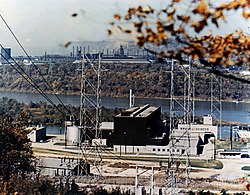
The first commercial nuclear station to become operational in the United States was the 60 MW Shippingport Reactor in Pennsylvania, in December 1957.
Image source: Shippingport Atomic Power Station
1958
% complete
Derived from the Borax boiling water reactor (BWR) design, this reactor first achieved operational criticality and connection to the grid in 1958.
Image source: Boiling water reactor
1973
% complete
The French plan, known as the Messmer plan, aimed for complete independence from oil, with an envisaged construction of 80 reactors by 1985 and 170 by 2000. France would ultimately construct 25 fission-electric stations, installing 56 mostly PWR design reactors over the next 15 years.
Image source: Nuclear power in France
1973
% complete
The 1973 oil crisis had a significant effect on countries such as France and Japan, which had relied more heavily on oil for electric generation (39% and 73% respectively), prompting them to invest heavily in nuclear power.
Image source: 1973 oil crisis
1958 - 1964
% complete
Beginning with the proposed Bodega Bay station in California in 1958, early anti-nuclear conflict with local citizens emerged, and by 1964 the concept was ultimately abandoned.
Image source: Bodega Bay Nuclear Power Plant
1961
% complete
For reasons unknown, in 1961 a technician removed a control rod about 22 inches farther than the prescribed 4 inches, causing a fatal accident at the SL-1 reactor.
Image source: SL-1
Sep 16, 1967
% complete
The Pathfinder Nuclear Station near Sioux Falls, South Dakota, open for about a year, suffered an accident when an operator opened a valve too fast, causing the one-year-old plant to be retired permanently.
Image source: Pathfinder Nuclear Generating Station
1968
% complete
Another serious accident happened in 1968, when one of the two liquid-metal-cooled reactors on board the Soviet submarine K-27 underwent a fuel element failure, with the emission of gaseous fission products into the surrounding air.
Image source: Soviet submarine K-27
1972
% complete
In 1972 Alvin Weinberg, co-inventor of the light water reactor design, was fired from his job at Oak Ridge National Laboratory by the Nixon administration, 'at least in part' over his raising of concerns about the safety and wisdom of ever larger scaling-up of his design, especially above a power rating of ~500 MWe.
Image source: Alvin M. Weinberg
1975
% complete
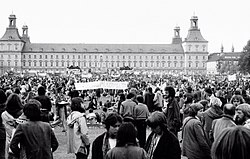
In the early 1970s, there were large protests about a proposed nuclear power plant in Wyhl, Germany, and the project was cancelled in 1975, marking a milestone in the European anti-nuclear movement.
Image source: Wyhl
1975 - 1980
% complete
A total of 63 nuclear units were canceled in the United States between 1975 and 1980, reflecting rising costs, regulatory delays, and public opposition. More than two-thirds of all nuclear plants ordered after January 1970 were eventually cancelled.
Image source: Nuclear power in the United States
1978 - 1987
% complete
Numerous countries, including Austria (1978), Sweden (1980) and Italy (1987) (influenced by Chernobyl) have voted in referendums to oppose or phase out nuclear power.
Image source: Anti-nuclear movement
1979
% complete
According to some commentators, the 1979 accident at Three Mile Island played a major part in the reduction in the number of new plant constructions in many other countries.
Image source: Three Mile Island accident
May 1979
% complete
In May 1979, an estimated 70,000 people, including then governor of California Jerry Brown, attended a march against nuclear power in Washington, D.C., following the Three Mile Island accident.
Image source: Anti-nuclear movement in the United States
1982
% complete
In 1982, amongst a backdrop of ongoing protests directed at the construction of the first commercial scale breeder reactor in France, a later member of the Swiss Green Party fired five RPG-7 rocket-propelled grenades at the still under construction containment building of the Superphenix reactor.
Image source: Superphénix
1986
% complete
An international organization to promote safety awareness and the professional development of operators in nuclear facilities, the World Association of Nuclear Operators (WANO), was created as a direct outcome of the 1986 Chernobyl accident.
Image source: World Association of Nuclear Operators
Apr 26, 1986
% complete
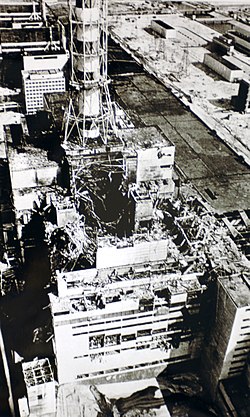
The Chernobyl disaster occurred on Saturday 26 April 1986 at the No. 4 reactor of the Chernobyl Nuclear Power Plant. The initial emergency response, together with later decontamination of the environment, ultimately involved more than 500,000 personnel and cost an estimated 18 billion Soviet rubles—roughly US$68 billion in 2019, adjusted for inflation.
Image source: Chernobyl disaster
2005
% complete
Total global installed nuclear capacity initially rose relatively quickly, from less than 1 GW in 1960 to 100 GW in the late 1970s and 300 GW in the late 1980s. Since the late 1980s worldwide capacity has risen much more slowly, reaching 366 GW in 2005.
2011
% complete
In 2011 the International Energy Agency halved its prior estimate of new generating capacity to be built by 2035, reflecting the impact of the Fukushima disaster on nuclear outlooks.
Image source: International Energy Agency
2011
% complete
Germany approved plans to close all its reactors by 2022, though following the energy crisis caused by the Russian invasion of Ukraine, Germany later decided to keep reactors running until April 2023.
Image source: Nuclear power in Germany
Mar 11, 2011
% complete
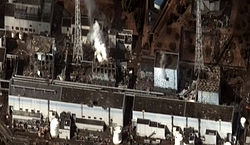
Following the Tōhoku earthquake on 11 March 2011, one of the largest earthquakes ever recorded, and a subsequent tsunami off the coast of Japan, the Fukushima Daiichi Nuclear Power Plant suffered three core meltdowns due to failure of the emergency cooling system for lack of electricity supply.
Image source: Fukushima nuclear accident
Jun 2011
% complete
Italian nuclear energy plans ended when Italy banned the generation, but not consumption, of nuclear electricity in a June 2011 referendum.
Image source: Nuclear power in Italy
2015
% complete
By 2015, the global trend was for new nuclear power stations coming online to be balanced by the number of old plants being retired, and eight new grid connections were completed by China in 2015.
Image source: Nuclear power in China
Aug 2015
% complete
In August 2015, following 4 years of near zero fission-electricity generation, Japan began restarting its nuclear reactors after safety upgrades were completed, beginning with Sendai Nuclear Power Plant.
Image source: Sendai Nuclear Power Plant
2016
% complete
In 2016, the BN-800 sodium-cooled fast reactor in Russia began commercial electricity generation, while plans for a BN-1200 awaited results from MBIR, an under-construction multi-loop Generation IV research facility testing lead, lead-bismuth and gas coolants.
Image source: BN-800 reactor
2017
% complete
While South Korea has a large nuclear power industry, the new government in 2017, influenced by a vocal anti-nuclear movement, committed to halting nuclear development after the completion of the facilities presently under construction.
Image source: Nuclear power in South Korea
Mar 2017
% complete
The bankruptcy of Westinghouse in March 2017 due to US$9 billion of losses from the halting of construction at Virgil C. Summer and Vogtle nuclear plants marked a major setback for the U.S. nuclear industry.
Image source: Westinghouse Electric Company
2018
% complete
In 2018 the MIT Energy Initiative study on the future of nuclear energy concluded that, together with strong government support for Generation IV technologies, a worldwide renaissance would require a global standardization of regulations, moving towards serial manufacturing of standardized units akin to aircraft manufacturing.
Image source: Massachusetts Institute of Technology
Jan 2019
% complete
In January 2019, China had 45 reactors in operation, 13 under construction, and plans to build 43 more, which would make it the world's largest generator of nuclear electricity. As of 2019, over 60 GW in new nuclear power plants was under construction, mostly in China, Russia, Korea, India and UAE.
2020
% complete
Many countries in the world are considering Small Modular Reactors, with one in Russia connected to the grid in 2020. As of 2020, a number of US nuclear power plants were also cleared by the Nuclear Regulatory Commission for operations up to 80 years.
Image source: Small modular reactor
2022 - Apr 2023
% complete
Following the energy crisis caused by the Russian invasion of Ukraine, Germany decided to postpone the shutdown of its three remaining nuclear power plants until April 2023.
Mar 2022
% complete
Following the 2022 Russian invasion of Ukraine, the situation changed. With the Versailles declaration agreed in March 2022, EU leaders of the 27 member states agreed to phase out the EU's dependence on Russian fossil fuels as soon as possible.
Or browse the full history timeline directory, with more than 2,000 topics.
This History of Nuclear Power timeline was generated with the help of AI, using information found on the internet.
We work hard to keep these timelines accurate, but mistakes do get through. If you spot one, email us at [email protected] and we'll fix it for future visitors.
Generate yours with AI or build it from scratch, for free.
Export your timeline, add your own events, edit or remove AI-generated events, and much more
No credit card required.
Cancel anytime.
Cancel anytime.
You can create an unlimited number of timelines with up to 10 events on each one, customize how they look, export them to PDF, PNG, PowerPoint, CSV, and Excel, and share them with a link. Paid plans raise the event limit and add features like spreadsheet imports and collaborators.
Yes. You can cancel your subscription from your account page at any time, and you will not be charged again. Your subscription stays active for the rest of the period you already paid for.
Yes. We will email you a reminder before the annual renewal, and we will also email you a receipt.
Yes. You can email us within 15 days of any payment, and we will issue you a full refund.
Check out our pricing docs or send us an email anytime: [email protected].