-
Use Cases
-
Resources
-
Pricing
The history of nuclear physics traces humanity's understanding of the atomic nucleus, beginning with radioactivity discoveries in the 1890s and advancing through landmark achievements such as Rutherford's nuclear model, Chadwick's discovery of the neutron, nuclear fission, and the development of both nuclear power and nuclear weapons. More Less
1896
The history of nuclear physics as a discipline distinct from atomic physics begins with Henri Becquerel's discovery of radioactivity in 1896, made while investigating phosphorescence in uranium salts. His observation that uranium emitted penetrating rays without external excitation opened an entirely new field of scientific inquiry.
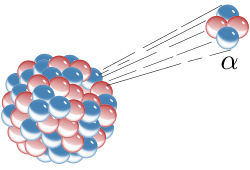
Image source: Radioactive decay
1899 - 1903
By the turn of the century, physicists had discovered three types of radiation emanating from atoms, which they named alpha, beta, and gamma radiation. Classifying these emissions by their penetrating power and electric charge laid crucial groundwork for understanding the structure of the nucleus.
Dec 10, 1903
The 1903 Nobel Prize in Physics was awarded jointly to Henri Becquerel for his discovery of radioactivity, and to Marie and Pierre Curie for their subsequent research into radioactivity, recognizing the foundational importance of these discoveries to the new science of nuclear physics.
Image source: Henri Becquerel

Nov 13, 1908
Ernest Rutherford was awarded the Nobel Prize in Chemistry in 1908 for his investigations into the disintegration of the elements and the chemistry of radioactive substances, honoring his pioneering work on transmutation and radioactive decay.
Image source: Ernest Rutherford

1900
At the beginning of the 20th century, the accepted model of the atom was J. J. Thomson's plum pudding model, which pictured atoms as diffuse spheres of positive charge with electrons embedded within them like raisins in a pudding. This model would soon be challenged by experiments with radioactivity.
Image source: Plum pudding model

1906
In 1906, Ernest Rutherford published 'Retardation of the a Particle from Radium in passing through matter,' beginning systematic studies of how alpha particles interact with matter.
Image source: Rutherford scattering experiments

1908
Hans Geiger expanded on Rutherford's work in a communication to the Royal Society, describing experiments he and Rutherford had done passing alpha particles through air, aluminum foil, and gold leaf.
Image source: Hans Geiger

1909
More work was published in 1909 by Hans Geiger and Ernest Marsden, documenting their observations of alpha particles deflected by thin metal foils, including the surprising large-angle scattering that hinted at a concentrated positive charge in the atom.
1909
Published in 1909, with the eventual classical analysis by Rutherford published in May 1911, the key preemptive experiment was performed during 1909 at the University of Manchester, firing alpha particles at gold foil and observing their scattering patterns.
1910
Further greatly expanded work was published in 1910 by Hans Geiger, providing detailed quantitative data on alpha particle scattering that Rutherford would use in developing his nuclear theory of the atom.
This History of Nuclear Physics timeline was generated with the help of AI, using information found on the internet.
We work hard to keep these timelines accurate, but mistakes do get through. If you spot one, email us at [email protected] and we'll fix it for future visitors.
Generate yours with AI or build it from scratch, for free.