-
Use Cases
-
Resources
-
Pricing
The history of particle physics traces humanity's quest to understand the fundamental building blocks of matter. Beginning with J.J. Thomson's discovery of the electron in 1897, the field evolved through the identification of protons, neutrons, and a zoo of subatomic particles, the development of quantum field theory, the Standard Model, and landmark discoveries such as quarks and the Higgs boson at modern particle accelerators. More Less
900 BC - 500 BC
% complete
The Jains in ancient India were among the earliest to advocate the particular nature of material objects between the 9th and 5th centuries BCE, proposing an early form of particle-based philosophy of matter.
Image source: Jainism
600 BC
% complete
The idea that matter consists of smaller particles and that there exists a limited number of sorts of primary, smallest particles in nature has existed in natural philosophy since at least the 6th century BC, forming the conceptual foundation for later particle physics.
Image source: Atomism
600 BC
% complete
The idea that all matter is composed of elementary particles dates back as far as the 6th century BCE, when philosophers first speculated about indivisible constituents of the physical world.
Image source: Elementary particle
1800 - 1899
% complete
In the 19th century, John Dalton, through his work on stoichiometry, concluded that each chemical element was composed of a single, unique type of particle, giving physical credibility to ancient atomist ideas.
Image source: John Dalton
1879 - 1897
% complete
The electron was discovered between 1879 and 1897 in works of William Crookes, Arthur Schuster, J.J. Thomson and other physicists, marking the identification of the first subatomic particle.
Image source: Electron
1880
% complete
Near the end of the 19th century, physicists discovered that Dalton's atoms are not, in fact, the fundamental particles of nature, but rather conglomerates of even smaller particles.
Image source: Atom
1900
% complete
Early 20th-century physicists knew only two fundamental forces: electromagnetism and gravitation, where the latter could not explain the structure of atoms, motivating the search for new interactions.
Jan 1, 1907
% complete
Speculation about the structure of atoms was severely constrained by Rutherford's 1907 gold foil experiment, showing that the atom is mainly empty space, with almost all its mass concentrated in a tiny atomic nucleus.
Image source: Rutherford scattering experiments
Jan 1, 1909 - Dec 31, 1909
% complete
The charge of the electron was carefully measured by Robert Andrews Millikan and Harvey Fletcher in their oil drop experiment of 1909, providing precise knowledge of a fundamental constant.
Image source: Oil drop experiment
Jan 1, 1914
% complete
By 1914, experiments by Ernest Rutherford, Henry Moseley, James Franck and Gustav Hertz had largely established the structure of an atom as a dense nucleus of positive charge surrounded by lower-mass electrons.
1900 - 1950
% complete
The next step was a reduction in the number of fundamental interactions, envisaged by early 20th-century physicists as the 'united field theory', inspiring decades of unification efforts.
Image source: Unified field theory
1960
% complete
It began with what Gell-Mann referred to as the 'Eightfold Way', proceeding into several different 'octets' and 'decuplets' which could predict new particles, transforming the classification of hadrons.
Image source: Eightfold way (physics)
1960 - 1970
% complete
While the quark model at first seemed inadequate to describe strong nuclear forces, allowing the temporary rise of competing theories such as the S-matrix theory during the 1960s.
Image source: S-matrix theory
1964
% complete
The Ω−, famously predicted by the Eightfold Way, was detected at Brookhaven National Laboratory in 1964, giving rise to the quark model of hadron composition.
Image source: Omega baryon
1964
% complete
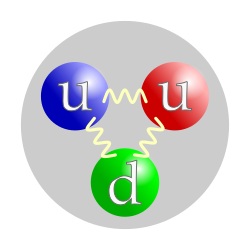
Following the detection of the Ω−, the quark model arose to explain hadron composition in terms of fundamental quark constituents, reshaping particle physics.
Image source: Quark model
1970 - 1979
% complete
The establishment of quantum chromodynamics in the 1970s finalized a set of fundamental and exchange particles, securing the quark model's place in describing strong nuclear forces.
Image source: Quantum chromodynamics
1973
% complete
After the discovery, made at CERN, of the existence of neutral weak currents mediated by the Z boson foreseen in the standard model, electroweak theory gained crucial experimental support.
Dec 10, 1979
% complete
Following the discovery of neutral weak currents, physicists Salam, Glashow and Weinberg received the 1979 Nobel Prize in Physics for their electroweak theory unifying electromagnetism and the weak force.
Jan 1, 1909
% complete
In 1909 Ernest Rutherford and Thomas Royds demonstrated that an alpha particle combines with two electrons and forms a helium atom, clarifying the nature of radioactive emissions.
Image source: Ernest Rutherford
Jan 1, 1918
% complete
In 1918, Rutherford confirmed that the hydrogen nucleus was a particle with a positive charge, which he named the proton, identifying another key constituent of matter.
Image source: Proton
Jan 1, 1939
% complete
Also in 1939, Hans Bethe demonstrated the mechanism of nuclear fusion, explaining how stars produce energy by fusing light nuclei together.
Image source: Hans Bethe
Jan 1, 1939
% complete
It culminated in proofs of nuclear fission in 1939 by Lise Meitner, based on experiments by Otto Hahn, revealing the enormous energy stored within atomic nuclei.
Image source: Nuclear fission
2000
% complete
Production of progressively heavier synthetic elements continued into the 21st century as a branch of nuclear physics, pursued purely for scientific purposes rather than practical applications.
Image source: Synthetic element
Jan 1, 1928
% complete
Improved understanding of the world of particles prompted bold predictions such as Dirac's positron in 1928, founded on the Dirac Sea model, anticipating antimatter.
Image source: Positron
Jan 1, 1930
% complete
In 1930 Pauli proposed the neutrino, founded on conservation of energy and angular momentum in beta decay, a particle that would remain elusive for decades.
Image source: Neutrino
Jan 1, 1957
% complete
In 1957 Chien-Shiung Wu proved that parity is not conserved in weak interactions, overturning a long-held symmetry assumption in physics.
Image source: Wu experiment
1964
% complete
Peter Higgs was one of six physicists, working in three independent groups, who in 1964 invented the notion of the cosmic molasses, or Higgs field, a mechanism thought to give particles mass.
2011
% complete
As of 2011, the Higgs boson, the quantum of a field thought to provide particles with rest masses, remained the only particle of the Standard Model yet to be verified experimentally.
Image source: Higgs boson
Jul 4, 2012
% complete
On July 4, 2012, physicists working at CERN's Large Hadron Collider announced they had discovered a new subatomic particle greatly resembling the Higgs boson, a potential key to understanding why elementary particles have masses and indeed to the existence of diversity and life in the universe.
Jul 4, 2012
% complete
Rolf-Dieter Heuer, director general of CERN, said it was too soon to know for sure whether the newly found particle was entirely new, one of the heaviest subatomic particles yet, or indeed the elusive particle predicted by the Standard Model, the theory that has ruled physics for half a century.
Image source: Rolf-Dieter Heuer
Mar 14, 2013
% complete
Further experiments continued, and in March 2013 it was tentatively confirmed that the newly discovered particle was a Higgs boson, fulfilling a rendezvous with destiny for a generation of physicists who believed in its existence for half a century without ever seeing it.
Or browse the full history timeline directory, with more than 2,000 topics.
This History of Particle Physics timeline was generated with the help of AI, using information found on the internet.
We work hard to keep these timelines accurate, but mistakes do get through. If you spot one, email us at [email protected] and we'll fix it for future visitors.
Generate yours with AI or build it from scratch, for free.
Export your timeline, add your own events, edit or remove AI-generated events, and much more
No credit card required.
Cancel anytime.
Cancel anytime.
You can create an unlimited number of timelines with up to 10 events on each one, customize how they look, export them to PDF, PNG, PowerPoint, CSV, and Excel, and share them with a link. Paid plans raise the event limit and add features like spreadsheet imports and collaborators.
Yes. You can cancel your subscription from your account page at any time, and you will not be charged again. Your subscription stays active for the rest of the period you already paid for.
Yes. We will email you a reminder before the annual renewal, and we will also email you a receipt.
Yes. You can email us within 15 days of any payment, and we will issue you a full refund.
Check out our pricing docs or send us an email anytime: [email protected].