-
Use Cases
-
Resources
-
Pricing
The history of physics traces humanity's effort to understand matter, motion, energy, and the fundamental forces of nature. Beginning with ancient Greek thinkers like Aristotle and Archimedes, it advanced through the Scientific Revolution with Copernicus, Galileo, and Newton's laws of motion and gravitation, then transformed in the 19th century with thermodynamics and electromagnetism, culminating in the 20th-century revolutions of Einstein's relativity and quantum mechanics. More Less
1543
% complete
Nicolaus Copernicus published his heliocentric model placing the Sun at the center of the universe, with Earth and other planets orbiting it. This revolutionary work began the transformation of astronomy and laid groundwork for modern physics.
Image source: De revolutionibus orbium coelestium
1609 - 1619
% complete
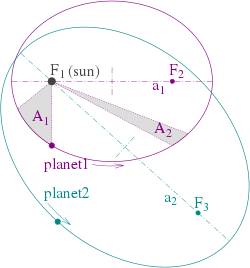
Johannes Kepler published his three laws of planetary motion between 1609 and 1619, showing that planets move in elliptical orbits with the Sun at one focus. These empirical laws later became the foundation for Newton's theory of gravitation.
Image source: Kepler's laws of planetary motion
1610
% complete
Galileo Galilei published Sidereus Nuncius, reporting his telescopic discoveries including Jupiter's moons and lunar craters. His observations provided strong evidence for the Copernican system and helped establish experimental observation as central to science.
Image source: Sidereus Nuncius
Jul 5, 1687
% complete
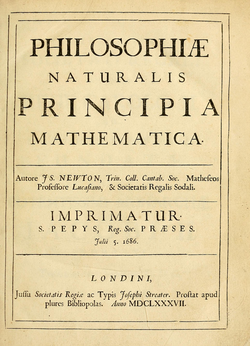
Isaac Newton published the Principia, establishing the three laws of motion and the law of universal gravitation. This unified terrestrial and celestial mechanics under a single mathematical framework and is often considered the most influential book in the history of physics.
Image source: Philosophiæ Naturalis Principia Mathematica
1705
% complete
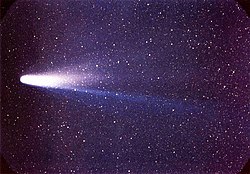
Edmond Halley used Newtonian mechanics to show that comets observed in 1531, 1607, and 1682 were the same object, predicting its return in 1758. The comet's confirmed return demonstrated the predictive power of Newtonian gravitation.
Image source: Halley's Comet
1738
% complete
Daniel Bernoulli published Hydrodynamica, establishing key principles of fluid dynamics including what is now known as Bernoulli's principle. He also gave an early kinetic theory explanation of gas pressure based on molecular collisions.
Image source: Daniel Bernoulli
1788
% complete
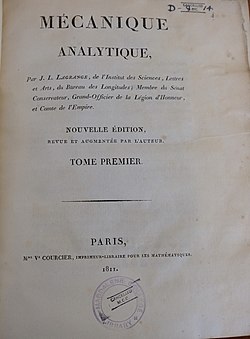
Joseph-Louis Lagrange reformulated classical mechanics using variational principles and generalized coordinates, eliminating geometric reasoning in favor of pure algebraic analysis. Lagrangian mechanics remains fundamental to modern theoretical physics.
Image source: Mécanique analytique
1798
% complete
Henry Cavendish used a torsion balance to measure the attractive force between lead spheres, allowing the first accurate determination of Earth's density and, indirectly, Newton's gravitational constant G. It is often called 'weighing the Earth.'
Image source: Cavendish experiment
1799 - 1825
% complete
Pierre-Simon Laplace's five-volume Mécanique céleste summarized and extended Newtonian gravitation, demonstrating the stability of the solar system and completing the Newtonian program of celestial mechanics.
Image source: Traité de mécanique céleste
1800
% complete
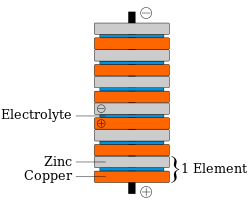
Alessandro Volta invented the voltaic pile, the first true electrochemical battery capable of providing continuous electric current. This invention enabled the rapid development of electromagnetism and electrochemistry throughout the nineteenth century.
Image source: Voltaic pile
Apr 1820
% complete
Hans Christian Ørsted discovered that an electric current deflects a nearby compass needle, revealing the connection between electricity and magnetism. This discovery launched the study of electromagnetism as a unified field.
Image source: Hans Christian Ørsted
1824
% complete
Sadi Carnot analyzed the efficiency of heat engines, establishing that no engine can be more efficient than a reversible Carnot cycle. His work founded the science of thermodynamics and introduced concepts central to the second law.
Image source: Reflections on the Motive Power of Fire
1831
% complete
Michael Faraday discovered electromagnetic induction, showing that changing magnetic fields generate electric currents. This principle underlies generators and transformers, and Faraday's concept of field lines transformed how physicists think about forces.
Image source: Electromagnetic induction
1845
% complete
James Prescott Joule's experiments showed that mechanical work can be converted into heat in fixed proportion, establishing the conservation of energy. His paddle-wheel experiments quantified the mechanical equivalent of heat, a cornerstone of thermodynamics.
Image source: Mechanical equivalent of heat
1865
% complete
James Clerk Maxwell unified electricity, magnetism, and light in a set of four equations, predicting electromagnetic waves traveling at the speed of light. This synthesis is regarded as one of the greatest achievements in theoretical physics.
Image source: Maxwell's equations
1877
% complete
Ludwig Boltzmann explained macroscopic thermodynamic properties in terms of molecular statistics, developing the famous entropy formula S = k log W. His work bridged microscopic mechanics and macroscopic thermodynamics despite significant contemporary opposition.
Image source: Ludwig Boltzmann
1887
% complete
Albert Michelson and Edward Morley attempted to detect Earth's motion through the luminiferous ether using an interferometer, obtaining a null result. This puzzling failure set the stage for Einstein's special relativity and the abandonment of the ether.
Image source: Michelson–Morley experiment
Nov 8, 1895
% complete
Wilhelm Röntgen discovered X-rays while experimenting with cathode rays, producing images of bones inside the human body. He received the first Nobel Prize in Physics in 1901, and X-rays revolutionized medicine and opened the door to nuclear physics.
Image source: X-ray
1896
% complete
Henri Becquerel discovered that uranium salts spontaneously emit penetrating radiation without external excitation. This discovery of radioactivity revealed that atoms have internal structure and initiated the study of nuclear phenomena.
Image source: Henri Becquerel
1897
% complete
J.J. Thomson showed that cathode rays are streams of negatively charged particles much lighter than atoms, discovering the electron. This was the first identified subatomic particle and proved that atoms are divisible.
Image source: J. J. Thomson
1898
% complete
Marie and Pierre Curie isolated the radioactive elements polonium and radium from pitchblende. Marie Curie's pioneering research on radioactivity earned her two Nobel Prizes and established radiochemistry as a field.
Image source: Marie Curie
1905
% complete
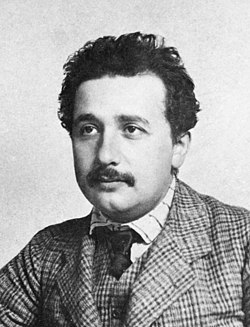
In his annus mirabilis, Albert Einstein published papers on the photoelectric effect, Brownian motion, and special relativity, abolishing the ether and showing that space and time are relative while the speed of light is constant. He also derived E=mc².
Image source: Special relativity
1909
% complete
Robert Millikan's oil drop experiment precisely measured the elementary electric charge, confirming the quantization of charge and providing strong evidence for the existence of electrons. He won the Nobel Prize in Physics in 1923.
Image source: Oil drop experiment
1911
% complete
Ernest Rutherford's gold foil scattering experiments, conducted with Geiger and Marsden, revealed that atoms contain a tiny, dense, positively charged nucleus. This overturned Thomson's plum pudding model and defined the structure of the atom.
Image source: Rutherford scattering experiments
Nov 25, 1915
% complete
Einstein completed general relativity, describing gravity not as a force but as the curvature of spacetime caused by mass and energy. The theory explained Mercury's perihelion precession and predicted light bending, black holes, and gravitational waves.
Image source: General relativity
May 29, 1919
% complete
Arthur Eddington's expedition photographed stars near the eclipsed Sun and confirmed that starlight was deflected by the Sun's gravity as general relativity predicted. The result made Einstein world-famous overnight.
Image source: Eddington experiment
Dec 14, 1900
% complete
Max Planck resolved the blackbody radiation problem by proposing that energy is emitted in discrete quanta proportional to frequency, introducing Planck's constant h. This date is often considered the birth of quantum theory.
Image source: Max Planck
1913
% complete
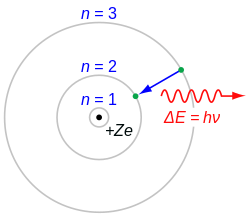
Niels Bohr proposed a quantum model of the hydrogen atom in which electrons occupy discrete orbits and emit or absorb photons when transitioning between them. The model successfully explained hydrogen's spectral lines and advanced old quantum theory.
Image source: Bohr model
1922
% complete
Otto Stern and Walther Gerlach passed silver atoms through a non-uniform magnetic field and observed discrete deflections, demonstrating the quantization of angular momentum. The experiment later became crucial evidence for electron spin.
Image source: Stern–Gerlach experiment
1924
% complete
Louis de Broglie hypothesized that particles such as electrons have wave properties with wavelength inversely proportional to momentum, extending wave-particle duality to matter. His hypothesis was soon confirmed by electron diffraction experiments.
Image source: Matter wave
Jul 1925
% complete
Werner Heisenberg developed matrix mechanics, the first complete formulation of quantum mechanics, representing observables as matrices whose products do not commute. This work marked the beginning of fully consistent quantum theory.
Jan 1926
% complete
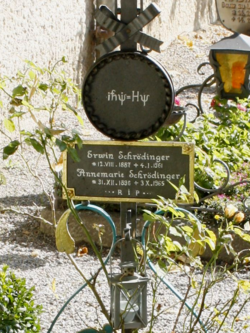
Erwin Schrödinger formulated the Schrödinger equation, describing quantum systems with wavefunctions evolving deterministically. Wave mechanics proved mathematically equivalent to matrix mechanics and became the standard formalism of quantum theory.
Image source: Schrödinger equation
1927
% complete
Werner Heisenberg articulated the uncertainty principle, showing that position and momentum cannot both be measured with arbitrary precision simultaneously. This fundamental limit reshaped philosophical understanding of measurement and causality in physics.
Image source: Uncertainty principle
1928
% complete
Paul Dirac derived a relativistic wave equation for the electron that naturally incorporated spin and predicted the existence of antimatter. The Dirac equation founded relativistic quantum field theory.
1964
% complete
John Stewart Bell proved that no local hidden variable theory can reproduce all predictions of quantum mechanics, deriving testable inequalities. Bell's theorem transformed debates over quantum foundations and underpins modern quantum information science.
Image source: Bell's theorem
1932
% complete
James Chadwick discovered the neutron, a neutral particle in the atomic nucleus, resolving puzzles about nuclear mass and spin. The neutron enabled new models of the nucleus and opened the path to nuclear fission research.
Image source: Neutron
Aug 2, 1932
% complete
Carl Anderson observed the positron, the electron's antiparticle, in cosmic ray cloud chamber photographs. This was the first discovery of antimatter, confirming Dirac's theoretical prediction.
Image source: Positron
Dec 2, 1942
% complete
Enrico Fermi's team achieved the first self-sustaining nuclear chain reaction at Chicago Pile-1 beneath Stagg Field. This milestone launched the nuclear age and was pivotal to the Manhattan Project.
Image source: Chicago Pile-1
1948 - 1950
% complete
Richard Feynman, Julian Schwinger, and Sin-Itiro Tomonaga independently developed renormalized quantum electrodynamics, explaining the Lamb shift and anomalous magnetic moment with extraordinary precision. Feynman diagrams became an essential tool of particle physics.
Image source: Quantum electrodynamics
Apr 25, 1953
% complete
Watson and Crick proposed the double-helix structure of DNA, aided by Rosalind Franklin's X-ray crystallography. The use of physical techniques like X-ray diffraction exemplified physics methods transforming biology.
Image source: Molecular Structure of Nucleic Acids: A Structure for Deoxyribose Nucleic Acid
1954
% complete
Chen-Ning Yang and Robert Mills generalized gauge symmetry to non-abelian groups, creating the mathematical framework underlying the Standard Model of particle physics, including the strong and electroweak interactions.
Image source: Yang–Mills theory
May 20, 1964
% complete
Arno Penzias and Robert Wilson accidentally detected the cosmic microwave background radiation, the relic glow of the Big Bang. This discovery provided decisive evidence for Big Bang cosmology and earned them the 1978 Nobel Prize.
Image source: Discovery of cosmic microwave background radiation
1967 - 1973
% complete
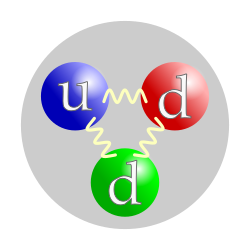
Building on Weinberg, Salam, and Glashow's electroweak theory and the development of quantum chromodynamics, physicists assembled the Standard Model, classifying all known elementary particles and three of the four fundamental forces.
Image source: Standard Model
Nov 28, 1967
% complete
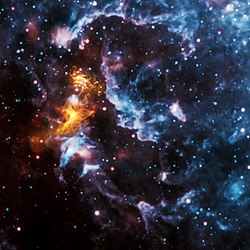
Jocelyn Bell Burnell and Antony Hewish detected the first pulsar, a rapidly rotating neutron star emitting periodic radio pulses. Pulsars confirmed the existence of neutron stars predicted by theory and became precision tools for testing general relativity.
Image source: Pulsar
1974
% complete
Stephen Hawking applied quantum field theory to black holes, predicting they emit thermal radiation and slowly evaporate. Hawking radiation connected gravity, quantum theory, and thermodynamics, inspiring decades of research into quantum gravity.
Image source: Hawking radiation
Jul 4, 2012
% complete
The ATLAS and CMS experiments at CERN's Large Hadron Collider announced the discovery of a Higgs boson, confirming the mechanism that gives elementary particles mass. The discovery completed the Standard Model's particle roster.
Image source: Higgs boson
Sep 14, 2015
% complete
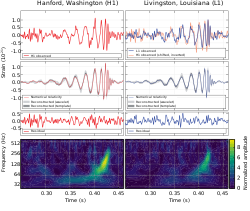
The LIGO collaboration detected gravitational waves from the merger of two black holes, exactly a century after Einstein's prediction. This opened gravitational-wave astronomy and earned the 2017 Nobel Prize in Physics.
Image source: First observation of gravitational waves
Apr 10, 2019
% complete
The Event Horizon Telescope collaboration released the first image of a black hole's shadow, capturing the supermassive black hole in galaxy M87. This achievement tested general relativity in the strong-field regime and showcased global scientific collaboration.
Image source: Event Horizon Telescope
Or browse the full history timeline directory, with more than 2,000 topics.
This History of Physics timeline was generated with the help of AI, using information found on the internet.
We work hard to keep these timelines accurate, but mistakes do get through. If you spot one, email us at [email protected] and we'll fix it for future visitors.
Generate yours with AI or build it from scratch, for free.
Export your timeline, add your own events, edit or remove AI-generated events, and much more
No credit card required.
Cancel anytime.
Cancel anytime.
You can create an unlimited number of timelines with up to 10 events on each one, customize how they look, export them to PDF, PNG, PowerPoint, CSV, and Excel, and share them with a link. Paid plans raise the event limit and add features like spreadsheet imports and collaborators.
Yes. You can cancel your subscription from your account page at any time, and you will not be charged again. Your subscription stays active for the rest of the period you already paid for.
Yes. We will email you a reminder before the annual renewal, and we will also email you a receipt.
Yes. You can email us within 15 days of any payment, and we will issue you a full refund.
Check out our pricing docs or send us an email anytime: [email protected].