-
Use Cases
-
Resources
-
Pricing
Michael Faraday (1791–1867) was an English scientist whose pioneering experiments in electromagnetism and electrochemistry laid the foundations for modern electrical technology. Born into a poor family, he rose from bookbinder's apprentice to one of history's most influential physicists and chemists, discovering electromagnetic induction, diamagnetism, and electrolysis laws. More Less
1790
% complete
James Faraday moved his wife, Margaret (née Hastwell), and two children to London during the winter of 1790 from Outhgill in Westmorland, where he had been an apprentice to the village blacksmith.
Sep 22, 1791
% complete
Michael Faraday was born on 22 September 1791 in Newington Butts, Surrey, which is now part of the London Borough of Southwark. He would grow up to become an English chemist and physicist who contributed vastly to the study of electrochemistry and electromagnetism.
1812
% complete
In 1812, at the age of 20 and at the end of his apprenticeship, Faraday attended lectures by the eminent English chemist Humphry Davy of the Royal Institution and the Royal Society, and John Tatum, founder of the City Philosophical Society.
Jun 12, 1821
% complete
1839
% complete
Faraday had a nervous breakdown in 1839 but eventually returned to his investigations into electromagnetism.
Jul 12, 1812
% complete
Using a voltaic pile, Faraday passed electric current through a solution of sulfate of magnesia and succeeded in decomposing the chemical compound, recording the result in his first letter to Benjamin Abbott dated 12 July 1812.
1820
% complete
In 1820 Faraday reported the first synthesis of compounds made from carbon and chlorine, hexachloroethane and perchloroethylene, and published his results the following year.
1820
% complete
Faraday determined the composition of the chlorine clathrate hydrate, a compound that had been discovered by Humphry Davy in 1810.
1821
% complete
In 1821, soon after the Danish physicist and chemist Hans Christian Ørsted discovered the phenomenon of electromagnetism, Davy and William Hyde Wollaston tried, but failed, to design an electric motor. From his initial discovery in 1821, Faraday continued his laboratory work, exploring electromagnetic properties of materials.
1824
% complete
In 1824, Faraday briefly set up a circuit to study whether a magnetic field could regulate the flow of a current in an adjacent wire, but he found no such relationship.
Oct 28, 1831
% complete
Two years after the death of Davy, in 1831, Faraday began his great series of experiments in which he discovered electromagnetic induction, recording in his laboratory diary on 28 October 1831 that he was 'making many experiments with the great magnet of the Royal Society'. As recorded by the Royal Institution, 'Faraday invented the generator in 1831 but it took nearly 50 years before all the technology came into common use'.
Image source: Electromagnetic induction
1832
% complete
In 1832, he completed a series of experiments aimed at investigating the fundamental nature of electricity; Faraday used 'static', batteries, and 'animal electricity' to produce the phenomena of electrostatic attraction, electrolysis, magnetism, etc.
Jan 1836
% complete
In January 1836, Faraday had put a wooden frame, 12 ft square, on four glass supports and added paper walls and wire mesh, conducting experiments that demonstrated the shielding effect now known as the Faraday cage.
Image source: Faraday cage
1845
% complete
In 1845, Faraday discovered that many materials exhibit a weak repulsion from a magnetic field: an effect he termed diamagnetism.
Image source: Diamagnetism
Sep 1845
% complete
In September 1845 he wrote in his notebook, 'I have at last succeeded in illuminating a magnetic curve or line of force and in magnetising a ray of light', marking the discovery of the magneto-optical effect later known as the Faraday effect.
Image source: Faraday effect
1857
% complete
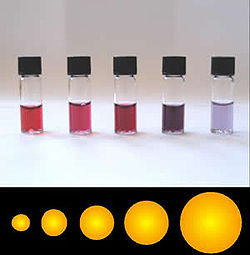
In 1857 he discovered that the optical properties of gold colloids differed from those of the corresponding bulk metal. He also advised the National Gallery on the cleaning and protection of its art collection, and served on the National Gallery Site Commission in 1857.
Image source: Colloidal gold
1862
% complete
Later on in his life, in 1862, Faraday used a spectroscope to search for a different alteration of light, the change of spectral lines by an applied magnetic field. Pieter Zeeman later used an improved apparatus to study the same phenomenon, publishing his results in 1897 and receiving the 1902 Nobel Prize in Physics for his success. In both his 1897 paper and his Nobel acceptance speech, Zeeman made reference to Faraday's work.
Image source: Zeeman effect
Mar 1, 1813
% complete
In 1813, when Davy damaged his eyesight in an accident with nitrogen trichloride, he decided to hire Michael Faraday as an assistant. As a result, Faraday was appointed Chemical Assistant at the Royal Institution on 1 March 1813.
1821
% complete
He was appointed Assistant Superintendent of the House of the Royal Institution in 1821.
1824
% complete
Faraday was elected a Fellow of the Royal Society in 1824. He twice refused to become President of the society.
Image source: Royal Society
1825
% complete
In 1825, he became Director of the Laboratory of the Royal Institution.
Image source: Royal Institution
1832
% complete
In 1832, Faraday was elected a Foreign Honorary Member of the American Academy of Arts and Sciences.
Image source: American Academy of Arts and Sciences
Jun 1832
% complete
In June 1832, the University of Oxford granted Faraday an honorary Doctor of Civil Law degree.
Image source: University of Oxford
1833
% complete
Six years after becoming Director of the Laboratory, in 1833, Faraday became the first Fullerian Professor of Chemistry at the Royal Institution of Great Britain, a position to which he was appointed for life without the obligation to deliver lectures.
1838
% complete
He was elected a foreign member of the Royal Swedish Academy of Sciences in 1838.
Image source: Royal Swedish Academy of Sciences
1840
% complete
In 1840, he was elected to the American Philosophical Society.
Image source: American Philosophical Society
1844
% complete
He was one of eight foreign members elected to the French Academy of Sciences in 1844.
Image source: French Academy of Sciences
1848
% complete
In 1848, as a result of representations by the Prince Consort, Faraday was awarded a grace and favour house in Hampton Court in Middlesex, free of all expenses and upkeep. In 1858 Faraday retired to live there.
Image source: Hampton Court Palace
1849
% complete
In 1849 he was elected as associated member to the Royal Institute of the Netherlands, which two years later became the Royal Netherlands Academy of Arts and Sciences and he was subsequently made foreign member.
Image source: Royal Netherlands Academy of Arts and Sciences
1816 - 1818
% complete
Before his famous Christmas lectures, Faraday delivered chemistry lectures for the City Philosophical Society from 1816 to 1818 in order to refine the quality of his lectures.
1825
% complete
He founded the Friday Evening Discourses in 1825, where lecturers would present their latest research to members.
1841
% complete
Among Faraday's celebrated Christmas lectures at the Royal Institution were those on Chemistry and Electricity, including 1841: The Rudiments of Chemistry and 1843: First Principles of Electricity.
Image source: Royal Institution Christmas Lectures
1846
% complete
In 1846, together with Charles Lyell, he produced a lengthy and detailed report on a serious explosion in the colliery at Haswell, County Durham, which killed 95 miners. The report should have warned coal owners of the hazard of coal dust explosions, but the risk was ignored for over 60 years until the 1913 Senghenydd Colliery Disaster.
Image source: Shotton Colliery
1851
% complete
Faraday assisted with the planning and judging of exhibits for the Great Exhibition of 1851 in Hyde Park, London.
Image source: Great Exhibition
1853 - 1856
% complete
Having provided a number of various service projects for the British government, when asked by the government to advise on the production of chemical weapons for use in the Crimean War (1853–1856), Faraday refused to participate, citing ethical reasons.
Jul 1855
% complete
In July 1855, Faraday wrote a letter to The Times on the subject of the foul condition of the River Thames, which resulted in an often-reprinted cartoon in Punch.
1862
% complete
Education was another of Faraday's areas of service; he lectured on the topic in 1854 at the Royal Institution, and, in 1862, he appeared before a Public Schools Commission to give his views on education in Great Britain.
Aug 25, 1867
% complete
Faraday died at his house at Hampton Court on 25 August 1867, aged 75.
1876
% complete
A Royal Society of Arts blue plaque, unveiled in 1876, commemorates Faraday at 48 Blandford Street in London's Marylebone district.
Image source: Royal Society of Arts
1960
% complete
A hall at Loughborough University was named after Faraday in 1960.
Image source: Loughborough University
1961
% complete
The Faraday Memorial, designed by brutalist architect Rodney Gordon and completed in 1961, is at the Elephant & Castle gyratory system, near Faraday's birthplace at Newington Butts, London.
Image source: Michael Faraday Memorial
1991 - 2001
% complete
From 1991 until 2001, Faraday's picture featured on the reverse of Series E £20 banknotes issued by the Bank of England. In 1991, as a pioneer of electricity he also featured in Royal Mail's Scientific Achievements issue along with Charles Babbage, Frank Whittle and Robert Watson-Watt; in 1999, under the title 'Faraday's Electricity', he featured alongside Charles Darwin, Edward Jenner and Alan Turing.
Image source: Bank of England £20 note
2002
% complete
In 2002, Faraday was ranked number 22 in the BBC's list of the 100 Greatest Britons following a UK-wide vote.
Image source: 100 Greatest Britons
2006
% complete
The institute carrying Faraday's name was created in 2006 by a $2,000,000 grant from the John Templeton Foundation to carry out academic research, foster understanding of the interaction between science and religion, and engage public understanding in both these subject areas.
2014
% complete
Faraday's life and contributions to electromagnetics was the principal topic of 'The Electric Boy', the tenth episode of the 2014 American science documentary series Cosmos: A Spacetime Odyssey, which was broadcast on Fox and the National Geographic Channel.
Image source: Cosmos: A Spacetime Odyssey
2017
% complete
The Faraday Institution, an independent energy storage research institute established in 2017, also derives its name from Michael Faraday.
Or browse the full history timeline directory, with more than 2,000 topics.
This Michael Faraday timeline was generated with the help of AI, using information found on the internet.
We work hard to keep these timelines accurate, but mistakes do get through. If you spot one, email us at [email protected] and we'll fix it for future visitors.
Generate yours with AI or build it from scratch, for free.
Export your timeline, add your own events, edit or remove AI-generated events, and much more
No credit card required.
Cancel anytime.
Cancel anytime.
You can create an unlimited number of timelines with up to 10 events on each one, customize how they look, export them to PDF, PNG, PowerPoint, CSV, and Excel, and share them with a link. Paid plans raise the event limit and add features like spreadsheet imports and collaborators.
Yes. You can cancel your subscription from your account page at any time, and you will not be charged again. Your subscription stays active for the rest of the period you already paid for.
Yes. We will email you a reminder before the annual renewal, and we will also email you a receipt.
Yes. You can email us within 15 days of any payment, and we will issue you a full refund.
Check out our pricing docs or send us an email anytime: [email protected].