-
Use Cases
-
Resources
-
Pricing
The history of relativity traces the development of ideas about motion, space, and time—from Galileo's principle of relativity in the 17th century, through 19th-century puzzles about light and electromagnetism, to Albert Einstein's revolutionary theories of special (1905) and general (1915) relativity, which redefined gravity as the curvature of spacetime and continue to shape modern physics. More Less
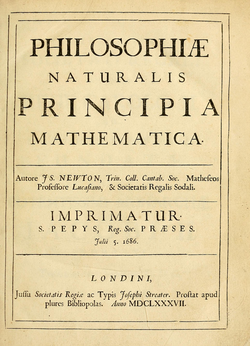
Jul 5, 1687
Isaac Newton's 'Principia Mathematica' established absolute space and time as the backdrop for mechanics. Newtonian physics dominated for over two centuries, but its reliance on absolute space would later be challenged by Einstein's theories of relativity.
Image source: Philosophiæ Naturalis Principia Mathematica
1865
James Clerk Maxwell published 'A Dynamical Theory of the Electromagnetic Field', showing that light is an electromagnetic wave traveling at a fixed speed. This fixed speed of light seemed to conflict with Galilean relativity, setting the stage for Einstein's revolution.
Image source: Maxwell's equations

1892 - 1904
Hendrik Lorentz developed mathematical transformations to explain the null results of aether-drift experiments, introducing length contraction and local time. His work provided crucial mathematical tools that Einstein would later reinterpret on physical grounds.
Image source: Lorentz transformation
1904
Henri Poincaré articulated a broad 'principle of relativity', arguing that the laws of physics should be the same for all observers moving uniformly. In 1906 he completed the Lorentz transformations mathematically, coming remarkably close to special relativity independently of Einstein.
Image source: Henri Poincaré

1887
Albert Michelson and Edward Morley attempted to detect Earth's motion through the luminiferous aether by measuring differences in the speed of light. Their null result showed that light's speed is independent of direction, undermining the aether theory and paving the way for special relativity.
Image source: Michelson–Morley experiment

May 29, 1919
Arthur Eddington led expeditions to Príncipe and Brazil to photograph stars near the Sun during a total solar eclipse. The observed deflection of starlight matched Einstein's prediction of twice the Newtonian value, making Einstein world-famous overnight.
Image source: Eddington experiment

1938
Herbert Ives and G.R. Stilwell measured the transverse Doppler shift in fast-moving hydrogen ions, directly confirming the time dilation predicted by special relativity. It was one of the first precision laboratory tests of relativistic effects.
Image source: Ives–Stilwell experiment

1959
Robert Pound and Glen Rebka measured the gravitational redshift of gamma rays over a height difference of about 22 meters at Harvard, confirming Einstein's prediction that time runs slower deeper in a gravitational field.
Image source: Pound–Rebka experiment

1974
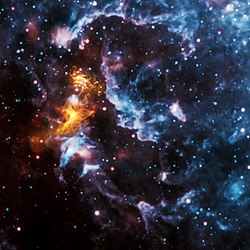
Russell Hulse and Joseph Taylor discovered a binary pulsar whose orbital decay matched precisely the energy loss predicted by gravitational wave emission in general relativity. The result earned them the 1993 Nobel Prize in Physics.
Image source: Hulse–Taylor pulsar

Apr 20, 2004
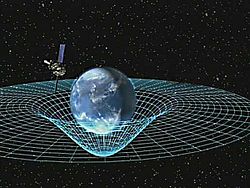
NASA's Gravity Probe B satellite used gyroscopes in orbit around Earth to measure geodetic precession and frame dragging—the twisting of spacetime by Earth's rotation. Its results, announced in 2011, confirmed both predictions of general relativity.
Image source: Gravity Probe B

This History of Relativity timeline was generated with the help of AI, using information found on the internet.
We work hard to keep these timelines accurate, but mistakes do get through. If you spot one, email us at [email protected] and we'll fix it for future visitors.
Generate yours with AI or build it from scratch, for free.