-
Use Cases
-
Resources
-
Pricing
1300 - 1399
In the 14th century, the rediscovery of major ancient works describing atomist teachings led to increased scholarly attention on the subject, including Lucretius's De rerum natura and Diogenes Laërtius's Lives and Opinions of Eminent Philosophers.
1600 - 1699
The French Catholic priest Pierre Gassendi revived Epicurean atomism with modifications, arguing that atoms were created by God and, though extremely numerous, are not infinite in number.
Image source: Atomic theory
1600 - 1699
Gassendi's modified theory of atoms was popularized in France by the physician François Bernier and in England by the natural philosopher Walter Charleton.
1600 - 1699
The chemist Robert Boyle and the physicist Isaac Newton both defended atomism, and by the end of the 17th century, the idea of an atomistic foundation of nature had become accepted by portions of the scientific community.
1775 - 1799
Near the end of the 18th century, two laws about chemical reactions emerged without referring to the notion of an atomic theory.
1797
First established by the French chemist Joseph Proust in 1797, this law states that if a compound is broken down into its constituent chemical elements, then the masses of the constituents will always have the same proportions by weight, regardless of the quantity or source of the original substance.
Image source: Joseph Proust
1808
John Dalton applied the term "atom" to the basic units of mass of the chemical elements under the mistaken belief that chemical atoms are the fundamental particles in nature; it was another century before scientists realized that Dalton's so-called atoms have an underlying structure of their own.
1811
The flaw in Dalton's theory was corrected in principle in 1811 by Amedeo Avogadro, who concluded that atoms combine in simple whole-number ratios and proposed that equal volumes of gases at the same temperature and pressure contain equal numbers of molecules.
Image source: Amedeo Avogadro
1875 - 1899
The anti-atomist positions of the equivalentists and energeticists were eventually quashed by two important advancements that happened later in the 19th century: the development of the periodic table and the discovery that molecules have an internal architecture that determines their properties.
1738
In 1738, Swiss physicist and mathematician Daniel Bernoulli postulated that the pressure of gases and heat were both caused by the underlying motion of molecules.
Image source: Daniel Bernoulli
1830
In 1830, Jöns Jacob Berzelius introduced the term isomerism to describe the phenomenon of compounds with the same composition but different arrangements of their atoms.
1860
In 1860, Louis Pasteur hypothesized that the molecules of isomers might have the same composition but different arrangements of their atoms in three dimensions.
Image source: Isomer
1860
In 1860, James Clerk Maxwell, a vocal proponent of atomism, was the first to use statistical mechanics in physics to describe the behavior of gases and the motion of particles.
Image source: James Clerk Maxwell
1874
In 1874, Jacobus Henricus van 't Hoff proposed that the carbon atom forms bonds to other atoms in a tetrahedral arrangement, which explained the existence of optical isomerism.
Image source: Jacobus Henricus van 't Hoff
1897
Atoms were thought to be the smallest possible division of matter until 1897 when J. J. Thomson discovered electrons, which he called "corpuscles" or "electrons".
Image source: J. J. Thomson
1903 - 1904
In 1903, Hantaro Nagaoka challenged Thomson's plum pudding model with a "Saturnian" model, in which electrons orbit a massive positive center like the rings of Saturn.
1905
In 1905, Albert Einstein theorized that the random motion of particles suspended in a fluid, known as Brownian motion, was caused by the continuous motion of the fluid's molecules.
Image source: Brownian motion
1908
Einstein's model of Brownian motion was validated experimentally in 1908 by French physicist Jean Perrin, who used Einstein's equations to determine the size of atoms.
Image source: Jean Baptiste Perrin
1911
Thomson's plum pudding model was overturned in 1911 by Ernest Rutherford, who discovered that most of the mass and positive charge of an atom is concentrated in a very small fraction of its volume, which he assumed to be at the very center.
Image source: Ernest Rutherford
1910 - 1912
This led to a series of quantum atomic models such as the quantum model of Arthur Erich Haas in 1910 and the 1912 John William Nicholson quantum atomic model that quantized angular momentum as h/2π.
1913
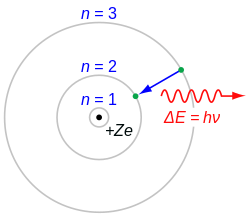
In 1913, Niels Bohr incorporated the idea of quantized energy levels into his Bohr model of the atom, in which an electron could only orbit the nucleus in particular circular orbits with fixed angular momentum and energy.
Image source: Bohr model
1913
While experimenting with the products of radioactive decay, in 1913 radiochemist Frederick Soddy discovered that there appeared to be more than one variety of some elements.
Image source: Isotope
1916
In 1916, Arnold Sommerfeld added elliptical orbits to Bohr's model to explain the extra emission lines observed in atomic spectra.
Image source: Arnold Sommerfeld
1924
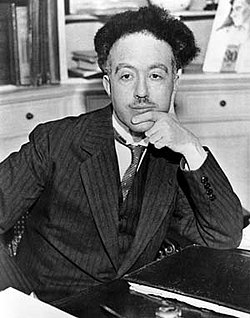
In 1924, Louis de Broglie proposed that all moving particles, including subatomic particles like electrons, exhibit wave-like behavior.
Image source: Louis de Broglie
1926
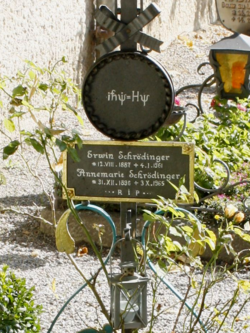
Schrödinger's equation, published in 1926, describes an electron as a wave function instead of as a point particle, providing a mathematical framework for quantum mechanics.
Image source: Schrödinger equation
1927
Werner Heisenberg first published a version of the uncertainty principle in 1927, which states that the more precisely one measures the position of a particle, the less precisely one can measure its momentum, and vice versa.
Image source: Uncertainty principle
1932
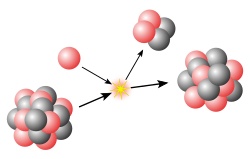
The nature of differing atomic masses was later explained by the discovery of neutrons in 1932: all atoms of the same element contain the same number of protons, while different isotopes have different numbers of neutrons.
1932
In 1932, James Chadwick exposed various elements to a mysterious radiation and deduced the existence of electrically neutral particles with a mass similar to that of a proton, which were later named neutrons.
Image source: James Chadwick
Or browse the full history timeline directory, with more than 2,500 topics.
This Atomic Theory timeline was generated with the help of AI, using information found on the internet.
We work hard to keep these timelines accurate, but mistakes do get through. If you spot one, email us at [email protected] and we'll fix it for future visitors.
Generate yours with AI or build it from scratch, for free.
Export your timeline, add your own events, edit or remove AI-generated events, and much more
No credit card required.
Cancel anytime.
Cancel anytime.
You can create an unlimited number of timelines with up to 10 events on each one, customize how they look, export them to PDF, PNG, PowerPoint, CSV, and Excel, and share them with a link. Paid plans raise the event limit and add features like spreadsheet imports and collaborators.
Yes. You can cancel your subscription from your account page at any time, and you will not be charged again. Your subscription stays active for the rest of the period you already paid for.
Yes. We will email you a reminder before the annual renewal, and we will also email you a receipt.
Yes. You can email us within 15 days of any payment, and we will issue you a full refund.
Check out our pricing docs or send us an email anytime: [email protected].