-
Use Cases
-
Resources
-
Pricing
The history of quantum mechanics traces the development of the physical theory describing matter and energy at atomic and subatomic scales. Beginning with Max Planck's quantization of energy in 1900, it evolved through contributions from Einstein, Bohr, Heisenberg, Schrödinger, Dirac, and others into one of the most successful and revolutionary theories in science. More Less
1801
The resulting Huygens–Fresnel principle was extremely successful at reproducing light's behaviour and was consistent with Thomas Young's discovery of wave interference of light by his double-slit experiment in 1801, strengthening the wave view of light.
Image source: Huygens–Fresnel principle

1803 - 1860
During the early 19th century, chemical research by John Dalton and Amedeo Avogadro lent weight to the atomic theory of matter, an idea that James Clerk Maxwell, Ludwig Boltzmann and others built upon to establish the kinetic theory of gases.
Image source: Atomic theory

1850
The wave view did not immediately displace the ray and particle view, but began to dominate scientific thinking about light in the mid 19th century, since it could explain polarization phenomena that the alternatives could not.
Image source: History of quantum mechanics

1877
Ludwig Boltzmann suggested in 1877 that the energy levels of a physical system, such as a molecule, could be discrete (rather than continuous), an early hint of quantization that would later underpin quantum mechanics.
Image source: Ludwig Boltzmann

1885
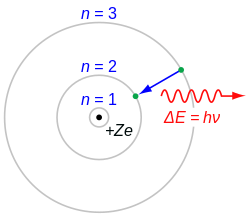
By the end of the nineteenth century, a simple rule known as Balmer's formula showed how the frequencies of the different spectral lines of hydrogen related to each other, though without explaining why this was, or making any prediction about the intensities.
Image source: Balmer series

1904
By 1904 Thomson proposed the first atomic model with subatomic constituents, using circulating electrons in a background of positive charge, the so-called plum pudding model. Thomson's concepts were supported by early beta particle scattering experiments.
Image source: Plum pudding model

1911
By 1911 Hans Geiger and his student Ernest Marsden demonstrated backscattering of alpha particles which Ernest Rutherford interpreted as compelling evidence that the positive charge was concentrated in a small volume we now call the nucleus. This led to the planetary model of the atom (1911), though Rutherford's discovery did not immediately cause atomic models to be revised.
Image source: Rutherford scattering experiments

1850 - 1900
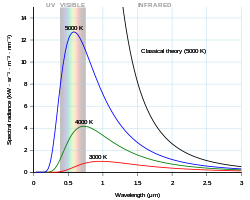
The study of black-body radiation between 1850 and 1900 could not be explained without quantum concepts. By the late 19th century, thermal radiation had been fairly well characterized experimentally, but classical physics failed to account for its spectrum.
Image source: Black-body radiation
1887
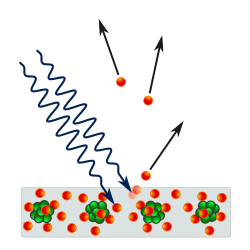
In 1887, Heinrich Hertz observed that when light with sufficient frequency hits a metallic surface, the surface emits cathode rays. This photoelectric effect would later become one of the key pieces of evidence for the quantum nature of light.
Image source: Photoelectric effect
1900
The first model that was able to explain the full spectrum of thermal radiation was put forward by Max Planck in 1900. Planck's law was the first quantum theory in physics, and Planck won the 1918 Nobel Prize in Physics 'in recognition of the services he rendered to the advancement of Physics by his discovery of energy quanta'. This marked the beginning of the old quantum theory era.
This History of Quantum Mechanics timeline was generated with the help of AI, using information found on the internet.
We work hard to keep these timelines accurate, but mistakes do get through. If you spot one, email us at [email protected] and we'll fix it for future visitors.
Generate yours with AI or build it from scratch, for free.