
-
Use Cases
-
Resources
-
Pricing
Quantum computing is a revolutionary field that harnesses the principles of quantum mechanics—superposition, entanglement, and interference—to process information in fundamentally new ways. This timeline traces its evolution from theoretical foundations proposed in the early 1980s through landmark algorithms like Shor's factoring breakthrough, the development of experimental hardware by IBM, Google, and others, to Google's 2019 quantum supremacy claim and ongoing efforts to build fault-tolerant, large-scale quantum machines. More Less
1961
% complete
The technique later used for controlling single-atom spins in silicon quantum computers without oscillating magnetic fields was first suggested in 1961, laying conceptual foundations for silicon-based qubits.
2001
% complete
Researchers factored the number 15 using 1018 identical molecules, each containing seven active nuclear spins, demonstrating Shor's algorithm on a liquid-state nuclear magnetic resonance quantum computer.
Image source: Nuclear magnetic resonance quantum computer
2013
% complete
Researchers extended qubit lifetime by a factor of 1000, a major advance in coherence times that improves the reliability of quantum information processing across multiple platforms.
Image source: Qubit
Sep 2019
% complete
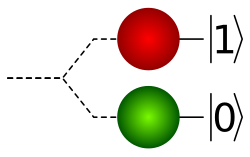
A paper by Google's quantum computer research team was briefly available in late September 2019, claiming the project had reached quantum supremacy with its Sycamore processor performing a sampling task faster than classical supercomputers.
May 7, 2022
% complete
On May 7, two studies complemented research published September 2020 by quantum-entangling two mechanical oscillators, advancing the field of quantum mechanics at macroscopic scales.
Image source: Quantum entanglement
Aug 29, 2024
% complete
Researchers at Empa successfully constructed a one-dimensional alternating Heisenberg model using synthetic nanographenes, confirming century-old quantum physics predictions.
2025
% complete
This result doubled the number of spin qubits published in September 2022, advancing silicon quantum computers that use single-atom spins without needing oscillating magnetic fields.
1976
% complete
A paper describing a quantum-mechanical model of the Turing machine was published in 1976 (with work dating from 43–72 in an earlier numbering). It laid early groundwork for thinking about computation under quantum laws.
Image source: Paul Benioff
Jun 1979 - Apr 1980
% complete
Benioff's influential paper on a quantum-mechanical model of computers was submitted in June 1979 and published in April 1980, showing that a computer can operate under the laws of quantum mechanics.
1980
% complete
Benioff gave a talk that built on his earlier 1980 work showing that a computer can operate under the laws of quantum mechanics, helping to establish the theoretical possibility of quantum computation.
1982
% complete
Richard Feynman's conjecture on a quantum simulating computer was published in 1982. It is understood as meaning that the reality of quantum mechanics, expressed as an effective quantum system, necessitates quantum computers, and is conventionally accepted as the beginning of quantum computing.
Image source: Quantum computing
2002
% complete
Braunstein's result, coupled with related findings on highly mixed states, called the validity of NMR quantum computation into question, casting doubt over whether such systems were truly entangled quantum computers.
Oct 23, 2003
% complete
The United States government DARPA Quantum Network became fully operational on October 23, 2003, becoming the world's first quantum key distribution network, linking sites in the Boston area.
Image source: DARPA Quantum Network
2017
% complete
The first reported achievement of counterfactual quantum communication demonstrated that information can be exchanged without any physical particle traveling between observers and without quantum teleportation.
Jun 2017
% complete
The first teleportation using a satellite, connecting ground stations over a distance of 1400 km apart, was announced. Using China's Micius satellite, it demonstrated long-distance quantum teleportation between ground stations.
Dec 21, 2021
% complete
Research on counterfactual quantum communication was published on December 21, building on the first achievement reported in 2017, showing information exchange without any physical particle traveling between observers and without quantum teleportation.
Jan 2017
% complete
D-Wave Systems Incorporated announced general commercial availability of the D-Wave 2000Q quantum annealer, which it claimed has 2000 qubits, marking a significant step in commercial quantum hardware.
Image source: D-Wave Systems
Dec 17, 2018
% complete
IonQ introduced the first commercial trapped-ion quantum computer, with a program length of over 60 two-qubit gates, 11 fully connected qubits, 55 addressable pairs, one-qubit gate error of <0.03% and two-qubit gate error of <1.0%.
Image source: IonQ
Dec 21, 2018
% complete
The US National Quantum Initiative Act was signed into law by US President Donald Trump, establishing goals and priorities for a 10-year plan to accelerate the development of quantum information science and technology applications in the United States.
Image source: National Quantum Initiative Act
Apr 14, 2023
% complete
The Quantinuum System Model H1-2 doubled its performance, claiming to be the first commercial quantum computer to pass quantum volume 4096.
Dec 4, 2023
% complete
IBM presented its 1121-qubit 'Condor' quantum processor, the successor to its Osprey and Eagle systems, pushing superconducting quantum processors beyond the thousand-qubit threshold.
Or browse the full history timeline directory, with more than 2,000 topics.
This History of Quantum Computing timeline was generated with the help of AI, using information found on the internet.
We work hard to keep these timelines accurate, but mistakes do get through. If you spot one, email us at [email protected] and we'll fix it for future visitors.
Generate yours with AI or build it from scratch, for free.

Export your timeline, add your own events, edit or remove AI-generated events, and much more
No credit card required.
Cancel anytime.
Cancel anytime.
You can create an unlimited number of timelines with up to 10 events on each one, customize how they look, export them to PDF, PNG, PowerPoint, CSV, and Excel, and share them with a link. Paid plans raise the event limit and add features like spreadsheet imports and collaborators.
Yes. You can cancel your subscription from your account page at any time, and you will not be charged again. Your subscription stays active for the rest of the period you already paid for.
Yes. We will email you a reminder before the annual renewal, and we will also email you a receipt.
Yes. You can email us within 15 days of any payment, and we will issue you a full refund.
Check out our pricing docs or send us an email anytime: [email protected].