-
Resources
-
Pricing
The history of the computer mouse traces the evolution of a simple pointing device into an essential tool for navigating graphical user interfaces and digital environments. More Less
Build a timeline like this one in minutes, for free. Start Yours →
Part of our collection of invention and technology timelines.
1946
Ralph Benjamin invented the trackball in 1946 as part of the Comprehensive Display System, a post-World War II fire-control radar plotting system.
Image source: Trackball
1947
The trackball was patented in 1947. Only a prototype using a metal ball rolling on two rubber-coated wheels was built, and the device remained a military secret.
1952
Taylor worked for the original Ferranti Canada on the Royal Canadian Navy's DATAR, or Digital Automated Tracking and Resolving, system.
1963
By 1963, Douglas Engelbart had established the Augmentation Research Center at SRI to develop hardware and software intended to augment human intelligence.
Nov 14, 1963
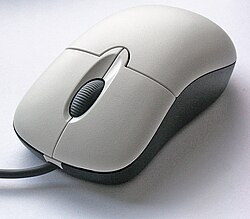
On 14 November 1963, Engelbart recorded an idea for a device he initially called a “bug,” consisting of a drop point and two orthogonal wheels in a three-point form.
Image source: Computer mouse
1964
In 1964, Bill English joined Engelbart's Augmentation Research Center and helped build the first computer mouse prototype.
Jul 1965
Bill English's July 1965 publication, “Computer-Aided Display Control,” is the earliest known written use of the term mouse for a computer pointing device.
1966
Inspired by a discussion with a university customer, Mallebrein proposed reversing the existing Rollkugel trackball into a movable mouse-like device so customers would not need mounting holes.
1966
AEG-Telefunken developed the Rollkugel, or trackball control, in 1966 through a parallel and independent development based on an earlier trackball device.
1968
J. C. R. Licklider used “mice” in his 1968 work “The Computer as a Communication Device,” an early recorded plural usage of mouse in this context.
Oct 2, 1968
Telefunken published information about its early ball mouse on 2 October 1968, documenting a German contribution to the independent development of mouse-like input devices.
Dec 9, 1968
On 9 December 1968, Douglas Engelbart publicly demonstrated a mouse-controlled computer system during the event later known as the Mother of All Demos.
Image source: The Mother of All Demos
1970
In 1970, Telefunken developed the Touchinput-Einrichtung, a touch input device based on a conductively coated glass screen.
Image source: Touchscreen
1968
The Rollkugel device was finished in early 1968 and was commercially offered later that year alongside light pens and trackballs for AEG-Telefunken systems.
Oct 2, 1968
On 2 October 1968, AEG-Telefunken showed the Rollkugelsteuerung in a sales brochure as an optional input device for the SIG 100 vector graphics terminal.
1972
While working at Xerox PARC, Bill English created a ball mouse in 1972, replacing the earlier wheel-based sensing approach with a rolling ball.
1972
Several Rollkugel mice were installed at the Leibniz Supercomputing Centre in Munich in 1972. Multiple examples have since been preserved in museums.
1973
The Xerox Alto, designed for individual use in 1973, is regarded as the first modern computer to use a mouse.
Image source: Xerox Alto
1975
Beginning in 1975, Jack Hawley, operating as The Mouse House in Berkeley, California, manufactured ball mice and wheel mice for Xerox.
1978 - 1980
The Lilith computer was developed by a team around Niklaus Wirth at ETH Zürich between 1978 and 1980 and included a mouse.
1981
Sun Microsystems, Symbolics, Lisp Machines Inc., and Tektronix began shipping workstations with mice at about this time.
1981
Around 1981, Xerox included mice with the Xerox Star, building on the mouse developed for the Alto at Xerox PARC.
Image source: Xerox Star
1981
The Xerox 8010 Star, released in 1981, included the third marketed version of an integrated mouse shipped as part of a computer for personal navigation.
1982
Logitech introduced the P4 Mouse at the Comdex trade show in Las Vegas in 1982, marking the company's first hardware mouse.
1982
By 1982, the Xerox 8010 was probably the best-known computer equipped with a mouse.
1983
Microsoft shipped its mouse in 1983, beginning the company's Microsoft Hardware division.
1984
The Macintosh 128K, released in 1984 with an updated single-button Lisa Mouse, helped move the mouse from relative obscurity into widespread use.
Image source: Macintosh 128K
1984
The Classic Mac OS Desk Accessory Puzzle, released in 1984, was the first game designed specifically for a mouse.
Image source: Classic Mac OS
1985 - 1989
From the mid-1980s, aftermarket mice became available for many 8-bit home computers, including the Commodore 64 and 128, MSX, Acorn BBC Micro and Electron, Sinclair ZX Spectrum, and Amstrad CPC.
1985 - 1986
The mouse remained relatively obscure until the Macintosh, Amiga 1000, and Atari ST. By 1986, mice were also associated with the Atari ST, Amiga, Windows 1.0, GEOS for the Commodore 64, and Apple IIGS.
1988
In 1988, the VTech Socrates educational video game console offered a wireless mouse with an attached mouse pad as an optional controller for some games.
Nov 2008
In November 2008, Logitech built its billionth mouse, marking the enormous scale reached by the modern mouse industry.
Image source: Logitech
1985
In 1985, René Sommer added a microprocessor to Nicoud's and Guignard's design. The innovation made the mouse more intelligent, although Mouse Systems had incorporated microprocessors into optical mice by 1984.
1990
The Logitech 3D Mouse, introduced in 1990, was the first ultrasonic mouse and an isotonic three-dimensional mouse with six degrees of freedom.
1992
Nintendo's 1992 game Mario Paint made extensive use of the mouse's capabilities, demonstrating its value as a creative and gaming interface.
1996
The ability to surf the internet using a touch-enabled mouse was first developed in 1996 and later implemented commercially by the Wingman Force Feedback Mouse.
1996
The Wingman Force Feedback Mouse commercially implemented touch-enabled internet control, extending the mouse beyond cursor positioning with physical feedback.
2000
In 2000, Logitech introduced the iFeel Mouse, developed by Immersion Corporation. A small actuator enabled it to generate simulated physical sensations.
Image source: Haptic technology
2000
At the end of the twentieth century, digitizer mice, or pucks, equipped with magnifying glasses were used with AutoCAD to digitize blueprints.
2008
In 2008, Motion4U introduced OptiBurst, an infrared-tracking system intended for use as a Maya graphics-software plugin.
Image source: Motion capture
Jun 5, 2025
On 5 June 2025, Nintendo released the Joy-Con 2 controller, which provides mouse control for the Nintendo Switch 2.
1985
The 1985 Sun-3 workstations shipped with a ball-based bus mouse connected through a three-pin mini-DIN socket.
1986
In 1986, Apple introduced the Apple Desktop Bus, allowing up to 16 devices, including mice, to be daisy-chained without configuration.
1987
With the IBM PS/2 personal-computer series in 1987, IBM introduced the eponymous PS/2 port for mice and keyboards, which other manufacturers rapidly adopted.
1987
The 1987 Acorn Archimedes line retained quadrature-encoded mice but used its own proprietary nine-pin mini-DIN connector.
2009
By 2009, Linux distributions and other X.Org-based systems such as OpenSolaris and FreeBSD supported up to 255 cursors or input points through Multi-Pointer X.
Build a timeline like this one in minutes, for free. Start Yours →
Or browse the full history timeline directory, with more than 2,500 topics.
This History of the Computer Mouse timeline was generated with the help of AI, using information found on the internet.
We work hard to keep these timelines accurate, but mistakes do get through. If you spot one, email us at [email protected] and we'll fix it for future visitors.
Generate yours with AI or build it from scratch, for free.
Export your timeline, add your own events, edit or remove AI-generated events, and much more
No credit card required.
15-day money-back guarantee.
You can create an unlimited number of timelines with up to 10 events on each one, customize how they look, export them to PDF, PNG, PowerPoint, CSV, and Excel, and share them with a link. Timelines made with Timeline Maker AI keep every event the generator created, and you can add up to 5 events of your own. Paid plans remove the event limit, add spreadsheet imports and hide Preceden's branding, and the higher-priced plan also adds collaborators, a custom logo and a custom domain.
Yes. You can cancel your subscription from your account page at any time, and you will not be charged again. Your subscription stays active for the rest of the period you already paid for.
Yes. We email you a reminder 15 days before your annual renewal, and we email you a receipt after every payment.
Yes. You can email us within 15 days of any payment, and we will issue you a full refund.
Check out our pricing docs or send us an email anytime: [email protected].