-
Use Cases
-
Resources
-
Pricing
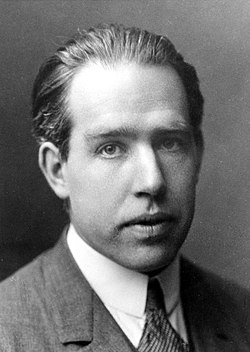
Niels Bohr (1885–1962) was a Danish physicist widely regarded as one of the founders of modern atomic theory and quantum mechanics. His groundbreaking model of the atom, featuring electrons orbiting a nucleus in discrete energy levels, transformed our understanding of atomic structure. Bohr also made major contributions to quantum mechanics, nuclear physics, and the philosophy of science, and received the Nobel Prize in Physics in 1922. He founded the Institute for Theoretical Physics in Copenhagen, which became a global center for physics research. More Less
Oct 7, 1885
% complete
Niels Henrik David Bohr was born on 7 October 1885 in Copenhagen, the second of three children of Christian Bohr, Professor of Physiology at the University of Copenhagen, and Ellen Adler, daughter of Danish Jewish banker David Baruch Adler.
Image source: Niels Bohr
1903
% complete
In 1903, Bohr enrolled as an undergraduate at the University of Copenhagen, beginning his studies in physics.
1905
% complete
In 1905, a gold medal competition was sponsored by the Royal Danish Academy of Sciences and Letters to investigate a method for measuring the surface tension of liquids proposed by Lord Rayleigh in 1879. Bohr's experiments won him the medal.
1909
% complete
Bohr read the 19th-century Danish Christian existentialist philosopher Søren Kierkegaard, and in 1909 sent his brother Harald Kierkegaard's Stages on Life's Way as a birthday gift.
Apr 1909
% complete
Bohr's brother Harald became the first of the two brothers to earn a master's degree, which he earned for mathematics in April 1909. Harald was also a footballer who played for Denmark at the 1908 Summer Olympics.
1910
% complete
In 1910, Bohr met Margrethe Nørlund, the sister of mathematician Niels Erik Nørlund. The two would marry two years later.
Apr 1911 - May 13, 1911
% complete
Bohr's doctoral thesis was accepted in April 1911, and he conducted his formal defence on 13 May. In 1921, Hendrika Johanna van Leeuwen would independently derive a theorem from it now known as the Bohr–Van Leeuwen theorem.
Apr 16, 1912 - Aug 1, 1912
% complete
Bohr resigned his membership in the Church of Denmark on 16 April 1912, returned to Denmark in July for his wedding, and married Margrethe in a civil ceremony at the town hall in Slagelse on 1 August. They honeymooned around England and Scotland.
Sep 1911
% complete
Supported by a fellowship from the Carlsberg Foundation, Bohr travelled to England, where most theoretical work on atomic structure was being done. He found success with younger physicists like William Lawrence Bragg and Ernest Rutherford.
1912 - 1921
% complete
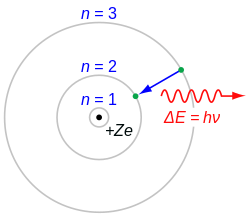
Taking Darwin's 1912 paper as his starting point, Bohr advanced the theory of electrons travelling in orbits of quantised "stationary states" around the nucleus. His 1921 paper showed that chemical properties were largely determined by electrons in the outer orbits.
Image source: Bohr model
Jul 1913
% complete
Martin Knudsen put Bohr's name forward for a docentship, which was approved in July 1913, and Bohr then began teaching medical students.
Oct 1914 - Jul 1916
% complete
The First World War broke out while Bohr was in Tyrol, complicating his voyage with Margrethe to England, where he arrived in October 1914. They stayed until July 1916.
Jul 1916
% complete
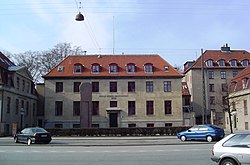
By July 1916 Bohr had been appointed to the Chair of Theoretical Physics at the University of Copenhagen, a position created especially for him.
Image source: University of Copenhagen
Apr 1917 - Nov 1918
% complete
In April 1917, Bohr began a campaign to establish an Institute of Theoretical Physics, and legislation establishing the institute was passed in November 1918.
Image source: Niels Bohr Institute
1919
% complete
By 1919, Bohr was moving away from the idea that electrons orbited the nucleus and developed heuristics to describe their behavior instead.
Image source: Old quantum theory
Mar 3, 1921
% complete
The Institute of Theoretical Physics at the University of Copenhagen opened on 3 March 1921, with Bohr as its director. It is now known as the Niels Bohr Institute.
Jun 12, 1922 - Jun 22, 1922
% complete
The Bohr Festival was a series of seven lectures given by Bohr from 12 to 22 June 1922 at the Institute of Theoretical Physics in Göttingen.
Image source: Niels Bohr
1923
% complete
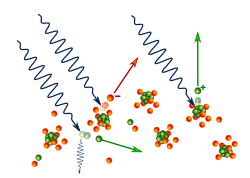
The discovery of Compton scattering by Arthur Holly Compton in 1923 convinced most physicists that light was composed of photons and that energy and momentum were conserved in collisions between electrons and photons.
Image source: Compton scattering
1924
% complete
An important development came in 1924 with Wolfgang Pauli's discovery of the exclusion principle, which put Bohr's models on a firm theoretical footing.
Image source: Pauli exclusion principle
1924 - 1927
% complete
Heisenberg first came to Copenhagen in 1924, developed the mathematical foundations of quantum mechanics after returning to Göttingen in June 1925, and worked in Copenhagen as lecturer and assistant to Bohr from 1926 to 1927, taking Kramers's place when Kramers left for Utrecht in 1926.
Image source: Werner Heisenberg
Nov 1925
% complete
The introduction of spin by George Uhlenbeck and Samuel Goudsmit in November 1925 was a milestone in the development of quantum theory.
Image source: Spin (physics)
Sep 1926 - Dec 31, 1926
% complete
British physicist Paul Dirac came to Copenhagen for six months beginning in September 1926, attracted by the new quantum mechanics. Austrian physicist Erwin Schrödinger also visited in 1926.
Image source: Paul Dirac
Feb 1927 - Sep 1927
% complete
In February 1927, Heisenberg developed the uncertainty principle. In September 1927, at the Como Conference, Bohr emphasised that Heisenberg's uncertainty relations could be derived from classical considerations about optical resolving power, part of his complementarity framework after experiments confirmed wave behavior of matter.
Image source: Uncertainty principle
May 1933
% complete
In 1933, the Rockefeller Foundation created a fund to help support refugee academics, and Bohr discussed this programme with its president, Max Mason, in May 1933 during a visit to the United States.
Image source: Rockefeller Foundation
1936 - 1938
% complete
Prompted by beta decay puzzles and the 1932 discovery of the neutron, Bohr created a new theory of the compound nucleus in 1936 explaining how neutrons could be captured by the nucleus, working with collaborator Fritz Kalckar, who died suddenly in 1938.
Image source: Nuclear reaction
Jan 26, 1939
% complete
After Otto Hahn's December 1938 discovery of nuclear fission and Lise Meitner's explanation, Bohr brought the news to the United States, opening the fifth Washington Conference on Theoretical Physics with Fermi on 26 January 1939. With Wheeler, he published "The Mechanism of Nuclear Fission" in September 1939.
Image source: Nuclear fission
Feb 1952 - 1957
% complete
After long debate, Bohr pledged his support to CERN in February 1952, and Geneva was chosen as the site in October. The CERN Theory Group was based in Copenhagen until new accommodation in Geneva was ready in 1957.
Image source: CERN
Feb 1956 - 1957
% complete
Bohr served as first chairman of the Research Establishment Risø of the Danish Atomic Energy Commission from February 1956, and became the first chairman of the Nordic Institute for Theoretical Physics (Nordita) in 1957.
1922
% complete
In 1922, Bohr was awarded the Nobel Prize in Physics "for his services in the investigation of the structure of atoms and of the radiation emanating from them."
Image source: List of Nobel laureates in Physics
1932
% complete
Carl Jacobsen had bequeathed his mansion in 1914 as an honorary residence for Denmark's most prominent contributor to science, literature or the arts. Upon Harald Høffding's death in July 1931, Bohr was granted occupancy, and his family moved there in 1932.
Image source: Carlsberg Laboratory
Mar 17, 1939
% complete
Bohr was elected president of the Academy on 17 March 1939.
Image source: Royal Danish Academy of Sciences and Letters
Oct 17, 1947
% complete
At a memorial meeting of the Academy on 17 October 1947 for King Christian X, the new king Frederik IX announced that he was conferring the Order of the Elephant on Bohr.
Image source: Order of the Elephant
1957
% complete
In 1957, Bohr received the first ever Atoms for Peace Award in recognition of his advocacy for peaceful uses of atomic energy.
Nov 18, 1962
% complete
Bohr died of heart failure on 18 November 1962 at his home in Carlsberg, Copenhagen.
Oct 7, 1965
% complete
On what would have been Bohr's 80th birthday, the Institute for Theoretical Physics at the University of Copenhagen was officially renamed the Niels Bohr Institute, as it had been called unofficially for many years.
1975
% complete
Bohr's son Aage became a successful physicist, and in 1975 was awarded the Nobel Prize in Physics, like his father. His son Ernest played field hockey for Denmark at the 1948 Summer Olympics, while eldest son Christian died in a boating accident in 1934.
Image source: Aage Bohr
1997 - 2012
% complete
An asteroid (3948 Bohr), the Bohr lunar crater, and bohrium (element 107) were named in his honour. In 1997, the Danish National Bank issued a 500-krone banknote bearing his portrait; in 1999 he was named the fourth greatest physicist of all time; and on 7 October 2012 his birthday was celebrated with a Google Doodle of the Bohr model.
Image source: Bohrium
Apr 1940
% complete
In April 1940, early in the Second World War, Nazi Germany invaded and occupied Denmark. That March, Bohr's Nobel medal, donated to the Finnish Relief Fund auction, had been bought and later given to the Danish Historical Museum at Frederiksborg Castle.
Image source: Denmark in World War II
Sep 1941
% complete
In September 1941, Heisenberg, head of the German nuclear energy project, visited Bohr in Copenhagen. In 1957 Heisenberg wrote to Robert Jungk about the meeting, and Michael Frayn's 1998 play Copenhagen explores what might have happened; it was screened by the BBC on 26 September 2002 and dramatised earlier by Horizon in 1992.
Sep 1943 - Oct 1943
% complete
In September 1943 word reached Bohr and his brother Harald that the Nazis considered their family Jewish and they were in danger of arrest. On 2 October 1943 Swedish radio announced asylum offers, and the mass rescue of Danish Jews followed swiftly as Bohr fled to Sweden.
Image source: Rescue of the Danish Jews
Dec 8, 1943 - Feb 1945
% complete
On 8 December 1943, Bohr arrived in Washington, D.C., where he met Manhattan Project director Leslie R. Groves. He later clarified key issues for Oppenheimer in early February 1945 regarding the implosion device.
Image source: Manhattan Project
May 16, 1944 - Sep 19, 1944
% complete
Bohr met Churchill on 16 May 1944 but found they "did not speak the same language". After meeting Roosevelt on 26 August 1944 via Frankfurter, Churchill and Roosevelt rejected openness about the bomb at Hyde Park on 19 September and ordered enquiries into Bohr's activities.
Aug 25, 1945 - Sep 21, 1945
% complete
Following the end of the war, Bohr returned to Copenhagen on 25 August 1945, and was re-elected President of the Royal Danish Academy of Arts and Sciences on 21 September.
Jun 1950
% complete
In June 1950, Bohr addressed an "Open Letter" to the United Nations calling for international cooperation on nuclear energy. The International Atomic Energy Agency was later created along the lines of his suggestion after the Soviet Union's 1949 nuclear test.
Image source: International Atomic Energy Agency
Or browse the full history timeline directory, with more than 2,000 topics.
This Niels Bohr timeline was generated with the help of AI, using information found on the internet.
We work hard to keep these timelines accurate, but mistakes do get through. If you spot one, email us at [email protected] and we'll fix it for future visitors.
Generate yours with AI or build it from scratch, for free.
Export your timeline, add your own events, edit or remove AI-generated events, and much more
No credit card required.
Cancel anytime.
Cancel anytime.
You can create an unlimited number of timelines with up to 10 events on each one, customize how they look, export them to PDF, PNG, PowerPoint, CSV, and Excel, and share them with a link. Paid plans raise the event limit and add features like spreadsheet imports and collaborators.
Yes. You can cancel your subscription from your account page at any time, and you will not be charged again. Your subscription stays active for the rest of the period you already paid for.
Yes. We will email you a reminder before the annual renewal, and we will also email you a receipt.
Yes. You can email us within 15 days of any payment, and we will issue you a full refund.
Check out our pricing docs or send us an email anytime: [email protected].