-
Use Cases
-
Resources
-
Pricing
Ho Chi Minh (1890–1969) was a Vietnamese revolutionary leader and statesman who founded the Democratic Republic of Vietnam in 1945. He spent decades abroad organizing communist and nationalist movements before returning to Vietnam to lead the struggle against French colonial rule, becoming President of North Vietnam and an enduring symbol of Vietnamese independence. More Less
May 19, 1890
% complete
Nguyen Sinh Cung, later known as Ho Chi Minh, was born in Kim Lien village in Nghe An province, French Indochina. His father was a Confucian scholar and minor official, and the young boy grew up witnessing the poverty and oppression endured by Vietnamese peasants under French colonial rule.
Image source: Ho Chi Minh
1908
% complete
Ho Chi Minh attended the prestigious Quoc Hoc Academy in Hue, a school for the children of elite families. During this period he became increasingly involved in antigovernment activities and was exposed to nationalist ideas that would shape his political awakening.
Image source: Quốc Học – Huế High School for the Gifted
Jun 5, 1911
% complete
Under the name Van Ba, Ho Chi Minh left Saigon aboard the French steamer Amiral Latouche-Tréville, working as a kitchen helper. He would spend the next three decades abroad, traveling across the world while developing his revolutionary philosophy and searching for ways to free Vietnam from colonialism.
1912 - 1917
% complete
During his years at sea and afterward, Ho lived briefly in the United States, including New York and Boston, and then in London, where he worked as a pastry cook under the famed chef Auguste Escoffier at the Carlton Hotel. These experiences exposed him to labor movements and Western politics.
1917 - 1923
% complete
Settling in Paris under the name Nguyen Ai Quoc (Nguyen the Patriot), Ho became active in leftist circles. In 1919 he submitted a petition to the Versailles Peace Conference demanding civil rights for the Vietnamese people, which was ignored but brought him attention as a nationalist figure.
Dec 1920
% complete
At the Tours Congress, Ho Chi Minh voted to join the newly founded French Communist Party, having been inspired by Vladimir Lenin's writings on colonial liberation. He became convinced that communism offered a path to Vietnamese independence and dedicated himself to international revolutionary work.
Image source: French Communist Party

1923 - 1924
% complete
Ho traveled to Soviet Russia, where he studied at the University of the Toilers of the East and worked with the Communist International (Comintern). He wrote extensively on colonial issues and strengthened his ties to the international communist movement.
Jun 1925
% complete
While based in Canton, China, Ho founded the Vietnamese Revolutionary Youth League (Thanh Nien), which trained young Vietnamese revolutionaries and laid the organizational groundwork for the future communist party of Vietnam.
Image source: Viet Minh
Feb 3, 1930
% complete
Ho presided over the unification of competing communist factions into the Indochinese Communist Party at a conference in Hong Kong. This unified organization became the leading force in Vietnam's struggle against both French colonialism and later foreign intervention.
Image source: Communist Party of Vietnam
Jun 6, 1931
% complete
Ho was arrested by British police in Hong Kong and held in prison while facing possible deportation to French Indochina and certain imprisonment. His lawyers successfully argued his case, and after his release in 1933 he departed for the Soviet Union, where he remained for several years.
1938 - 1940
% complete
Ho returned to southern China, serving with communist Chinese forces and re-establishing contact with Vietnamese revolutionaries. As World War II engulfed Europe and Japan occupied northern Vietnam, he saw an opening to advance the independence movement.
May 19, 1941
% complete
In a cave at Pac Bo near the Chinese border, Ho chaired the eighth plenum of the Indochinese Communist Party's Central Committee and founded the League for the Independence of Vietnam (Viet Minh), uniting nationalist forces under a broad front aimed at expelling both Japanese and French occupiers.
Image source: Viet Minh
Aug 1942 - Sep 1943
% complete
Traveling to seek aid from Chinese Nationalist forces, Ho was arrested and imprisoned for over a year in various Chinese jails, during which time he wrote his famous Prison Diary, a collection of poems composed largely in classical Chinese verse.
Oct 1944 - May 1945
% complete
A catastrophic famine caused by Japanese exploitation, wartime disruption, and French mismanagement killed an estimated several hundred thousand to two million Vietnamese. The famine discredited colonial authorities and boosted recruitment for the Viet Minh, who organized rice seizures and relief efforts.
Image source: Vietnamese famine of 1944–1945
Aug 14, 1945 - Aug 28, 1945
% complete
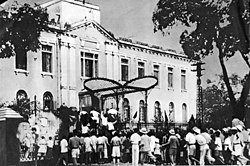
After Japan surrendered to the Allies, the Viet Minh launched a nationwide uprising, rapidly seizing control of cities including Hanoi, Hue, and Saigon. Emperor Bao Dai abdicated, ending the Nguyen dynasty and transferring authority to the revolutionary government led by Ho Chi Minh.
Image source: August Revolution
Dec 19, 1946
% complete
Following the Haiphong shelling and rising hostilities, Viet Minh forces attacked French positions in Hanoi, launching a full-scale war for independence. Ho led the resistance from jungle headquarters, waging a protracted guerrilla campaign against the better-equipped French army.
Image source: First Indochina War
Jun 1949
% complete
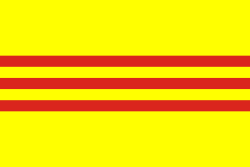
France created the Associated State of Vietnam under former emperor Bao Dai to counter Ho's government diplomatically. The move won recognition from the United States and Britain, intensifying Cold War involvement in the Indochina conflict.
Image source: State of Vietnam
Jan 1950
% complete
The People's Republic of China and the Soviet Union formally recognized Ho's government, providing critical diplomatic legitimacy, military advisers, and weapons. This support transformed the Viet Minh's military capacity and shifted the war's balance against the French.
Image source: Sino-Soviet Treaty of Friendship and Alliance
Mar 13, 1954 - May 7, 1954
% complete
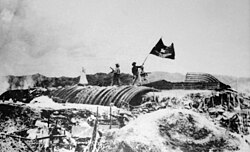
Viet Minh forces under General Vo Nguyen Giap besieged and destroyed the fortified French garrison at Dien Bien Phu after a 57-day battle. The stunning victory ended French colonial rule in Indochina and forced negotiations at the Geneva Conference.
Image source: Battle of Dien Bien Phu
Jul 20, 1954
% complete
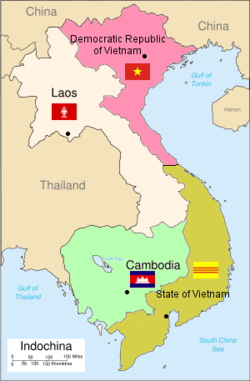
The Geneva Accords ended the First Indochina War, dividing Vietnam along the 17th parallel into a communist north and a non-communist south pending reunification elections planned for 1956. Ho's government controlled the north while Ngo Dinh Diem emerged as leader of South Vietnam.
Image source: 1954 Geneva Conference
Dec 20, 1960
% complete
The National Liberation Front for South Vietnam, commonly known as the Viet Cong, was formed with North Vietnamese backing to overthrow the Diem regime. It united communists and other opponents of the southern government in a broad insurgent front.
Image source: Viet Cong
Aug 2, 1964 - Aug 4, 1964
% complete
Alleged attacks on US destroyers off North Vietnam prompted Congress to pass the Gulf of Tonkin Resolution, authorizing President Lyndon Johnson to escalate military action. Massive American bombing and troop deployments followed, transforming the conflict into a major war.
Image source: Gulf of Tonkin incident
Jan 30, 1968 - Sep 1968
% complete
During the Lunar New Year holiday, North Vietnamese and Viet Cong forces launched coordinated attacks on over one hundred southern cities and bases, including the US embassy in Saigon. Though militarily costly for the attackers, the offensive shattered American public confidence and led to peace talks beginning in Paris.
Image source: Tet Offensive
Jan 27, 1973
% complete
The United States and North Vietnam signed agreements ending direct American military involvement in Vietnam. US forces withdrew in exchange for the return of prisoners of war, though fighting continued between North and South until the fall of Saigon in April 1975.
Image source: Paris Peace Accords
Sep 2, 1945
% complete
Before a huge crowd at Ba Dinh Square in Hanoi, Ho Chi Minh read the Declaration of Independence proclaiming the Democratic Republic of Vietnam, quoting the American Declaration of Independence. He became president of the new state and head of its provisional government.
Image source: Declaration of independence of the Democratic Republic of Vietnam
Mar 6, 1946
% complete
Ho signed the Preliminary Convention with France, permitting French troops into northern Vietnam in exchange for recognition of Vietnam as a free state within the French Union. The fragile compromise collapsed within months amid escalating tensions and clashes between the two sides.
1953 - 1956
% complete
The government redistributed land from landlords to poor peasants, but the campaign was marked by denunciations, executions of alleged class enemies, and excesses. Ho publicly acknowledged errors in 1956, and party leaders were disciplined for the program's failures.
1956
% complete
The nationwide elections stipulated by the Geneva Accords never took place, as South Vietnam's Diem, backed by the United States, refused to participate fearing a communist victory. The division of Vietnam hardened, setting the stage for renewed conflict.
1959
% complete
Facing repression of communists in the south, the North Vietnamese leadership approved armed struggle and expanded the Ho Chi Minh trail, a logistics network through Laos and Cambodia supplying fighters and material to southern insurgents who formed the Viet Cong.
Image source: Ho Chi Minh trail
Sep 2, 1969
% complete
Ho Chi Minh died of heart failure at age 79 in Hanoi, on the anniversary of Vietnam's declaration of independence. His embalmed body lies in a mausoleum in Ba Dinh Square, and his legacy endures as the revered founding father of modern Vietnam, whose name graces its largest city.
Image source: Ho Chi Minh Mausoleum
Or browse the full history timeline directory, with more than 2,000 topics.
This Ho Chi Minh timeline was generated with the help of AI, using information found on the internet.
We work hard to keep these timelines accurate, but mistakes do get through. If you spot one, email us at [email protected] and we'll fix it for future visitors.
Generate yours with AI or build it from scratch, for free.
Export your timeline, add your own events, edit or remove AI-generated events, and much more
No credit card required.
Cancel anytime.
Cancel anytime.
You can create an unlimited number of timelines with up to 10 events on each one, customize how they look, export them to PDF, PNG, PowerPoint, CSV, and Excel, and share them with a link. Paid plans raise the event limit and add features like spreadsheet imports and collaborators.
Yes. You can cancel your subscription from your account page at any time, and you will not be charged again. Your subscription stays active for the rest of the period you already paid for.
Yes. We will email you a reminder before the annual renewal, and we will also email you a receipt.
Yes. You can email us within 15 days of any payment, and we will issue you a full refund.
Check out our pricing docs or send us an email anytime: [email protected].