-
Use Cases
-
Resources
-
Pricing
This timeline traces the history of Ho Chi Minh City (formerly Saigon), covering its founding as a Khmer fishing village, development under Vietnamese rule, transformation during French colonization, its role as the capital of South Vietnam, the events of the Vietnam War era, and its growth into Vietnam's largest city and economic hub. More Less
1000
% complete
A settlement called Baigaur was established on the site in the 11th century by the Champa kingdom.
Image source: Ho Chi Minh City
1145
% complete
Baigaur was renamed Prey Nokor after conquest by the Khmer Empire around 1145. Prey Nokor grew on the site of a fishing village and area of forest.
Image source: Names of Ho Chi Minh City
1620
% complete
Thanks to the marriage between Princess Nguyễn Phúc Ngọc Vạn, daughter of Lord Nguyễn Phúc Nguyên, and King Chey Chettha II of Cambodia in 1620, relations between Vietnam and Cambodia improved, and people of the two countries could freely move back and forth.
Image source: Nguyễn Phúc Nguyên
1674
% complete
Cambodian prince Ang Nan was installed as uparaja at Sài Gòn (柴棍) by Vietnamese forces, according to accounts recorded in later chronicles such as Gia Định thành thông chí.
1679
% complete
In 1679, Lord Nguyễn Phúc Tần allowed a group of Chinese refugees fleeing the Qing dynasty to settle in Mỹ Tho, Biên Hòa, and Saigon.
Image source: Hoa people
1698
% complete
In 1698, Vietnamese noble Nguyễn Hữu Cảnh was sent by the Nguyễn rulers of Huế to establish Vietnamese administrative structures in the area, detaching it from Cambodia. The area was officially renamed Gia Định (嘉定), a name retained until the French conquest in the 1860s.
Image source: Nam tiến
1700
% complete
In February 1700, King Chey Chettha IV of Cambodia invaded from An Giang in an attempt to stop the Vietnamese expansion but was defeated by Nguyễn Hữu Cảnh.
1760
% complete
The Thien Hau Temple, a Chinese-style temple dedicated to Mazu, was first built around 1760 and remains a notable historic religious site in the city's Cholon district.
Image source: List of Mazu temples
1777 - 1801
% complete
The city served as the capital of the Nguyễn lords in their final years before the establishment of the Nguyễn dynasty in 1802.
Image source: Nguyễn lords
1788
% complete
In 1788, Nguyễn Ánh captured the city and used it as a centre of resistance against the Tây Sơn forces, laying groundwork for the eventual establishment of the Nguyễn dynasty.
Image source: Gia Long
1833 - 1835
% complete
The Citadel of Saigon was captured by Lê Văn Khôi during his revolt against emperor Minh Mạng. Following the revolt's suppression, Minh Mạng ordered the citadel dismantled, and a new citadel called Phụng Thành was built in 1836.
Image source: Lê Văn Khôi revolt
1859
% complete
After the fall of the Citadel of Saigon during the Cochinchina campaign, the citadel was destroyed by the French following the Battle of Kỳ Hòa, opening the way for colonial rule over southern Vietnam.
Image source: Siege of Saigon
1862
% complete
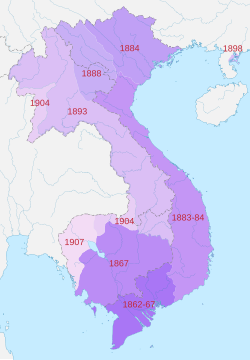
Ceded to France by the 1862 Treaty of Saigon, the city became the capital of French Cochinchina and was planned by the French to transform into a town for colonization. It adopted the name Sài Gòn, francized as Saïgon.
Image source: Treaty of Saigon (1862)
1863 - 1900
% complete
During the late 19th and early 20th centuries, French-style buildings were constructed throughout the city, including a botanical garden, Norodom Palace, Hotel Continental, Notre-Dame Cathedral (built between 1863 and 1880), and Bến Thành Market.
Image source: Notre-Dame Cathedral Basilica of Saigon
Apr 1865
% complete
In April 1865, Gia Định Báo was established in Saigon, becoming the first newspaper published in Vietnam.
Image source: Gia Dinh Bao
1887 - 1902
% complete
Saigon served as the capital of French Indochina from 1887 until 1902, when the capital moved to Hanoi; it regained this role again from 1945 until the end of French rule in 1954.
Image source: French Indochina
Apr 27, 1931 - 1955
% complete
On 27 April 1931, a new région called Saigon–Cholon consisting of Saigon and the Chinese-majority district of Cholon was formed. The name Cholon was dropped after South Vietnam gained independence from France in 1955.
Image source: Chợ Lớn, Ho Chi Minh City
Jun 14, 1949 - 1955
% complete
On 14 June 1949, ten days after France returned Cochinchina to Vietnam, former emperor Bảo Đại made Saigon the capital of the State of Vietnam within the French Union, with himself as head of state.
Image source: State of Vietnam
Jul 1954
% complete
In July 1954, the Geneva Agreement partitioned Vietnam along the 17th parallel (Bến Hải River), with the Việt Minh under Ho Chi Minh gaining control of the northern half, while the south remained under the State of Vietnam with Saigon as its capital.
Image source: 1954 Geneva Conference
1955
% complete
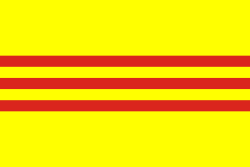
The State officially became the Republic of Vietnam when Bảo Đại was deposed by his Prime Minister Ngô Đình Diệm in the 1955 referendum, with Saigon as its capital.
Apr 28, 1955
% complete
On 28 April 1955, the Vietnamese National Army launched an attack against the Bình Xuyên military force within the city, securing government control of Saigon.
Image source: Battle of Saigon (1955)
Oct 22, 1956
% complete
On 22 October 1956, the city was given the official name Đô thành Sài Gôn ('Metropolitan city of Saigon'). After a decree of 27 March 1959 came into effect, it was divided into eight districts and 41 wards.
Jun 11, 1963
% complete
On 11 June 1963, Buddhist monk Thích Quảng Đức self-immolated at a busy Saigon intersection in protest against the persecution of Buddhists under the Diệm regime, drawing worldwide attention.
Image source: Thích Quảng Đức
1968
% complete
During the 1968 Tet Offensive, communist forces launched a failed attempt to capture Saigon, including an attack on the US Embassy grounds, though the offensive had far-reaching political consequences.
Image source: Tet Offensive
Apr 30, 1975
% complete
Seven years after the Tet Offensive, on 30 April 1975, Saigon was captured, ending the Vietnam War, and the city came under the control of the Vietnamese People's Army.
Image source: Fall of Saigon
Jul 1976
% complete
In July 1976, upon the establishment of the unified Socialist Republic of Vietnam, the city of Saigon (including Cholon), the province of Gia Định, and two suburban districts of nearby provinces were combined to create Ho Chi Minh City, honouring the late Communist leader Ho Chi Minh.
Image source: Reunification Day
2001
% complete
The Stock Exchange, the first stock exchange in Vietnam, opened in Ho Chi Minh City in 2001, marking a milestone in the country's economic modernization.
Image source: Ho Chi Minh City Stock Exchange
Oct 29, 2002
% complete
On 29 October 2002, a fire in the International Trade Center building in Ho Chi Minh City killed 60 people and injured 90 others, one of the deadliest fires in the city's history.
2010
% complete
The Ho Chi Minh City – Trung Lương Expressway, the city's first expressway, opened in 2010, connecting Ho Chi Minh City with Tiền Giang province and the Mekong Delta.
Image source: North–South Expressway East
2015
% complete
The Ho Chi Minh City – Long Thành – Dầu Giây Expressway, the city's second expressway, opened in 2015, connecting the city with Đồng Nai, Bà Rịa–Vũng Tàu, and the rest of the Southeast region.
2024
% complete
Ho Chi Minh City's first metro line, Line 1 connecting District 1 to Thủ Đức, opened in 2024, marking the debut of urban rail transit in Vietnam's largest city.
Image source: Ho Chi Minh City Metro
2025
% complete
In 2025, the provinces of Bình Dương and Bà Rịa–Vũng Tàu were merged into Ho Chi Minh City, allowing the city — now home to more than 14 million people — to inherit the two former provinces' industrial and coastal metropolitan areas. Saigon remains the official name of the city's administrative centre.
Or browse the full history timeline directory, with more than 2,000 topics.
This History of Ho Chi Minh City timeline was generated with the help of AI, using information found on the internet.
We work hard to keep these timelines accurate, but mistakes do get through. If you spot one, email us at [email protected] and we'll fix it for future visitors.
Generate yours with AI or build it from scratch, for free.
Export your timeline, add your own events, edit or remove AI-generated events, and much more
No credit card required.
Cancel anytime.
Cancel anytime.
You can create an unlimited number of timelines with up to 10 events on each one, customize how they look, export them to PDF, PNG, PowerPoint, CSV, and Excel, and share them with a link. Paid plans raise the event limit and add features like spreadsheet imports and collaborators.
Yes. You can cancel your subscription from your account page at any time, and you will not be charged again. Your subscription stays active for the rest of the period you already paid for.
Yes. We will email you a reminder before the annual renewal, and we will also email you a receipt.
Yes. You can email us within 15 days of any payment, and we will issue you a full refund.
Check out our pricing docs or send us an email anytime: [email protected].