-
Use Cases
-
Resources
-
Pricing
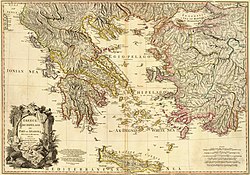
Greek city-states, known as poleis, were independent political units that flourished across the Aegean world from roughly 800 BCE until their absorption into larger empires. Each polis had its own government, laws, army, and culture, ranging from the democratic Athens to the militaristic Sparta. These fiercely independent communities drove remarkable achievements in philosophy, art, science, and politics, while also engaging in frequent wars with one another, most notably the Peloponnesian War. More Less
1100 BC
% complete
The collapse of Mycenaean palace civilization around 1100 BC ushered in the Greek Dark Ages. Writing was lost, trade declined, and populations dispersed, setting the stage for the gradual emergence of small, independent communities that would eventually develop into the Greek city-states.
Image source: Greek Dark Ages
800 BC
% complete
Around 800 BC, independent city-states known as poleis began to emerge across Greece. Each polis consisted of an urban center and surrounding countryside, with its own government, laws, army, and religious cults, becoming the defining political unit of ancient Greek life.
Image source: Polis
776 BC
% complete
The first recorded Olympic Games were held at Olympia in 776 BC, dedicated to Zeus. The games brought together athletes from rival city-states, fostering a shared Greek identity through competition even amid frequent inter-polis warfare.
Image source: Ancient Olympic Games
753 BC
% complete
The legendary founding of Rome in 753 BC marked the spread of Mediterranean urban culture influenced by Greek colonization and trade. Greek city-states would later establish colonies across Italy and Sicily, spreading their political ideas, art, and commerce throughout the western Mediterranean.
Image source: Founding of Rome
750 BC - 700 BC
% complete
The Iliad and Odyssey were composed around this period, drawing on oral traditions about the Trojan War. These epics became foundational texts for Greek education and identity, shaping values of honor, heroism, and piety across all the city-states.
Image source: Homeric Question
478 BC
% complete
In 478 BC, Athens formed the Delian League, an alliance of Greek city-states to continue fighting Persia. Member states contributed ships or money to a common treasury on Delos, but Athens gradually transformed the league into an empire under its control.
Image source: Delian League
650 BC
% complete
Traditionally attributed to the lawgiver Lycurgus, Sparta's constitution established a dual kingship, council of elders, citizen assembly, and rigorous military training system. This transformed Sparta into one of the most formidable military powers in Greece.
621 BC
% complete
The Athenian lawmaker Draco codified Athens' laws around 621 BC, creating a written legal code notorious for its severity, where minor offenses could be punished by death. His code marked an early step toward rule of written law over aristocratic whim.
Image source: Draco (legislator)
594 BC
% complete
Appointed archon in 594 BC, Solon enacted sweeping reforms that canceled debts, freed debt-slaves, and reorganized citizens into classes based on wealth rather than birth. His reforms laid the groundwork for the eventual development of Athenian democracy.
Image source: Solon
508 BC
% complete
In 508 BC, Cleisthenes introduced sweeping democratic reforms in Athens, reorganizing citizens into ten tribes and expanding the role of the assembly. Often called the father of Athenian democracy, he gave ordinary citizens unprecedented power in government.
Image source: Cleisthenes
483 BC
% complete
Using revenue from newly discovered silver mines at Laurion, Themistocles persuaded Athens to build a fleet of 200 triremes. This naval expansion proved decisive against Persia and made Athens the dominant sea power in the Aegean.
Image source: Themistocles
461 BC - 429 BC
% complete
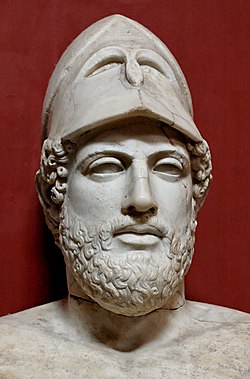
Under Pericles' leadership, Athens experienced its golden age: democracy flourished, the Parthenon rose on the Acropolis, and drama, philosophy, and art thrived. Pericles dominated Athenian politics until his death from plague in 429 BC.
Image source: Pericles
546 BC
% complete
The Persian king Cyrus the Great conquered the Greek city-states of Ionia on the coast of Asia Minor around 546 BC. Persian control over these Greek communities created tensions that would eventually erupt into open revolt and war between Greece and Persia.
Image source: Ionian Revolt
499 BC - 493 BC
% complete
Greek city-states in Ionia, led by Miletus, revolted against Persian rule in 499 BC. Athens and Eretria sent ships to aid the rebels, and although the revolt was crushed by 493 BC, it provoked Persian retaliation and set the stage for the Greco-Persian Wars.
Sep 490 BC
% complete
In September 490 BC, a vastly outnumbered Athenian army defeated the Persian invasion force at Marathon. The victory preserved Athenian independence and became legendary, inspiring the story of the runner Pheidippides and the modern marathon race.
Image source: Battle of Marathon
Aug 480 BC
% complete
In August 480 BC, King Leonidas of Sparta led a small Greek force, including his famous 300 Spartans, in a heroic stand against the massive Persian army of Xerxes at the pass of Thermopylae. Though ultimately defeated, their sacrifice delayed the Persians and inspired Greek resistance.
Image source: Battle of Thermopylae
Sep 480 BC
% complete
In September 480 BC, the Greek fleet under Themistocles lured the Persian navy into the narrow straits of Salamis and inflicted a crushing defeat. The victory turned the tide of the war and saved Greece from Persian conquest.
Image source: Battle of Salamis
479 BC
% complete
A united Greek army led by Spartan regent Pausanias decisively defeated the Persian land forces at Plataea in 479 BC. Combined with the naval victory at Mycale the same year, it ended the Persian threat to mainland Greece for good.
Image source: Battle of Plataea
460 BC - 445 BC
% complete
Fought mainly between Athens and Corinth with Sparta involved, this series of conflicts ended with the Thirty Years' Peace in 445 BC. The war foreshadowed the larger struggle between Athens and Sparta that would soon engulf all of Greece.
Image source: First Peloponnesian War
431 BC
% complete
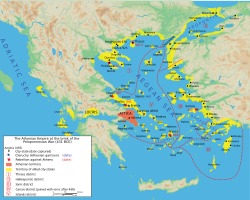
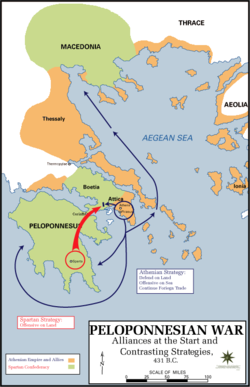
Tensions between Athens and Sparta erupted into full-scale war in 431 BC. The conflict pitted the Athenian empire and its navy against the Spartan-led Peloponnesian League, dragging nearly every Greek city-state into decades of devastating warfare.
Image source: Peloponnesian War
430 BC - 426 BC
% complete
A devastating epidemic swept through overcrowded Athens early in the Peloponnesian War, killing perhaps a third of the population including Pericles himself. The plague severely weakened Athens and demoralized its citizens during the critical early years of the war.
Image source: Plague of Athens
415 BC - 413 BC
% complete
Athens launched a massive expedition to conquer Syracuse in Sicily in 415 BC. The campaign ended catastrophically in 413 BC with the destruction of the entire Athenian fleet and army, a turning point that doomed Athens in the Peloponnesian War.
Image source: Sicilian Expedition
404 BC
% complete
After the destruction of its final fleet at Aegospotami, Athens surrendered to Sparta in 404 BC. Its walls were torn down, its empire dissolved, and a pro-Spartan oligarchy known as the Thirty Tyrants briefly ruled the city, ending Athens' golden age.
387 BC
% complete
Plato established the Academy in Athens around 387 BC, one of the earliest institutions of higher learning in the Western world. It attracted students from across the Greek world, including Aristotle, and profoundly shaped Western philosophy.
Image source: Platonic Academy
386 BC
% complete
The Peace of Antalcidas, brokered by Persia in 386 BC, forced all Greek city-states except Persia's allies to become autonomous. It revealed how far Greek powers had declined and demonstrated Persia's ability to dictate terms to the quarreling poleis.
Image source: Peace of Antalcidas
378 BC
% complete
Athens attempted to rebuild its maritime power by forming a new defensive alliance in 378 BC. Though initially successful, the league never matched the old Delian Empire and was weakened by internal revolts, notably the Social War of 357–355 BC.
Image source: Second Athenian League
359 BC
% complete
Philip II ascended the Macedonian throne in 359 BC and built a professional army with innovative tactics like the phalanx armed with sarissas. He exploited divisions among the Greek city-states to expand Macedonian power southward.
Image source: Philip II of Macedon
338 BC
% complete
In 338 BC, Philip II of Macedon crushed the combined armies of Athens and Thebes at Chaeronea. The decisive victory ended the independence of the Greek city-states and brought most of Greece under Macedonian hegemony.
Image source: Battle of Chaeronea (338 BC)
334 BC
% complete
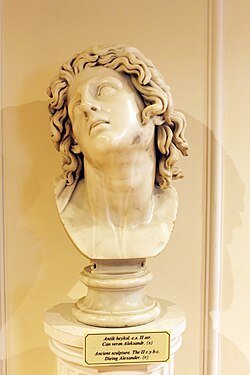
Alexander, son of Philip II, crossed into Asia Minor in 334 BC and began his conquest of the Persian Empire. Although the Greek city-states were now subordinate to Macedon, Alexander's conquests spread Greek language and culture across three continents.
Image source: Alexander the Great
Jun 323 BC
% complete
Alexander died in Babylon in June 323 BC without a clear successor. His death triggered wars among his generals and ended the classical era of the Greek city-states, ushering in the Hellenistic period dominated by large kingdoms rather than independent poleis.
Image source: Death of Alexander the Great
Or browse the full history timeline directory, with more than 2,000 topics.
This Greek City-States timeline was generated with the help of AI, using information found on the internet.
We work hard to keep these timelines accurate, but mistakes do get through. If you spot one, email us at [email protected] and we'll fix it for future visitors.
Generate yours with AI or build it from scratch, for free.
Export your timeline, add your own events, edit or remove AI-generated events, and much more
No credit card required.
Cancel anytime.
Cancel anytime.
You can create an unlimited number of timelines with up to 10 events on each one, customize how they look, export them to PDF, PNG, PowerPoint, CSV, and Excel, and share them with a link. Paid plans raise the event limit and add features like spreadsheet imports and collaborators.
Yes. You can cancel your subscription from your account page at any time, and you will not be charged again. Your subscription stays active for the rest of the period you already paid for.
Yes. We will email you a reminder before the annual renewal, and we will also email you a receipt.
Yes. You can email us within 15 days of any payment, and we will issue you a full refund.
Check out our pricing docs or send us an email anytime: [email protected].