-
Use Cases
-
Resources
-
Pricing
Greek cuisine is one of the world's oldest culinary traditions, shaped by ancient agriculture, trade across the Mediterranean and Near East, Byzantine refinement, Ottoman influence, and modern globalization. Built on olive oil, grains, wine, fresh vegetables, herbs, seafood, and cheese, it evolved from the symposiums of antiquity into the beloved meze culture, moussaka, souvlaki, and the internationally renowned Mediterranean diet of today. More Less
2700 BC - 1450 BC
% complete
On Crete, the Minoans cultivated olives, grapes, and grains, producing olive oil and wine that became staples of the Aegean diet. Frescoes and archaeological finds reveal a sophisticated food culture based on seafood, legumes, and aromatic herbs.
Image source: Minoan civilization
1600 BC - 1100 BC
% complete
The Mycenaeans expanded cultivation of barley, wheat, olives, and vines across mainland Greece. Linear B tablets record rationing of grains, oil, and figs, establishing the agricultural foundation of later Greek cooking.
Image source: Mycenaean Greece
800 BC
% complete
During the Archaic period, the olive tree, a gift of Athena in myth, spread throughout Greece. Olive oil was used for cooking, dressing salads, preserving foods, lighting lamps, and even as an athletic prize at Panhellenic games.
Image source: Greek cuisine
700 BC
% complete
The symposium, an aristocratic drinking party, popularized diluted wine consumed from kylix cups alongside simple snacks. It shaped Greek social dining customs and elevated wine to a cultural cornerstone.
Image source: Symposium
500 BC
% complete
In Greek Sicily, chefs like Mithaecus wrote the first known cookbooks, elevating fish cookery with cheese and oil. Sybaris in southern Italy became legendary for its luxury banquets, spreading refined tastes back to mainland Greece.
450 BC
% complete
Athenians ate a tripartite diet of bread, wine, and oil supplemented by fish, cheese, figs, and vegetables. Aristophanes mocked gourmets while Spartan black broth symbolized austere simplicity, defining contrasting Greek food identities.
Image source: Ancient Greek cuisine
350 BC
% complete
The Sicilian-born poet Archestratus composed Hedypatheia ('The Life of Luxury'), a humorous guide praising fresh, simply prepared fish across the Mediterranean. It is considered one of the first works of Western gastronomy.
Image source: Archestratus
330 BC - 31 BC
% complete
Following Alexander's conquests, Greek foodways mingled with Persian, Egyptian, and Near Eastern cuisines. New spices, fruits, and techniques entered Greek kitchens, and Greek dining customs influenced elites across the eastern Mediterranean.
Image source: Hellenistic period

100 AD - 300 AD
% complete
Wealthy Romans hired Greek cooks and embraced Greek delicacies such as garum-like fish sauces, honeyed pastries, and elaborate banquets. Greek gastronomy became the prestige cuisine of the imperial elite.
Image source: Ancient Roman cuisine
200 AD
% complete
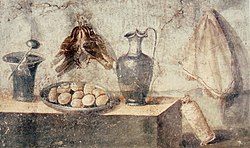
Writing in Roman-era Egypt, Athenaeus recorded an immense literary banquet cataloging ancient Greek dishes, wines, and dinner conversation. The work preserves much of what is known about classical Greek food culture.
Image source: Deipnosophistae
330 AD - 1450 AD
% complete
Constantinople's cosmopolitan kitchens fused Greek staples with Eastern spices, developing dishes like spiced stews, sweet-savory combinations, and elaborate court banquets. Orthodox fasting rules also entrenched a rich tradition of vegan Lenten foods.
500 AD
% complete
Church-mandated fast days totaling over half the year encouraged inventive use of shellfish, octopus, legumes, tahini, and halva. These nistisima (Lenten) dishes remain a distinctive pillar of Greek cuisine today.
Image source: Religious fasting
900 AD
% complete
The imperial court's opulent banquets featured silver plates, exotic spices, and ceremonial courses, influencing both Islamic courts and later medieval Europe through trade and diplomacy.
Image source: Byzantine Empire
1204 AD - 1797 AD
% complete
After the Fourth Crusade, Venice controlled Crete and other islands for centuries. Italian influence introduced pasta-based pies, risotto-like preparations, and sweetened coffee habits, enriching Cretan and Ionian island cooking.
Image source: Kingdom of Candia
1500 AD
% complete
Early modern travelers remarked on Cretans' robust health attributed to wild greens, olive oil, snails, and minimal meat consumption — a pattern later celebrated by Ancel Keys' Seven Countries Study.
1453 AD - 1821 AD
% complete
Four centuries of Ottoman rule embedded Turkish, Persian, and Arab elements into Greek cooking: phyllo dough pastries, stuffed vegetables, yogurt, coffee, and syrup-soaked desserts like baklava became shared heritage across the empire.
Image source: Ottoman cuisine
1500 AD
% complete
Layered nut-and-honey pastries perfected in Topkapi Palace kitchens were adopted widely in Greece, evolving into regional specialties like baklava of Crete, saragli, and kadaifi served at celebrations.
Image source: Baklava
1550 AD
% complete
Coffee arrived via Ottoman channels and was brewed thick in small briki pots, served with a glass of water and a sweet. The ritual of Greek coffee, complete with fortune-telling from grounds, remains a daily social institution.
Image source: Turkish coffee
1600 AD
% complete
Small shared plates — olives, cheeses, grilled octopus, dolmades, dips like tzatziki — accompanied ouzo or wine. This convivial meze culture, inherited from Ottoman practice, defines Greek social eating to this day.
Image source: Meze
1700 AD
% complete
Ottoman dolma traditions merged with Greek garden produce: tomatoes, peppers, zucchini, and vine leaves filled with rice, herbs, and sometimes minced meat became beloved household staples across Greece.
Image source: Dolma
1821 AD - 1832 AD
% complete
Independence brought efforts to define a distinct national identity, including reclaiming 'Greek' versions of shared Ottoman dishes. Foods like souvlaki and feta became emblems of Hellenic heritage.
Image source: Greek War of Independence
1850 AD
% complete
Sheep's and goat's milk brined cheese production standardized in regions like Epirus and Thessaly. Feta became Greece's most iconic export cheese, eventually winning EU protected designation of origin status in 2002.
Image source: Feta
1900 AD - 1940 AD
% complete
New World tomatoes, introduced earlier, became ubiquitous in the interwar years, inspiring gemista, tomatokeftedes, stifado, and the red-sauce ladera dishes now central to the Greek repertoire.
1922 AD - 1928 AD
% complete
After the Greco-Turkish War, over a million refugees resettled in Greece, bringing sophisticated urban cooking: bougatsa, saganaki, spicy soutzoukakia, and refined pastry techniques transformed Athens and Thessaloniki's food scenes.
Image source: Population exchange between Greece and Turkey
1925 AD
% complete
With Sephardic Jewish, Armenian, Pontic, and refugee communities, Thessaloniki developed a renowned food culture featuring bougatsa breakfasts, mezedopoleia, and layered spice-rich dishes unique within Greece.
Image source: Thessaloniki
1941 AD - 1944 AD
% complete
Wartime blockade and requisitions caused famine killing roughly 300,000 Greeks. Survival relied on foraged greens, bread substitutes, and solidarity meals — a trauma that shaped postwar attitudes toward food abundance.
Image source: Great Famine (Greece)
1950 AD - 1975 AD
% complete
Mass tourism after WWII turned tavernas, gyros stands, and seaside fish restaurants into global ambassadors of Greek cuisine, popularizing moussaka, souvlaki, and Greek salad among international visitors.
Image source: Tourism in Greece
1958 AD - 1980 AD
% complete
Ancel Keys' landmark research identified the traditional Cretan diet — olive oil, greens, legumes, fish, moderate wine — as linked to exceptional longevity, launching the global Mediterranean diet movement.
Image source: Seven Countries Study
Nov 16, 2010
% complete
UNESCO inscribed the Mediterranean diet, with Greece among the nominating countries, on its Representative List of Intangible Cultural Heritage, honoring it as a living tradition of seasonal, communal eating.
Image source: Mediterranean diet
2019 AD
% complete
Fine-dining restaurants in Athens and the islands began earning Michelin stars, blending ancient ingredients and island produce with modern technique and signaling a contemporary renaissance of Greek haute cuisine.
Image source: Michelin Guide
Or browse the full history timeline directory, with more than 2,000 topics.
This History of Greek Cuisine timeline was generated with the help of AI, using information found on the internet.
We work hard to keep these timelines accurate, but mistakes do get through. If you spot one, email us at [email protected] and we'll fix it for future visitors.
Generate yours with AI or build it from scratch, for free.
Export your timeline, add your own events, edit or remove AI-generated events, and much more
No credit card required.
Cancel anytime.
Cancel anytime.
You can create an unlimited number of timelines with up to 10 events on each one, customize how they look, export them to PDF, PNG, PowerPoint, CSV, and Excel, and share them with a link. Paid plans raise the event limit and add features like spreadsheet imports and collaborators.
Yes. You can cancel your subscription from your account page at any time, and you will not be charged again. Your subscription stays active for the rest of the period you already paid for.
Yes. We will email you a reminder before the annual renewal, and we will also email you a receipt.
Yes. You can email us within 15 days of any payment, and we will issue you a full refund.
Check out our pricing docs or send us an email anytime: [email protected].