-
Use Cases
-
Resources
-
Pricing
Thai cuisine is a vibrant culinary tradition shaped by centuries of trade, migration, and cultural exchange. Rooted in indigenous ingredients like rice, fish sauce, lemongrass, and galangal, it evolved through influences from China, Portugal, Persia, and neighboring Southeast Asian countries. Known for its balance of sweet, sour, salty, and spicy flavors, Thai food has become one of the world's most beloved cuisines. More Less
1238 - 1448
% complete
According to Lady Plian Bhaskarawongse's book Mae Khrua Hua Pa (first published in 1908), Thai cuisine had a strong gastronomical cultural line from the Sukhothai period (1238–1448), preserved through Siamese governmental officers' daily routines such as royal cooking.
Image source: Sukhothai Kingdom
1350
% complete
Thai cuisine and the culinary traditions of Thailand's neighbors, especially Cambodia, Laos, Myanmar, India, Malaysia and Indonesia, have influenced one another over the course of many centuries.
Image source: Thai cuisine
1691
% complete
Simon de la Loubère provides a recipe for nam phrik with pla ra and onions in Du Royaume de Siam, an account of his mission to Thailand published in 1691, offering one of the earliest written records of Thai food.
Image source: Nam phrik
1767 - 1782
% complete
According to Mae Khrua Hua Pa, Thai cuisine maintained a strong gastronomical cultural line through the Thonburi period (1767–1782), as recorded vis-à-vis Siamese governmental officers' daily routines and their related cousins.
Image source: Thonburi Kingdom
1850 - 1899
% complete
Ice cream in the second half of the 19th century in Thailand was made of coconut water blended with ice, an early form of Thai frozen dessert.
Image source: Ice cream
1908
% complete
Lady Plian Bhaskarawongse published Mae Khrua Hua Pa in 1908, documenting the history of Thai cuisine and tracing its gastronomical cultural line from Sukhothai through Ayutthaya and Thonburi periods.
1969
% complete
Apples, pears, peaches, grapes, and strawberries, which do not traditionally grow in Thailand and previously had to be imported, became increasingly popular after being introduced to Thai farmers by the Thai Royal Projects starting in 1969.
Image source: Royal Project Foundation
1986
% complete
According to the Bangkok Post, aitim tat ("cut ice cream") was very popular around 1986, roughly 30 years before the article's publication, representing a nostalgic era of Thai frozen desserts.
1988
% complete
The Doi Tung Project began in 1988, continuing efforts to introduce temperate fruits like apples, pears, grapes, and strawberries to Thai farmers, expanding local availability of these fruits.
Image source: Doi Tung
2006
% complete
In 2006 the per capita consumption of fish in Thailand was 33.6 kg, reflecting the importance of seafood in the Thai diet.
1351 - 1767
% complete
Thai royal cuisine can trace its history back to the cosmopolitan palace cuisine of the Ayutthaya kingdom (1351–1767 CE), which blended culinary traditions from across the region.
1400
% complete
Due to extensive, centuries-long contact between the Ayutthaya Kingdom and Khmer Empire, the flavour principles of many Central Thai dishes, such as sour fish soups, stews and coconut-based curries including steamed curries, are almost identical to Cambodian cuisine, with Central Thai dishes containing notably more chilli and sugar.
1511
% complete
Western influences began in 1511 when the first diplomatic mission from the Portuguese arrived at the court of Ayutthaya, creating dishes such as foi thong, the Thai adaptation of Portuguese fios de ovos, and sangkhaya, where coconut milk replaces cow's milk in custard.
Image source: Fios de ovos
1550
% complete
The most notable Western influence on Thai cuisine was the introduction of the chili pepper from the Americas in the 16th or 17th century, which became central to Thai cooking.
Image source: Chili pepper
1600 - 1699
% complete
Dishes like foi thong and sangkhaya were said to have been brought to Thailand in the 17th century by Maria Guyomar de Pinha, a woman of mixed Japanese-Portuguese-Bengali ancestry born in Ayutthaya, wife of Constantine Phaulkon, a Greek adviser to King Narai.
Image source: Maria Guyomar de Pinha
1880 - 1899
% complete
The street food culture of much of Southeast Asia was introduced by Chinese immigrants during the late 19th century, profoundly shaping Thailand's vibrant street food scene.
Image source: Street food of Thailand
1897
% complete
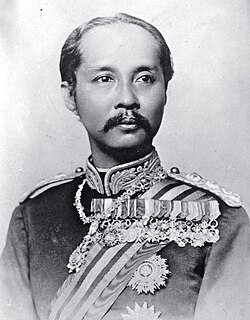
The fork and spoon were introduced to Thailand by King Chulalongkorn after his return from a tour of Europe in 1897 CE, reshaping how Thais eat their meals.
Image source: Chulalongkorn
1959
% complete
The earliest attested Thai restaurant in the United States, "Chada Thai", opened its doors in 1959 in Denver, Colorado, marking the beginning of Thai food's spread across America.
1967
% complete
"The Bangkok Restaurant", the oldest Thai restaurant in London, was opened in 1967 by Mr and Mrs Bunnag, a former Thai diplomat and his wife, in South Kensington.
2001
% complete
The Thaksin administration launched the "Kitchen of the World" campaign early in its tenure to promote Thai cuisine internationally, with a yearly budget of 500 million baht.
Image source: Culinary diplomacy
2002
% complete
The "Global Thai" program, launched in 2002, was a government-led culinary diplomacy initiative aiming to boost the number of Thai restaurants worldwide to 8,000 by 2003 from about 5,500 previously.
2003
% complete
The 2003 UNESCO convention intends to protect the "uses, representations, expressions, knowledge and techniques that communities, groups and, in some cases, individuals, recognised as an integral part of their cultural heritage", providing a framework relevant to preserving Thai culinary heritage.
Image source: Intangible cultural heritage
2003
% complete
A 2003 survey conducted by the Kellogg School of Management and Sasin Institute showed that Thai cuisine ranked fourth when people were asked to name an ethnic cuisine, after Italian, French, and Chinese cuisine.
2003
% complete
In 2003 the Ministry of Finance sent officials to the US to award certificates to deserving Thai restaurants, supporting quality and authenticity abroad.
Jun 2009
% complete
In June 2009, the Tourism Authority of Thailand organised a conference at the Queen Sirikit National Convention Centre in Bangkok to discuss matters related to promoting Thai cuisine internationally.
Image source: Tourism Authority of Thailand
2011
% complete
In 2011, seven Thai dishes appeared on CNN Travel's list of the "World's 50 Best Foods", based on an online poll of 35,000 people worldwide: som tam at 46, nam tok mu at 19, tom yam kung at 8, and massaman curry at first place.
Image source: The World's 50 Best Restaurants
2011
% complete
By 2011, the number of Thai restaurants worldwide had swelled to more than 10,000, far exceeding the goals of the government's Global Thai program.
2011
% complete
In 2011, the James Beard Foundation Award for Best Chef in the Northwestern United States went to Andy Ricker of "Pok Pok" in Portland, Oregon, and Best Chef in the Southwestern United States went to Saipin Chutima of "Lotus of Siam" in Winchester, Nevada.
Image source: James Beard Foundation Award
2012
% complete
In 2012, British Restaurant Magazine included Nahm Bangkok of chef David Thompson in its yearly list of The World's 50 Best Restaurants.
Oct 5, 2012 - Oct 10, 2012
% complete
Thai chefs won the IKA Culinary Olympic 2012 competition held in Erfurt, Germany between 5–10 October 2012, receiving four gold and one silver medal. They also took second place in the Gourmet Team Challenge (Practical) of the FHC China International Culinary Arts Competition in Shanghai on 14–16 November 2012.
2013
% complete
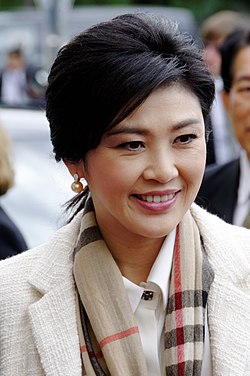
After some officials had a bad Thai meal abroad, in 2013 the Yingluck administration had the idea of standardising Thai food everywhere, leading to efforts to codify authentic recipes.
Image source: Yingluck Shinawatra
Aug 24, 2016
% complete
Standardised Thai recipes were featured at a gala dinner promoting "Authentic Thai Food for the World", held at the Plaza Athénée Hotel Bangkok on 24 August 2016, with Thailand's Minister of Industry as honored guest.
2018 - 2024
% complete
Culture Minister Vira Rojpojchanarat announced in 2018 that between 2020 and 2024, his ministry will investigate ways to preserve authentic Thai cuisine from the increasing influence of foreign dishes.
Image source: Ministry of Culture (Thailand)
Aug 2018
% complete
In August 2018, Thailand's Ministry of Commerce kicked off a project called "Thai Select" to certify and promote authentic Thai restaurants and products.
2020
% complete
By 2020, the Thai Delicious program plans to post over 300 Thai food recipes online to standardize and preserve authentic Thai cooking worldwide.
2012 - 2016
% complete
According to the Thai government's Eleventh National Economic and Social Development Plan (2012–2016), Thailand is number one in the world in the application of chemicals in agriculture.
Image source: Pesticide
2012 - 2015
% complete
The three-year survey, from 2012 to 2015, involved 1,121 samples of fish sauce sold under 422 brands from 245 manufacturers, examining quality across Thailand's fish sauce industry.
Image source: Fish sauce
Mar 2016 - Jun 2019
% complete
ThaiPAN surveys found over 50% of tested produce unsafe in 2016 and 46% contaminated in 2018; its June 2019 report found 41% of 286 samples contained unsafe chemical levels. Prior years showed "Q-Mark" goods with 61.5% contamination versus 57% during ThaiPAN's March 2016 survey.
Sep 2016
% complete
In September 2016, a shipment of pork labelled "halal"—a permissible food for Muslims—was delivered to a hotel in Krabi Province, raising concerns about food labelling integrity in Thailand.
Image source: Halal
Nov 2017
% complete
In late 2017, ThaiPAN tested 30 hydroponically-grown vegetables purchased at Thai fresh markets and supermarkets, adding hydroponic produce to its ongoing food safety monitoring.
Image source: Hydroponics
Oct 22, 2019
% complete
On 22 October 2019, the 26-member National Hazardous Substances Committee changed paraquat, glyphosate, and chlorpyrifos from Type 3 toxic substances to Type 4, effectively prohibiting their production, import, export, or possession, with use prohibited as of 1 December 2019.
Image source: Paraquat
Nov 27, 2019
% complete
On 27 November 2019, the NHSC amended its timetable, moving the ban date for paraquat and chlorpyrifos to 1 June 2020.
Or browse the full history timeline directory, with more than 2,000 topics.
This History of Thai Cuisine timeline was generated with the help of AI, using information found on the internet.
We work hard to keep these timelines accurate, but mistakes do get through. If you spot one, email us at [email protected] and we'll fix it for future visitors.
Generate yours with AI or build it from scratch, for free.
Export your timeline, add your own events, edit or remove AI-generated events, and much more
No credit card required.
Cancel anytime.
Cancel anytime.
You can create an unlimited number of timelines with up to 10 events on each one, customize how they look, export them to PDF, PNG, PowerPoint, CSV, and Excel, and share them with a link. Paid plans raise the event limit and add features like spreadsheet imports and collaborators.
Yes. You can cancel your subscription from your account page at any time, and you will not be charged again. Your subscription stays active for the rest of the period you already paid for.
Yes. We will email you a reminder before the annual renewal, and we will also email you a receipt.
Yes. You can email us within 15 days of any payment, and we will issue you a full refund.
Check out our pricing docs or send us an email anytime: [email protected].