-
Use Cases
-
Resources
-
Pricing
Singapore City's history spans from a modest Malay fishing settlement to a thriving 14th-century trading port known as Temasek, its founding as a British colonial outpost by Sir Stamford Raffles in 1819, Japanese occupation during World War II, self-governance and merger with Malaysia, and ultimately its emergence as one of the world's most prosperous city-states following independence in 1965. More Less
1299
% complete
The island known as Temasek was an early trading port frequented by Malay, Chinese, and Indian merchants. According to the Malay Annals, a Sumatran prince named Sang Nila Utama arrived and founded the Kingdom of Singapura, giving the island the name it bears today.
Image source: Kingdom of Singapura
1299
% complete
Legend holds that Sang Nila Utama, a Srivijayan prince, spotted what he believed to be a lion on the island and named it 'Singapura', meaning 'Lion City' in Sanskrit. The kingdom flourished as a trading hub for about a century.
Image source: Sang Nila Utama
1398
% complete
The Kingdom of Singapura was attacked by forces of the Majapahit Empire or Siamese forces around 1398. The last ruler, Parameswara, fled north and later founded the Sultanate of Malacca, and Singapore declined into a modest fishing village.
1528 - 1819
% complete
Following the fall of Malacca to the Portuguese in 1511, Singapore came under the control of the Johor Sultanate. The island remained sparsely populated, home to small Malay fishing communities and occasional Chinese planters.
Image source: Johor Sultanate
Jan 29, 1819
% complete
Sir Stamford Raffles of the British East India Company landed in Singapore and signed a treaty with Sultan Hussein Shah and the Temenggong, establishing Singapore as a British trading post due to its strategic position along the trade route between India and China.
Image source: Founding years of modern Singapore
Jun 26, 1819
% complete
A formal treaty was signed between the British East India Company, Sultan Hussein Shah, and Temenggong Abdul Rahman, cementing British presence on the island and permitting the establishment of a permanent trading settlement.
1823
% complete
Raffles declared Singapore a free port, abolishing duties on trade. This policy attracted merchants from across Asia and Europe, fueling rapid population growth and transforming Singapore into one of the busiest ports in the region.
Image source: History of Singapore
Mar 17, 1824
% complete
The Anglo-Dutch Treaty of 1824 divided the Malay world into British and Dutch spheres of influence, leaving Singapore firmly within the British sphere and removing any Dutch objections to the new colony's existence.
1826
% complete
Singapore was merged with Penang and Malacca to form the Straits Settlements, administered initially from India by the British East India Company, formalizing colonial administration over the three ports.
Image source: Straits Settlements
Apr 1, 1867
% complete
The Straits Settlements were transferred from the control of British India to direct rule by the Colonial Office in London, becoming a Crown Colony. This brought more responsive governance and greater investment in infrastructure.
Nov 17, 1869
% complete
The opening of the Suez Canal dramatically shortened the sea route between Europe and Asia, greatly increasing shipping traffic through Singapore and solidifying its role as the preeminent entrepôt port of Southeast Asia.
Image source: Suez Canal
1880 - 1930
% complete
Large waves of Chinese immigrants, many fleeing poverty and unrest in southern China, arrived in Singapore to work in rubber plantations, tin mines, and the port. By 1900 the Chinese formed the majority of the island's population.
Image source: Immigration to Singapore
1905 - 1913
% complete
Extensive dock facilities were developed at Keppel Harbour, including the King's Dock. These modern facilities enabled Singapore to handle increasingly large steamships and reinforced its status as a major imperial port.
Image source: Keppel Harbour
1938
% complete
Britain completed the massive King George VI Graving Dock naval base at Sembawang, intended to deter Japanese expansion. It was the largest dry dock in the world at the time but would prove inadequately defended just a few years later.
Image source: Singapore Naval Base
Feb 1942 - Sep 1945
% complete
During the occupation, Singapore was renamed 'Syonan-to', meaning 'Light of the South'. Residents endured severe hardships including food shortages, forced labor, and the Sook Ching massacre targeting Chinese communities suspected of anti-Japanese sympathies.
Image source: Japanese occupation of Singapore
Feb 1942 - Mar 1942
% complete
The Japanese military conducted systematic screenings of Chinese men aged 18 to 50, executing tens of thousands suspected of hostility toward Japan. The massacre remains one of the darkest episodes of the occupation period.
Image source: Sook Ching
Feb 15, 1942
% complete
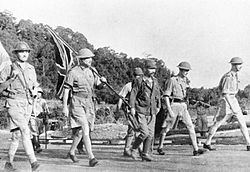
After a swift campaign down the Malay Peninsula, Japanese forces captured Singapore, described by Winston Churchill as the 'worst disaster' in British military history. Around 80,000 Allied troops surrendered, and the island entered a period of harsh Japanese rule.
Image source: Fall of Singapore
Sep 12, 1945
% complete
Following Japan's surrender, British forces returned to Singapore in Operation Tiderace and accepted the Japanese surrender at the Municipal Building. The island was placed under British Military Administration amid widespread devastation and hardship.
Image source: Operation Tiderace
Apr 1, 1946
% complete
The Straits Settlements were dissolved and Singapore became a Crown Colony in its own right, separated from Penang and Malacca, which joined the Malayan Union. This marked a distinct administrative identity for the city-state.
Image source: Colony of Singapore
Dec 11, 1950 - Dec 13, 1950
% complete
Riots broke out between Malays and Europeans/Chinese following a court ruling placing Maria Hertogh, a Dutch girl raised Muslim, in a Catholic convent. Eighteen people died and the riots exposed deep communal tensions in colonial society.
Image source: Maria Hertogh
May 13, 1954
% complete
Chinese middle school students protested against compulsory conscription into the British colonial military service. The clashes injured dozens and galvanized anti-colonial sentiment among Chinese-educated youth.
Image source: 1954 National Service riots
Nov 21, 1954
% complete
Lee Kuan Yew and a group of English-educated professionals founded the People's Action Party (PAP), which would go on to dominate Singaporean politics for decades and lead the country through independence and rapid development.
Image source: People's Action Party
May 12, 1955 - May 14, 1955
% complete
Striking workers and students clashed violently with police during a bus drivers' strike, resulting in four deaths. The riots highlighted labor unrest and contributed to political momentum for self-governance.
1956 - 1957
% complete
Chief Minister Lim Yew Hock led constitutional negotiations in London that secured agreement for Singapore to attain full internal self-government, paving the way for elections in which all citizens could vote.
Jun 3, 1959
% complete
Singapore achieved full internal self-government, and the PAP won a landslide victory in the May 1959 election. Lee Kuan Yew became the first Prime Minister of self-governing Singapore, while Britain retained control of defense and foreign affairs.
Sep 16, 1963
% complete
Singapore joined the Federation of Malaysia together with Sabah and Sarawak, ending 144 years of British colonial rule. However, political disputes and racial tensions quickly strained the union.
Image source: Singapore in Malaysia
Jul 21, 1964 - Sep 1964
% complete
Communal violence between Malays and Chinese erupted during a procession celebrating the Prophet Muhammad's birthday and again in September, killing 36 people and intensifying tensions between Singapore and the federal government in Kuala Lumpur.
Image source: 1964 race riots in Singapore
Aug 9, 1965
% complete
The Malaysian Parliament voted unanimously to expel Singapore from the federation. With no natural resources and a vulnerable position, Lee Kuan Yew tearfully announced independence, beginning Singapore's journey as a sovereign republic.
Sep 21, 1965
% complete
Shortly after independence, Singapore became the 117th member of the United Nations, gaining international recognition and legitimacy as a newly sovereign nation.
1961 - 1970
% complete
The Economic Development Board spearheaded aggressive industrialization, attracting foreign investment and developing Jurong from swampland into a vast industrial estate. Manufacturing boomed, transforming Singapore's economy beyond its traditional entrepôt trade.
Image source: Jurong
Jul 1, 1981
% complete
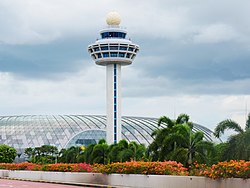
Singapore Changi Airport opened, replacing Paya Lebar as the nation's main air gateway. Renowned for its efficiency and amenities, Changi became consistently ranked among the world's best airports and cemented Singapore's status as a global aviation hub.
Image source: Changi Airport
Nov 7, 1987
% complete
The first segment of Singapore's Mass Rapid Transit (MRT) opened between Yio Chu Kang and Toa Payoh, revolutionizing urban mobility and supporting the city's compact, high-density development model.
Image source: Mass Rapid Transit (Singapore)
Oct 31, 2000
% complete
A Singapore Airlines Boeing 747 attempting takeoff from Taipei's closed runway during a typhoon crashed, killing 83 people. It remains the deadliest accident in the airline's history.
Image source: Singapore Airlines Flight 006
Mar 18, 2010
% complete
Universal Studios Singapore opened as Southeast Asia's first Universal Studios theme park, part of Resorts World Sentosa. It boosted tourism and marked Singapore's push to diversify its economy into entertainment and leisure.
Image source: Universal Studios Singapore
Apr 27, 2010
% complete
The iconic Marina Bay Sands integrated resort opened, featuring three towers topped by the SkyPark, a casino, luxury shopping, and convention facilities. It quickly became a symbol of modern Singapore and a major tourism draw.
Image source: Marina Bay Sands
Mar 23, 2015
% complete
Lee Kuan Yew, Singapore's founding prime minister who led the nation for 31 years, died at age 91. His state funeral drew hundreds of thousands of mourners and worldwide tributes honoring his role in building modern Singapore.
Image source: Death and state funeral of Lee Kuan Yew
Aug 9, 2015
% complete
Singapore celebrated 50 years of independence with extensive SG50 events, parades, and commemorations reflecting on the nation's remarkable transformation from a struggling port city to a global economic powerhouse.
Image source: Golden jubilee
Apr 17, 2019
% complete
Jewel Changi Airport opened featuring the world's tallest indoor waterfall, the Rain Vortex, surrounded by lush indoor gardens. The mixed-use complex further elevated Changi's reputation as a destination in itself.
Image source: Jewel Changi Airport
Or browse the full history timeline directory, with more than 2,000 topics.
This History of Singapore City timeline was generated with the help of AI, using information found on the internet.
We work hard to keep these timelines accurate, but mistakes do get through. If you spot one, email us at [email protected] and we'll fix it for future visitors.
Generate yours with AI or build it from scratch, for free.
Export your timeline, add your own events, edit or remove AI-generated events, and much more
No credit card required.
Cancel anytime.
Cancel anytime.
You can create an unlimited number of timelines with up to 10 events on each one, customize how they look, export them to PDF, PNG, PowerPoint, CSV, and Excel, and share them with a link. Paid plans raise the event limit and add features like spreadsheet imports and collaborators.
Yes. You can cancel your subscription from your account page at any time, and you will not be charged again. Your subscription stays active for the rest of the period you already paid for.
Yes. We will email you a reminder before the annual renewal, and we will also email you a receipt.
Yes. You can email us within 15 days of any payment, and we will issue you a full refund.
Check out our pricing docs or send us an email anytime: [email protected].