-
Use Cases
-
Resources
-
Pricing
Jan 30, 1933
% complete
Adolf Hitler becomes Chancellor of Germany, marking the beginning of Nazi rule. The Nazis quickly move to consolidate power and implement their antisemitic ideology, initiating a systematic campaign against Jews that would escalate over the following years into the Holocaust.
Image source: Adolf Hitler's rise to power
Mar 22, 1933
% complete
The Dachau concentration camp opens near Munich, initially holding political prisoners. It became a model for the vast network of Nazi camps and a training ground for SS guards who would later run the extermination camps of the Holocaust.
Image source: Dachau concentration camp
Apr 1, 1933
% complete
The Nazi regime organizes a nationwide one-day boycott of Jewish-owned businesses, shops, and professionals. SA members stood outside stores to intimidate customers, marking the first major state-sponsored antisemitic action against Germany's Jewish community.
Image source: Nazi boycott of Jewish businesses
Apr 7, 1933
% complete
Germany enacts legislation excluding Jews from government employment, including positions as teachers, professors, judges, and other civil servants. This was the first of hundreds of anti-Jewish laws that progressively stripped Jews of their rights and livelihoods.
Image source: Law for the Restoration of the Professional Civil Service
Sep 15, 1935
% complete
At the annual Nuremberg party rally, the Nazis pass the Reich Citizenship Law and the Law for the Protection of German Blood and German Honour. These laws stripped Jews of citizenship, prohibited marriage between Jews and non-Jews, and defined Jews by ancestry, institutionalizing racial antisemitism.
Image source: Nuremberg Laws
Jul 6, 1938 - Jul 15, 1938
% complete
Delegates from 32 countries meet in Évian-les-Bains, France to address the Jewish refugee crisis, but almost none agree to increase their immigration quotas. The conference's failure left hundreds of thousands of Jews with few options to escape Nazi persecution.
Image source: Évian Conference
Nov 9, 1938 - Nov 10, 1938
% complete
In a nationwide pogrom known as Kristallnacht or the Night of Broken Glass, Nazis destroy thousands of synagogues and Jewish businesses, arrest around 30,000 Jewish men and send them to concentration camps, and kill dozens of Jews, escalating persecution to open violence.
Image source: Kristallnacht
May 13, 1939 - Jun 17, 1939
% complete
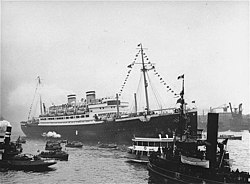
The MS St. Louis carrying over 900 Jewish refugees is denied entry to Cuba, the United States, and Canada before being forced back to Europe. Many passengers were later accepted by European countries, though roughly a quarter ultimately died in the Holocaust.
Image source: MS St. Louis
Sep 1, 1939
% complete
Germany invades Poland, home to Europe's largest Jewish population, beginning World War II. The occupation brought brutal repression, forced labor, and mass shootings of Polish Jews, setting the stage for the ghettoization and eventual extermination of Polish Jewry.
Image source: Invasion of Poland
Oct 1939
% complete
Following the occupation of Poland, the Nazis begin confining Jewish populations into overcrowded, sealed ghettos in cities such as Piotrków Trybunalski and Łódź. Hundreds of ghettos would eventually be created across Eastern Europe, isolating and impoverishing millions of Jews.
Image source: Jewish ghettos established by Nazi Germany
Oct 2, 1940
% complete
The Nazis order the establishment of the Warsaw Ghetto, sealing it off in November 1940. At its peak it confined over 400,000 Jews behind walls in horrific conditions, with starvation and disease killing tens of thousands before deportations to Treblinka began in 1942.
Image source: Warsaw Ghetto
Jul 22, 1942 - Sep 21, 1942
% complete
During the Grossaktion, the SS deportes approximately 254,000 to 300,000 Warsaw Jews to Treblinka over two months. News of the fate of the deportees galvanized resistance groups inside the ghetto to prepare armed opposition.
Image source: Grossaktion Warsaw
May 15, 1944 - Jul 9, 1944
% complete
After Germany occupies Hungary, the Nazis, aided by Hungarian authorities, deport over 430,000 Hungarian Jews to Auschwitz in under two months, with the majority sent directly to the gas chambers — one of the fastest and deadliest deportation campaigns of the Holocaust.
Image source: Hungary in World War II
Jun 23, 1944 - Aug 1944
% complete
The Nazis liquidate the last major ghetto in occupied Poland, deporting most of its remaining residents to Auschwitz and Chelmno. Of more than 200,000 Jews who had passed through the Litzmannstadt ghetto, fewer than 1,000 remained alive there at liberation.
Image source: Łódź Ghetto
Apr 1940
% complete
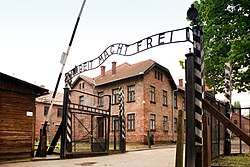
The SS establishes Auschwitz I near Oświęcim in occupied Poland, originally to hold Polish political prisoners. It would expand into the largest complex of Nazi camps, including Auschwitz II-Birkenau, where over a million people, most of them Jews, were murdered.
Jun 22, 1941
% complete
As Germany invades the Soviet Union, mobile killing units called Einsatzgruppen follow the army to systematically shoot Jews and other victims. Mass shootings such as those at Kamianets-Podilskyi and Babyn Yar killed well over a million Soviet Jews by 1943.
Image source: Einsatzgruppen
Sep 29, 1941 - Sep 30, 1941
% complete
Over two days, Einsatzgruppe C and German police murder approximately 33,771 Jews at the Babyn Yar ravine outside Kyiv, one of the largest single mass shootings of the Holocaust and a symbol of the 'Holocaust by bullets' in Eastern Europe.
Image source: Babi Yar
Dec 8, 1941
% complete
The Chelmno killing center in occupied Poland begins murdering Jews using gas vans, becoming the first facility dedicated solely to extermination. Around 150,000 people, mostly Jews from the Łódź area, were killed there before its liberation.
Image source: Chełmno extermination camp
Jan 20, 1942
% complete
Fifteen senior Nazi officials meet at Wannsee, a Berlin suburb, to coordinate the 'Final Solution to the Jewish Question.' Chaired by Reinhard Heydrich, the meeting formalized plans to deport and murder the Jews of Europe in extermination camps.
Image source: Wannsee Conference
Mar 1942
% complete
Auschwitz II-Birkenau begins functioning as a major killing center, using Zyklon B in purpose-built gas chambers. By 1944 it had become the site where approximately 1.1 million people, including nearly a million Jews deported from across Europe, were murdered.
Image source: Auschwitz concentration camp
Mar 17, 1942
% complete
Belzec, part of Operation Reinhard, starts killing Jews from Lublin and Galicia with exhaust fumes in gas chambers. Approximately 600,000 Jews were murdered at Belzec, which operated until December 1942 as the Nazis liquidated ghettos across the region.
Image source: Belzec extermination camp
Apr 1942
% complete
Sobibor begins operations in occupied Poland as another Operation Reinhard death camp. Roughly 170,000 to 250,000 Jews were gassed there until an uprising by prisoners in October 1943 led the SS to dismantle the camp.
Image source: Sobibor extermination camp
Jul 23, 1942
% complete
Treblinka II opens northeast of Warsaw and rapidly becomes one of the deadliest Nazi camps, murdering about 900,000 Jews, primarily from the Warsaw Ghetto, between July 1942 and October 1943 when a prisoner revolt occurred.
Image source: Treblinka extermination camp
Apr 19, 1943 - May 16, 1943
% complete
Jewish fighters of the ZOB and ZZW resist the final liquidation of the Warsaw Ghetto with smuggled weapons, fighting the heavily armed SS for weeks. Though the revolt was crushed and the ghetto burned, it became the largest single act of Jewish resistance during the Holocaust.
Image source: Warsaw Ghetto Uprising
Apr 19, 1943 - May 6, 1943
% complete
British and American delegates meet in Bermuda to discuss rescue of Holocaust victims but produce no meaningful action, refusing to significantly relax immigration quotas or aid refugees. Critics called it a gesture intended to quiet public pressure rather than save lives.
Image source: Bermuda Conference
Oct 14, 1943
% complete
Prisoners led by Alexander Pechersky and Leon Feldhendler stage a revolt at Sobibor, killing several SS guards and enabling about 300 inmates to escape. Roughly 50 survived the war; the camp was closed shortly afterward, one of only two successful death camp uprisings.
Jun 1944
% complete
The Vrba–Wetzler report and related escapee testimony, compiled as the Auschwitz Protocols, provide detailed evidence of mass murder at Auschwitz. Their publication helped prompt international appeals to Hungary to halt deportations, contributing to the suspension of transports in July 1944.
Image source: Auschwitz Protocols
Jan 1945 - May 1945
% complete
As Soviet forces advance, the SS evacuates prisoners westward on foot in brutal death marches. Thousands die from exposure, starvation, exhaustion, or are shot along the routes, as the Nazis attempt to prevent prisoners from being liberated.
Image source: Death marches during the Holocaust
Jan 27, 1945
% complete
Red Army soldiers liberate Auschwitz-Birkenau, finding around 7,000 surviving prisoners and evidence of industrial-scale murder. January 27 is now observed internationally as Holocaust Remembrance Day, honoring victims and survivors of the genocide.
Image source: Liberation of Auschwitz concentration camp
Apr 11, 1945 - Apr 15, 1945
% complete
American troops liberate Buchenwald on April 11, and British forces enter Bergen-Belsen on April 15, discovering tens of thousands of starving prisoners and unburied corpses. The shocking scenes documented by Allied photographers revealed the full horror of the camp system to the world.
Image source: Bergen-Belsen concentration camp
May 5, 1945
% complete
American forces liberate Mauthausen in Austria, one of the last major camps to be freed. Its network had imprisoned and worked to death over 190,000 people, including many political prisoners, and its liberation came just days before Germany surrendered.
Image source: Mauthausen concentration camp
May 8, 1945
% complete
Nazi Germany surrenders unconditionally to the Allies, ending World War II in Europe. In the aftermath, Allied forces care for tens of thousands of displaced survivors in DP camps while documenting the atrocities committed across the continent.
Image source: Victory in Europe Day
Nov 20, 1945 - Oct 1, 1946
% complete
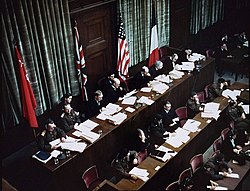
Allied prosecutors try leading Nazi officials at Nuremberg for crimes including crimes against humanity. The trials exposed the scale and machinery of the Holocaust to the world, established legal accountability for genocide, and laid foundations for modern international law.
Image source: Nuremberg trials
Or browse the full history timeline directory, with more than 2,000 topics.
This Holocaust timeline was generated with the help of AI, using information found on the internet.
We work hard to keep these timelines accurate, but mistakes do get through. If you spot one, email us at [email protected] and we'll fix it for future visitors.
Generate yours with AI or build it from scratch, for free.
Export your timeline, add your own events, edit or remove AI-generated events, and much more
No credit card required.
Cancel anytime.
Cancel anytime.
You can create an unlimited number of timelines with up to 10 events on each one, customize how they look, export them to PDF, PNG, PowerPoint, CSV, and Excel, and share them with a link. Paid plans raise the event limit and add features like spreadsheet imports and collaborators.
Yes. You can cancel your subscription from your account page at any time, and you will not be charged again. Your subscription stays active for the rest of the period you already paid for.
Yes. We will email you a reminder before the annual renewal, and we will also email you a receipt.
Yes. You can email us within 15 days of any payment, and we will issue you a full refund.
Check out our pricing docs or send us an email anytime: [email protected].