-
Use Cases
-
Resources
-
Pricing
Anne Frank was a German-born Jewish girl who, along with her family, hid from Nazi persecution in Amsterdam during World War II. While in hiding for two years, she kept a diary documenting her thoughts, fears, and hopes. After her arrest and death in a concentration camp, her diary was published and became one of the world's most widely read books, offering a powerful personal account of the Holocaust. More Less
Jun 12, 1929
% complete
Annelies Marie Frank was born on June 12, 1929, in Frankfurt am Main, Germany, to Otto and Edith Frank. She had an older sister, Margot. The family lived in a middle-class Jewish neighborhood, and Anne spent her earliest years in Germany before the rise of Nazism forced the family to reconsider their future.
Image source: Anne Frank
Jan 30, 1933
% complete
Adolf Hitler was appointed Chancellor of Germany on January 30, 1933. The Nazi regime quickly began implementing antisemitic policies that made life increasingly dangerous for Jewish families like the Franks. That same year, anti-Jewish boycotts and discriminatory laws were introduced across Germany.
Image source: Adolf Hitler's rise to power
Feb 1934
% complete
Fearing persecution under the Nazi regime, Otto Frank moved his family to Amsterdam in the Netherlands in late 1933 and early 1934. He established a business selling pectin, and Anne enrolled in a Montessori school, where she proved to be a lively and outgoing student.
Image source: Otto Frank
1940 - 1941
% complete
Under German occupation, Jews in the Netherlands faced escalating restrictions: they were required to register, wear a yellow Star of David, could not attend schools with non-Jews, and were barred from public places and many professions. Anne was forced to leave her Montessori school and attend a Jewish-only school.
Image source: The Holocaust in the Netherlands
May 10, 1940
% complete
On May 10, 1940, German forces invaded the Netherlands. The Dutch army surrendered after five days of fighting, and the country came under German occupation. This dramatically changed life for Jews in the Netherlands, as antisemitic measures were soon imposed.
Image source: German invasion of the Netherlands
Jun 12, 1942
% complete
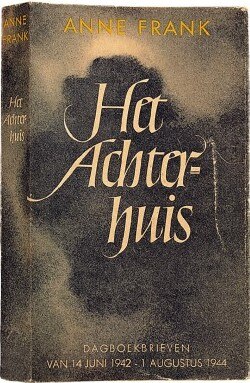
For her thirteenth birthday on June 12, 1942, Anne received a red-and-white checkered autograph book that she chose herself from a shop. She began writing in it almost immediately, addressing her entries to an imaginary friend named 'Kitty.' It would become one of the most famous documents of the twentieth century.
Image source: The Diary of a Young Girl
Jul 5, 1942
% complete
On July 5, 1942, Margot Frank received a summons to report to a forced labor camp in Germany. This prompted the family to move up their plans to go into hiding. They would disappear the very next day rather than comply with the order.
Image source: Margot Frank
Jul 6, 1942
% complete
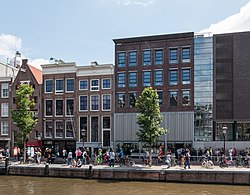
On July 6, 1942, the Frank family went into hiding in concealed rooms behind Otto Frank's office building at Prinsengracht 263 in Amsterdam, known as the Secret Annex. They were helped by trusted employees including Miep Gies, Johannes Kleiman, Victor Kugler, and Bep Voskuijl.
Image source: Anne Frank House
Jul 13, 1942
% complete
A week after the Franks went into hiding, Hermann, Auguste, and Peter van Pels joined them in the Secret Annex. Anne's diary describes the tensions and close quarters of sharing the small space with another family.
Nov 16, 1942
% complete
Dentist Fritz Pfeffer became the eighth resident of the Secret Annex in November 1942. Anne had to share her small bedroom with him, which she found difficult, and their conflicts feature prominently in her diary entries.
Image source: Fritz Pfeffer
Mar 28, 1944
% complete
In March 1944, Dutch minister Gerrit Bolkestein said in a Radio Oranje broadcast that after the war, diaries and letters documenting the suffering of the Dutch people should be collected and published. Inspired, Anne began rewriting her diary with publication in mind, editing it into a novel-like manuscript she titled 'Het Achterhuis' (The Secret Annex).
Aug 1, 1944
% complete
Anne's last diary entry was written on August 1, 1944, just three days before the residents of the Secret Annex were discovered. In it, she reflected on her dual nature — her cheerful exterior and her deeper, more serious inner self.
Aug 4, 1944
% complete
On August 4, 1944, the Secret Annex was raided following a tip-off from an informer whose identity remains uncertain. The eight residents were arrested by officers of the Sicherheitsdienst led by Karl Silberbauer, and after two days at a detention center, they were transferred to Westerbork transit camp.
Aug 4, 1944
% complete
After the arrest, helpers Miep Gies and Bep Voskuijl found Anne's diary papers scattered on the floor of the annex. Miep kept them safely in her desk drawer, hoping to return them to Anne after the war. She never read them while they were hidden.
Image source: Miep Gies
Aug 8, 1944
% complete
The eight residents of the Secret Annex were sent to Westerbork, a transit camp in the northeastern Netherlands. Because they had gone into hiding, they were treated as criminals and assigned to hard labor in the camp's punishment barracks.
Image source: Westerbork transit camp
Sep 3, 1944
% complete
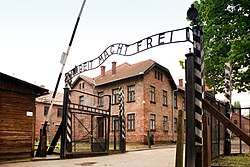
On September 3, 1944, the Franks were placed on the last transport from Westerbork to Auschwitz-Birkenau in occupied Poland. After a three-day journey in crowded cattle cars, they arrived on September 6. Men and women were separated upon arrival, and Otto Frank never saw his family again.
Image source: Auschwitz concentration camp
Sep 6, 1944
% complete
Upon arrival at Auschwitz-Birkenau, Anne, Margot, and Edith survived the selection process and were assigned to forced labor. Conditions were brutal, with starvation rations, disease, and constant terror. Edith was later separated from her daughters and died in Auschwitz in January 1945.
Oct 30, 1944
% complete
In late October 1944, Anne and Margot were transported to Bergen-Belsen concentration camp in northern Germany as Auschwitz began evacuating prisoners. Their mother remained behind and died shortly before the camp's liberation. At Bergen-Belsen, conditions were catastrophic, with rampant typhus and starvation.
Image source: Bergen-Belsen concentration camp
Feb 1945 - Mar 1945
% complete
Anne and Margot both contracted typhus in early 1945. Margot died first, and Anne died shortly afterward, likely in February or March 1945, only weeks before British troops liberated Bergen-Belsen on April 15, 1945. Anne was fifteen years old.
Apr 15, 1945
% complete
British troops liberated Bergen-Belsen on April 15, 1945, finding thousands of dead and dying prisoners. Anne had died just weeks earlier; had she survived a little longer, she might have been freed along with the other survivors.
2003 - 2022
% complete
Multiple investigations have attempted to identify who betrayed the residents of the Secret Annex. A major study published by the Anne Frank House in 2022 suggested the raid may have been triggered accidentally during an investigation into ration coupon fraud, though the question remains unresolved.
Jun 1945
% complete
Otto Frank, who survived Auschwitz, returned to Amsterdam after the war. By mid-1945 he learned that his wife and daughters had not survived. Miep Gies gave him Anne's diary papers, which she had saved since the arrest. Reading them, he was deeply moved by his daughter's writing.
Jun 25, 1947
% complete
After being rejected by several publishers, Anne's edited diary was published in the Netherlands on June 25, 1947, under the title 'Het Achterhuis' (The Secret Annex). It quickly sold out its first printing and was soon translated into numerous languages, becoming one of the world's most widely read books.
1952
% complete
The English edition, titled 'Anne Frank: The Diary of a Young Girl,' appeared in 1952 with an introduction by Eleanor Roosevelt. It became a bestseller in America and Britain, bringing Anne's story to millions of readers worldwide.
Oct 5, 1955
% complete
'The Diary of Anne Frank,' a play by Frances Goodrich and Albert Hackett, opened on Broadway in October 1955 and won the Pulitzer Prize for Drama in 1956. The production brought Anne's story to international audiences and was later adapted into a 1959 film.
1960 - 1980
% complete
Until his death in 1980, Otto Frank devoted himself to preserving Anne's legacy, responding to thousands of letters, giving interviews, and speaking out against antisemitism and denial of the Holocaust. He remarried in 1953 and lived in Switzerland until his death.
May 3, 1960
% complete
The building at Prinsengracht 263, saved from demolition through public fundraising, opened as a museum on May 3, 1960. The Anne Frank House preserves the Secret Annex and has become one of Amsterdam's most visited museums, welcoming over a million visitors annually.
1986
% complete
In 1986, the Netherlands State Institute for War Documentation published the 'Critical Edition,' containing Anne's original diary text, her own revised version, and the published edition, along with extensive historical analysis confirming the document's authenticity.
1995
% complete
In 1995, a new 'Definitive Edition' of the diary was published, restoring passages about Anne's developing sexuality and her strained relationship with her mother that Otto Frank had originally omitted. This fuller version deepened readers' understanding of Anne as a complex adolescent writer.
2009
% complete
In 2009, Anne Frank's original diaries and manuscripts held at the Netherlands Institute for War Documentation were inscribed in UNESCO's Memory of the World Register, recognizing their outstanding universal value as a testament to human resilience and a warning against hatred.
Image source: Memory of the World Programme
Or browse the full history timeline directory, with more than 2,000 topics.
This Anne Frank timeline was generated with the help of AI, using information found on the internet.
We work hard to keep these timelines accurate, but mistakes do get through. If you spot one, email us at [email protected] and we'll fix it for future visitors.
Generate yours with AI or build it from scratch, for free.
Export your timeline, add your own events, edit or remove AI-generated events, and much more
No credit card required.
Cancel anytime.
Cancel anytime.
You can create an unlimited number of timelines with up to 10 events on each one, customize how they look, export them to PDF, PNG, PowerPoint, CSV, and Excel, and share them with a link. Paid plans raise the event limit and add features like spreadsheet imports and collaborators.
Yes. You can cancel your subscription from your account page at any time, and you will not be charged again. Your subscription stays active for the rest of the period you already paid for.
Yes. We will email you a reminder before the annual renewal, and we will also email you a receipt.
Yes. You can email us within 15 days of any payment, and we will issue you a full refund.
Check out our pricing docs or send us an email anytime: [email protected].