
-
Use Cases
-
Resources
-
Pricing
Judaism is one of the world's oldest monotheistic religions, originating in the ancient Near East over 3,000 years ago. Rooted in the covenant between God and Abraham and centered on the Torah, Judaism has evolved through key periods including the era of the First and Second Temples, the Babylonian Exile, rabbinic development after the destruction of Jerusalem in 70 CE, the medieval flourishing of Jewish communities across Europe and the Islamic world, and the modern establishment of Israel. Its traditions, laws, and texts have profoundly shaped Western civilization. More Less
300 BC - 299 BC
% complete
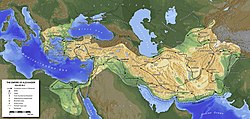
Hellenistic Judaism spread to Ptolemaic Egypt from the 3rd century BCE, sparking widespread controversy in Jewish communities and starting conflicts about accommodating the cultures of occupying powers.
Image source: Hellenistic Judaism
200 BC - 199 BC
% complete
The term Ioudaismos first appears in the Koine Greek book of 2 Maccabees in the 2nd century BCE, specifically in 2 Maccabees 2:21, 8:1 and 14:38.
Image source: Judaism
1 CE - 99 CE
% complete
Around the 1st century CE, there were several small Jewish sects: the Pharisees, Sadducees, Zealots, Essenes, and Christians.
Image source: Second Temple Judaism
1 CE - 99 CE
% complete
Christianity was originally a sect of Second Temple Judaism, but the two religions diverged in the first century.
Image source: Christianity and Judaism
66 CE - 73 CE
% complete
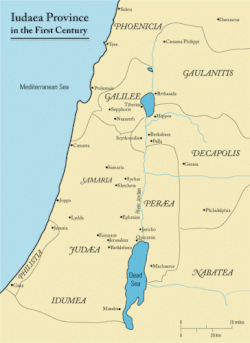
During the First Jewish–Roman War (66–73 CE), the Romans sacked Jerusalem and destroyed the Second Temple.
Image source: First Jewish–Roman War
189 CE
% complete
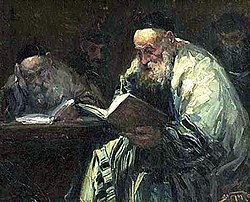
According to Abraham ben David, the Mishnah was compiled by Rabbi Judah haNasi after the destruction of Jerusalem, in anno mundi 3949, which corresponds to 189 CE.
Image source: Mishnah
200 CE
% complete
In 200 CE, Jews were granted Roman citizenship and Judaism was recognized as a religio licita ('licit religion' or 'legitimate religion') until the rise of Gnosticism and early Christianity in the fourth century.
Image source: History of the Jews in the Roman Empire
300 - 399
% complete
The Talmud is a compilation of the Mishnah and Gemara, rabbinic commentaries redacted over three centuries. The Jerusalem Talmud was compiled sometime during the 4th century in Palestine.
300 - 399
% complete
In the fourth century, the ruling class of the Himyarite Kingdom of pre-Islamic South Arabia converted to Judaism.
Image source: Himyar
500 - 599
% complete
Rabbinic Judaism has been the mainstream form of Judaism since the 6th century CE, after the codification of the Talmud.
Image source: Rabbinic Judaism
600 - 699
% complete
Adherents of Judaism and Islam have interacted with each other since the 7th century, when Islam originated and spread in the Arabian Peninsula.
Image source: Islamic–Jewish relations
700 - 899
% complete
Like the Sadducees who relied only on the Torah, some Jews in the 8th and 9th centuries rejected the authority and divine inspiration of the oral law as recorded in the Mishnah, relying instead only upon the Tanakh.
Image source: Karaite Judaism
712 - 1066
% complete
The period under the Umayyad and Abbasid caliphates between 712 and 1066 has been called the Golden age of Jewish culture in Spain.
Image source: Golden age of Jewish culture in Spain
1290
% complete
Some countries completely expelled Jews—for example, the English Edict of Expulsion in 1290. Jews were readmitted to England in 1655.
Image source: Edict of Expulsion
1400 - 1499
% complete
At times, Jews were restricted in their choice of residence—in Morocco, for example, Jews were confined to walled quarters (mellahs) beginning in the 15th century and increasingly since the early 19th century.
Image source: Mellah
1492
% complete
Spain expelled its Jews in 1492; they were readmitted in 1868.
1516
% complete
According to the Oxford English Dictionary, the earliest citation of the term 'Judaism' in English was in Robert Fabyan's 1516 book The New Chronicles of England and France, describing it as the profession or practice of the Jewish religion.
Image source: Robert Fabyan
1600 - 1699
% complete
Jews in Muslim countries were not entirely free from persecution—many were killed, exiled or forcibly converted by the Zaydi imams of Yemen in the 17th century (see Mawza Exile).
Image source: Mawza Exile
1654
% complete
The first Jewish settlers in North America arrived in the Dutch colony of New Amsterdam in 1654; they were forbidden to hold public office, open a retail shop, or establish a synagogue.
1671
% complete
When the colony was seized by the British in 1664, Jewish rights remained unchanged; by 1671, Asser Levy was the first Jew to serve on a jury in North America.
Image source: Asser Levy
1700 - 1760
% complete
Hasidic Judaism was founded by Yisroel ben Eliezer (1700–1760), also known as the Ba'al Shem Tov (or Besht).
Image source: Hasidic Judaism
1700 - 1999
% complete
Subbotniks (Sabbatarians) are a movement of Jews of Russian ethnic origin in the 18th–20th centuries, the majority of whom belonged to Rabbinic and Karaite Judaism.
Image source: Subbotniks
1775 - 1799
% complete
In the late 18th century CE, Europe was swept by a group of intellectual, social and political movements known as the Enlightenment, leading to major changes in Jewish life and thought.
Image source: Age of Enlightenment
1775 - 1899
% complete
Since the anti-religious Haskalah movement of the late 18th and 19th centuries, halakhic interpretations of Jewish identity have been challenged.
Image source: Haskalah
1791
% complete
In 1791, Revolutionary France was the first country to abolish disabilities altogether, followed by Prussia in 1848.
Image source: Jewish emancipation
1858
% complete
Emancipation of the Jews in the United Kingdom was achieved in 1858 after an almost 30-year struggle championed by Isaac Lyon Goldsmid, with Jews given the right to sit in parliament with the passing of the Jews Relief Act 1858.
Image source: Jews Relief Act 1858
1871
% complete
The newly created German Empire in 1871 abolished Jewish disabilities in Germany, which were reinstated in the Nuremberg Laws in 1935.
1900
% complete
According to the Jewish Year Book (1901), the global Jewish population in 1900 was around 11 million.
Image source: Jewish population by country
2001
% complete
According to the 2001 edition of the National Jewish Population Survey, in the United States' Jewish community—the world's second largest—4.3 million Jews out of 5.1 million had some sort of connection to the religion.
Image source: National Jewish Population Survey
2002
% complete
In 2002, according to the World Jewish Population Survey, there were 13.3 million Jews around the world. Jewish population growth is currently near zero percent, with 0.3% growth from 2000 to 2001.
2020
% complete
According to Pew Research Center (2020), about 85% of the global Jewish population of 14,780,000 is concentrated in Israel and the United States, the only nations with Jewish populations exceeding one million.
2022
% complete
In 2022, the world Jewish population was estimated at 15.2 million, with the majority living in one of two countries: Israel and the United States.
2025
% complete
In 2025, the world Jewish population was estimated at 14.8 million, although religious observance varies from strict to non-existent.
1935
% complete
The Jewish disabilities abolished by the German Empire in 1871 were reinstated in the Nuremberg Laws in 1935 under Nazi rule.
Image source: Nuremberg Laws
2008
% complete
In 2008, Israel's highest religious court invalidated the conversion of 40,000 Jews, mostly from Russian immigrant families, even though they had been approved by an Orthodox rabbi.
Dec 2015
% complete
In December 2015, the Vatican released a 10,000-word document that, among other things, stated that Catholics should work with Jews to fight antisemitism.
Or browse the full history timeline directory, with more than 2,000 topics.
This Judaism timeline was generated with the help of AI, using information found on the internet.
We work hard to keep these timelines accurate, but mistakes do get through. If you spot one, email us at [email protected] and we'll fix it for future visitors.
Generate yours with AI or build it from scratch, for free.

Export your timeline, add your own events, edit or remove AI-generated events, and much more
No credit card required.
Cancel anytime.
Cancel anytime.
You can create an unlimited number of timelines with up to 10 events on each one, customize how they look, export them to PDF, PNG, PowerPoint, CSV, and Excel, and share them with a link. Paid plans raise the event limit and add features like spreadsheet imports and collaborators.
Yes. You can cancel your subscription from your account page at any time, and you will not be charged again. Your subscription stays active for the rest of the period you already paid for.
Yes. We will email you a reminder before the annual renewal, and we will also email you a receipt.
Yes. You can email us within 15 days of any payment, and we will issue you a full refund.
Check out our pricing docs or send us an email anytime: [email protected].