-
Use Cases
-
Resources
-
Pricing
Islam is a monotheistic religion founded in the early 7th century CE by the Prophet Muhammad in the Arabian Peninsula. This timeline traces its key milestones, including the revelation of the Quran, the rapid expansion of the caliphates, the flourishing of Islamic civilization, and Islam's development into one of the world's major religions with nearly two billion followers today. More Less
300 - 399
% complete
Christian 4th-century theologian Augustine of Hippo's doctrines led to the broad repudiation of bodily pleasure in both life and the afterlife, shaping Christian thought that later Muslim scholars would engage with in interreligious debates.
Image source: Augustine of Hippo
800 - 899
% complete
In the 9th century, Al-Tabari completed the first commentary of the Quran, the Tafsir al-Tabari, which became one of the most cited commentaries in Sunni Islam.
Image source: Tafsir al-Tabari
800 - 899
% complete
Ninth-century Muslim scholar Ali ibn Sahl Rabban al-Tabari defended the Quranic description of paradise by asserting that the Bible also implies such ideas, such as drinking wine in heaven in the Gospel of Matthew.
900 - 1099
% complete
Avicenna was a pioneer in experimental medicine, and his The Canon of Medicine was used as a standard medicinal text in the Islamic world and Europe for centuries.
Image source: Avicenna
1201 - 1274
% complete
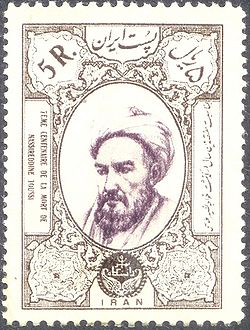
Nasir al-Din al-Tusi (1201–1274) proposed the mathematical model that was later argued to be adopted by Copernicus unrevised in his heliocentric model.
Image source: Nasir al-Din al-Tusi
1300 - 1399
% complete
Defamatory images of Muhammad, derived from early 7th-century depictions of the Byzantine Church, appear in the 14th-century epic poem Divine Comedy by Dante Alighieri.
Image source: Divine Comedy
1300 - 1499
% complete
Jamshīd al-Kāshī's estimate of pi would not be surpassed for 180 years, demonstrating the advanced state of Islamic mathematics.
Image source: Jamshid al-Kashi
900 - 999
% complete
One Isma'ili group, the Fatimid dynasty, took control of North Africa in the 10th century, establishing a powerful Shi'a caliphate that would rival the Sunni Abbasids.
Image source: Fatimid Caliphate

900 - 999
% complete
Another Isma'ili group, the Qarmatians, sacked Mecca and stole the Black Stone, a rock placed within the Kaaba, in their unsuccessful rebellion.
Image source: Qarmatians
945 - 1055
% complete
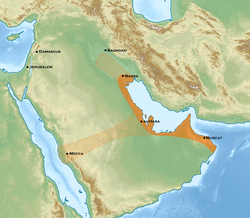
In this fragmentation came the Shi'a Century, roughly between 945 and 1055, which saw the rise of the millennialist Isma'ili Shi'a missionary movement.
Image source: Shi'a Century
1400 - 1499
% complete
Earlier, in the 15th century, the Reconquista succeeded in ending the Muslim presence in Iberia after centuries of Muslim rule on the peninsula.
Image source: Reconquista
1501
% complete
The Shia Safavid dynasty rose to power in 1501 and later conquered all of Iran, establishing Twelver Shi'ism as the state religion.
Image source: Safavid dynasty
1517
% complete
The caliphate was claimed by the Ottoman dynasty of the Ottoman Empire and its claims were strengthened in 1517 as Selim I became the ruler of Mecca and Medina.
Image source: Selim I
1100 - 1199
% complete
Yazdânism is seen as a blend of local Kurdish beliefs and Islamic Sufi doctrine introduced to Kurdistan by Sheikh Adi ibn Musafir in the 12th century.
1300 - 1399
% complete
Alevism is a blend of traditional 14th-century Turkish beliefs, with possible syncretist origins in Shamanism and Animism alongside Shia and Sufi beliefs.
Image source: Alevism
1300 - 1399
% complete
Earlier in the 14th century, Ibn Taymiyya promoted a puritanical form of Islam, rejecting philosophical approaches in favor of simpler theology, and called to open the gates of itjihad rather than blind imitation of scholars.
Image source: Ibn Taymiyya
1400 - 1499
% complete
Sikhism, founded by Guru Nanak in Punjab in the late 15th century, was influenced by Islam.
Image source: Sikhism
1700 - 1799
% complete
During the 18th century in Arabia, Muhammad ibn 'Abd al-Wahhab, influenced by the works of Ibn Taymiyya and Ibn al-Qayyim, founded a movement called Wahhabi to return to what he saw as unadulterated Islam.
Image source: Wahhabism
1700 - 1799
% complete
In the 18th century, Muhammad ibn Abd al-Wahhab led a Salafi movement, referred to by outsiders as Wahhabism, in modern-day Saudi Arabia.
Image source: Muhammad ibn Abd al-Wahhab
1800 - 1899
% complete
Ma Wanfu and Ma Debao promoted salafist movements in the 19th century such as Sailaifengye in China after returning from Mecca but were eventually persecuted and forced into hiding by Sufi groups.
Image source: Ma Wanfu
1877 - 1960
% complete
The Nurcu Sunni movement was initiated by Said Nursi (1877–1960); it incorporates elements of Sufism and science.
Image source: Nurism
1889
% complete
The Ahmadiyya Movement was founded in British India in 1889 by Mirza Ghulam Ahmad of Qadian, who claimed to be the promised Messiah, the Mahdi awaited by Muslims, and a subordinate prophet to Muhammad.
Image source: Ahmadiyya
1975 - 1999
% complete
A prominent late 20th century Quranist was Rashad Khalifa, an Egyptian-American biochemist who claimed to have discovered a numerological code in the Quran, and founded the Quranist organization United Submitters International.
Image source: Rashad Khalifa
1800 - 1899
% complete
The Ottoman Empire's 19th-century Tanzimat reforms led to the Mecelle civil code and represented the first attempt to codify sharia.
Image source: Mecelle
1800 - 1899
% complete
By the 19th century, the British East India Company had formally annexed the Mughal dynasty in India, ending Muslim imperial rule over much of the subcontinent.
Image source: Mughal Empire
1869
% complete
Similar to contemporary codification, sharia was for the first time partially codified into law in 1869 in the Ottoman Empire's Mecelle code.
1900 - 1999
% complete
In opposition to Islamic political movements, in 20th-century Turkey, the military carried out coups to oust Islamist governments, and headscarves were legally restricted, as also happened in Tunisia.
Image source: Secularism in Turkey
1924
% complete
The Ottoman Empire dissolved after World War I, the Ottoman Caliphate was abolished in 1924 and the subsequent Sharifian Caliphate fell quickly, thus leaving Islam without a Caliph.
Image source: Abolition of the Ottoman sultanate
1969
% complete
The Organisation of Islamic Cooperation (OIC), consisting of Muslim-majority countries, was established in 1969 after the burning of the Al-Aqsa Mosque in Jerusalem.
Image source: Organisation of Islamic Cooperation
1975 - 1999
% complete
The Islamic revival of the late 20th century brought along calls by Islamist movements for complete implementation of sharia.
Image source: Islamic revival
1869 - 1914
% complete
The resulting urbanization and increase in trade in sub-Saharan Africa brought Muslims to settle in new areas and spread their faith, likely doubling its Muslim population between 1869 and 1914.
Image source: Islam in Africa
1900 - 2050
% complete
In 1900, Muslims were estimated at 12.3% of the global population, in 1990 it was 19.9%, and projections suggest the proportion will be 29.7% by 2050.
Image source: Islamic world
2000 - 2099
% complete
By both percentage and total numbers, Islam is the world's fastest growing major religious group, and is projected to be the world's largest by the end of the 21st century, surpassing that of Christianity.
Image source: Islam
2005 - 2016
% complete
Islam in Europe is the second-largest religion after Christianity in many countries, with growth rates due primarily to immigration and higher birth rates of Muslims in 2005, accounting for 4.9% of all of Europe's population in 2016.
Image source: Islam in Europe
2010 - 2050
% complete
According to the Pew Research Center, conversion to Islam has no major net impact on Muslim population growth, though Islam is expected to experience a modest gain of 3 million through conversion between 2010 and 2050, mostly from Sub-Saharan Africa (2.9 million).
Image source: Conversion to Islam
2020
% complete
As of 2020, about 25.6% of the global population, or about 2 billion people, are Muslims.
2020
% complete
A Pew study from 2020 found that the global Muslim population was the fastest-growing religious group over the decade, mainly because Muslims tend to be younger on average and have higher birth rates—two key factors driving natural population growth.
Image source: Growth of religion
2020
% complete
According to the 2020 population estimate, 65% of the Muslim population is concentrated in ten countries, with the largest populations residing in Indonesia, Pakistan, India, Bangladesh, Nigeria, Egypt, Iran, Turkey, Sudan, and Algeria, in descending order.
2020
% complete
According to a 2020 Pew study, about 1% of adults raised Muslim leave the faith, while an equal proportion —about 1%— convert to Islam from other religions, resulting in low levels of religious switching both into and out of Islam.
Or browse the full history timeline directory, with more than 2,000 topics.
This Islam timeline was generated with the help of AI, using information found on the internet.
We work hard to keep these timelines accurate, but mistakes do get through. If you spot one, email us at [email protected] and we'll fix it for future visitors.
Generate yours with AI or build it from scratch, for free.
Export your timeline, add your own events, edit or remove AI-generated events, and much more
No credit card required.
Cancel anytime.
Cancel anytime.
You can create an unlimited number of timelines with up to 10 events on each one, customize how they look, export them to PDF, PNG, PowerPoint, CSV, and Excel, and share them with a link. Paid plans raise the event limit and add features like spreadsheet imports and collaborators.
Yes. You can cancel your subscription from your account page at any time, and you will not be charged again. Your subscription stays active for the rest of the period you already paid for.
Yes. We will email you a reminder before the annual renewal, and we will also email you a receipt.
Yes. You can email us within 15 days of any payment, and we will issue you a full refund.
Check out our pricing docs or send us an email anytime: [email protected].