-
Use Cases
-
Resources
-
Pricing
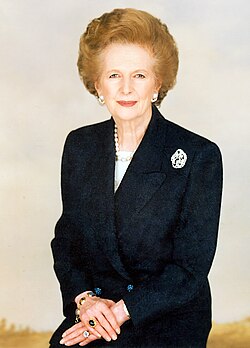
Margaret Thatcher (1925–2013) was a British stateswoman who served as Prime Minister of the United Kingdom from 1979 to 1990. Known as the 'Iron Lady,' she was the first woman to hold the office and led the Conservative Party through three consecutive election victories. Her tenure was marked by economic deregulation, privatization of state-owned industries, the Falklands War, and a confrontational approach to trade unions. More Less
Oct 13, 1925
% complete
Margaret Hilda Roberts was born in Grantham, Lincolnshire, the daughter of Alfred Roberts, a grocer and local alderman, and Beatrice Roberts. Her father's civic involvement and thrifty household values deeply influenced her later political philosophy.
Image source: Margaret Thatcher
1943 - 1947
% complete
Thatcher studied chemistry at Somerville College, Oxford, graduating with a second-class degree in 1947. She became president of the Oxford University Conservative Association, an early sign of her political ambitions.
Image source: Somerville College, Oxford
1947 - 1951
% complete
After university, Thatcher worked as a research chemist in Colchester and later at J. Lyons and Co., where she helped develop methods for preserving ice cream. Her scientific background shaped her pragmatic approach to policy.
Dec 13, 1951
% complete
Margaret Roberts married wealthy businessman Denis Thatcher, who provided financial security and steadfast support for her political career. They had twin children, Mark and Carol, in 1953.
Image source: Denis Thatcher
1953
% complete
Thatcher qualified as a barrister after studying law, specializing in taxation. This legal expertise proved useful throughout her political career, particularly in finance-related ministerial roles.
Image source: City Law School
Feb 23, 1950
% complete
Standing as the Conservative candidate in the safe Labour seat of Dartford, Thatcher lost but attracted attention as the youngest female candidate in the country. She contested the seat again in 1951 before seeking a winnable constituency.
Image source: Dartford (constituency)
Oct 8, 1959
% complete
Thatcher won the north London seat of Finchley, entering the House of Commons at age 33. She would hold the seat for over three decades, using it as her platform for national politics.
Image source: Finchley and Golders Green
1961 - 1964
% complete
Under Harold Macmillan, Thatcher gained her first government post, serving as joint parliamentary secretary at the Ministry of Pensions and National Insurance, gaining experience with welfare administration.
Image source: Ministry of Pensions and National Insurance
Jun 20, 1970 - Mar 4, 1974
% complete
As Secretary of State for Education and Science, Thatcher oversaw education policy during the Heath government. Controversially dubbed the 'milk snatcher,' she ended free school milk for older primary pupils to cut spending.
Image source: Secretary of State for Education
Feb 11, 1975
% complete
Thatcher defeated incumbent Edward Heath in the party leadership election, becoming the first woman to lead a major British political party. Her victory marked a decisive shift toward free-market conservatism.
Image source: 1975 Conservative Party leadership election
Jan 19, 1976
% complete
In a hard-hitting speech on defense policy, Thatcher warned against Soviet military expansion and the dangers of unilateral disarmament, establishing her reputation as a staunch Cold War hawk.
Image source: Britain Awake
Jan 24, 1976
% complete
The Soviet newspaper Red Star branded Thatcher the 'Iron Lady' for her anti-Soviet rhetoric. She embraced the nickname, which became her enduring global identity and symbol of resolute leadership.
Image source: Margaret Thatcher
1979 - 1990
% complete
Thatcher's governments privatized major state-owned industries including British Telecom, British Gas, and British Airways. Share-owning was extended to millions of ordinary Britons through popular share flotations.
Image source: United Kingdom
May 4, 1979
% complete
Following the Winter of Discontent, Thatcher led Conservatives to victory over James Callaghan's Labour government, becoming the first woman to serve as Prime Minister of the United Kingdom amid economic crisis and industrial unrest.
Image source: 1979 United Kingdom general election
1980 - 1982
% complete
A series of employment laws curtailed union powers, ending closed shops, restricting secondary picketing, and requiring secret ballots for strikes. These reforms dramatically reduced strike activity and union influence.
Image source: Trade union
Jan 3, 1980
% complete
The Housing Act gave millions of council tenants the right to buy their homes at discounted prices, transforming Britain's housing landscape and creating a new generation of property owners aligned with Thatcher's property-owning democracy.
Image source: Housing Act 1980
Apr 10, 1981 - Apr 12, 1981
% complete
Riots erupted in Brixton and other English cities amid unemployment, racial tensions, and police-community friction. The unrest challenged the government's inner-city policies despite its broader electoral resilience.
Image source: 1981 Brixton riot
Apr 2, 1982
% complete
Argentine forces seized the British overseas territory, triggering a crisis that threatened Thatcher's premiership. She responded by dispatching a naval task force 8,000 miles to retake the islands.
Image source: 1982 invasion of the Falkland Islands
Jun 14, 1982
% complete
Argentina surrendered after a brief but intense conflict costing over 900 lives, including 255 British. The victory transformed Thatcher's public standing and secured landslide re-election the following year.
Image source: Falklands War
Jun 9, 1983
% complete
Buoyed by Falklands triumph and a divided Labour Party, Thatcher won a landslide with 397 seats, giving her a commanding mandate to continue radical economic reforms.
Image source: 1983 United Kingdom general election
Oct 12, 1984
% complete
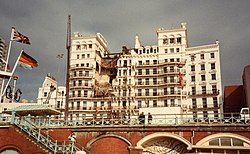
The Provisional IRA bombed the Grand Hotel during the Conservative Party Conference, killing five people. Thatcher narrowly escaped injury and defiantly delivered her conference speech on schedule the next morning.
Image source: Brighton hotel bombing
Dec 19, 1984
% complete
Thatcher's government agreed with China to transfer Hong Kong sovereignty in 1997 under 'one country, two systems.' Negotiations followed her earlier visit to Beijing where she signed preliminary accords in 1982.
Image source: Sino-British Joint Declaration
Mar 3, 1985
% complete
After nearly a year of bitter strikes led by Arthur Scargill, the National Union of Mineworkers returned to work without a settlement. The government's victory broke organized labor's political power and enabled pit closures.
Image source: 1984–1985 United Kingdom miners' strike
Nov 15, 1985
% complete
Thatcher and Irish Taoiseach Garret FitzGerald signed an agreement giving the Republic of Ireland a consultative role in Northern Ireland affairs, a landmark step in cross-border cooperation despite fierce Unionist opposition.
Image source: Anglo-Irish Agreement
Oct 27, 1986
% complete
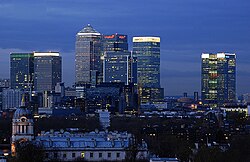
Radical deregulation of the London Stock Exchange abolished fixed commissions and opened the City to foreign banks, cementing London's status as a leading global financial center.
Image source: Big Bang (financial markets)
Jun 11, 1987
% complete
Thatcher secured a third consecutive term with a reduced but comfortable majority, becoming the first Prime Minister since Lord Liverpool to win three successive elections.
Image source: 1987 United Kingdom general election
Apr 1, 1990
% complete
The Community Charge replaced domestic rates with a flat-rate levy on all adults, provoking mass protests including a violent Trafalgar Square demonstration. Its unpopularity fatally damaged Thatcher's premiership.
Image source: Poll tax (Great Britain)
Nov 22, 1990
% complete
After Michael Heseltine's challenge forced a leadership contest, Thatcher withdrew on November 22 when cabinet colleagues urged her to concede she could lose the second ballot, ending eleven and a half years in office.
Image source: 1990 Conservative Party leadership election
Nov 28, 1990
% complete
Thatcher delivered a tearful farewell outside Number 10 and advised the Queen to appoint John Major as her successor. She remained in Parliament until 1992, then entered the House of Lords as Baroness Thatcher.
1993
% complete
Thatcher published a detailed account of her premiership, defending her record and offering candid assessments of world leaders and colleagues. It became a bestseller alongside her earlier volume, 'The Path to Power.'
Image source: The Downing Street Years
Apr 8, 2013
% complete
Baroness Thatcher died of a stroke aged 87. Her death prompted tributes worldwide alongside celebrations by some opponents, reflecting the deeply divisive legacy of Britain's longest-serving twentieth-century prime minister.
Image source: Death and funeral of Margaret Thatcher
Apr 17, 2013
% complete
Thatcher's funeral service took place at St Paul's Cathedral attended by Queen Elizabeth II, dignitaries, and thousands of mourners lining the procession route, honoring one of Britain's most consequential and controversial leaders.
Or browse the full history timeline directory, with more than 2,000 topics.
This Margaret Thatcher timeline was generated with the help of AI, using information found on the internet.
We work hard to keep these timelines accurate, but mistakes do get through. If you spot one, email us at [email protected] and we'll fix it for future visitors.
Generate yours with AI or build it from scratch, for free.
Export your timeline, add your own events, edit or remove AI-generated events, and much more
No credit card required.
Cancel anytime.
Cancel anytime.
You can create an unlimited number of timelines with up to 10 events on each one, customize how they look, export them to PDF, PNG, PowerPoint, CSV, and Excel, and share them with a link. Paid plans raise the event limit and add features like spreadsheet imports and collaborators.
Yes. You can cancel your subscription from your account page at any time, and you will not be charged again. Your subscription stays active for the rest of the period you already paid for.
Yes. We will email you a reminder before the annual renewal, and we will also email you a receipt.
Yes. You can email us within 15 days of any payment, and we will issue you a full refund.
Check out our pricing docs or send us an email anytime: [email protected].