-
Use Cases
-
Resources
-
Pricing
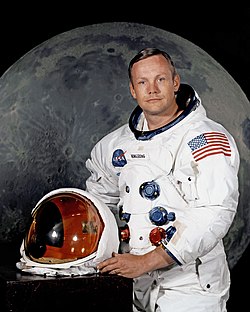
Neil Armstrong (1930–2012) was an American astronaut, naval aviator, test pilot, and aeronautical engineer who became the first person to walk on the Moon on July 20, 1969, during NASA's Apollo 11 mission. His famous words, 'That's one small step for man, one giant leap for mankind,' marked a defining moment in human history and the Space Race. More Less
Aug 5, 1930
% complete
Neil Alden Armstrong was born on August 5, 1930, near Wapakoneta, Ohio, to Stephen Koenig Armstrong and Viola Louise Engel. He was the eldest of three children, and his family moved frequently during his childhood before settling back in Wapakoneta.
Image source: Neil Armstrong
Jul 20, 1936
% complete
At age six, Armstrong experienced his first airplane flight in a Ford Trimotor, known as the Tin Goose, with his father in Warren, Ohio. This early exposure to aviation sparked a lifelong passion for flying.
Jul 1, 1946
% complete
Armstrong began taking flying lessons at the age of 15 and earned his student pilot's license on his 16th birthday in 1946, before he had even learned to drive a car. He flew solo later that same month.
Oct 1, 1947 - Jan 1, 1955
% complete
Armstrong enrolled at Purdue University in 1947 under the Holloway Plan, which required two years of study followed by naval service. He completed his bachelor of science degree in aeronautical engineering in 1955 after returning from military duty.
Image source: Purdue University
Jan 26, 1949
% complete
Armstrong was called to active duty by the U.S. Navy in January 1949. He completed flight training at Naval Air Station Pensacola and earned his wings in August 1950, becoming a naval aviator.
Aug 29, 1951 - Mar 5, 1952
% complete
Flying F9F Panther jets from the aircraft carrier USS Essex, Armstrong flew 78 combat missions over Korea. In September 1951, his aircraft was damaged by anti-aircraft fire during a low-altitude bombing run, forcing him to eject safely.
Image source: Korean War
Mar 1, 1955
% complete
After leaving the Navy, Armstrong joined the National Advisory Committee for Aeronautics (NACA), the predecessor of NASA, at its Lewis Flight Propulsion Laboratory in Cleveland, Ohio, beginning his career as an experimental research pilot.
Image source: NASA
Jul 1, 1955
% complete
Armstrong transferred to the NACA High-Speed Flight Station at Edwards Air Force Base in California, where he worked as an experimental test pilot on cutting-edge aircraft programs.
Image source: Armstrong Flight Research Center
Nov 30, 1960 - Jul 26, 1962
% complete
As a test pilot, Armstrong flew the North American X-15 rocket-powered aircraft seven times, reaching speeds of nearly Mach 5.8 and altitudes above 200,000 feet, contributing valuable data to the American space program.
Image source: North American X-15
Sep 17, 1962
% complete
Armstrong was selected as one of nine pilots in NASA's second astronaut group, known as 'The New Nine,' becoming the first civilian astronaut chosen by NASA. The group included future moonwalkers such as Buzz Aldrin and Jim Lovell.
Image source: NASA Astronaut Group 2
Aug 21, 1965 - Aug 29, 1965
% complete
Armstrong served as backup command pilot for the Gemini 5 mission alongside backup pilot Elliot See, gaining experience in mission operations while supporting Gordon Cooper and Charles Conrad's eight-day endurance flight.
Image source: Gemini 5
Mar 16, 1966 - Mar 17, 1966
% complete
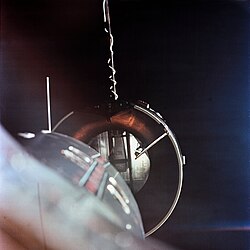
Commanding Gemini 8 with pilot David Scott, Armstrong achieved the first docking of two spacecraft in orbit when their capsule linked with an Agena target vehicle. Shortly afterward, a stuck thruster caused a dangerous spin that Armstrong corrected, demonstrating remarkable composure under pressure.
Image source: Gemini 8
May 6, 1968
% complete
While training at Ellington Air Force Base, Armstrong was forced to eject from the Lunar Landing Research Vehicle just seconds before it crashed and exploded. He escaped with only minor injuries, landing safely by parachute.
Image source: Lunar Landing Research Vehicle
Jan 9, 1969
% complete
NASA announced that Armstrong would command Apollo 11, joined by lunar module pilot Buzz Aldrin and command module pilot Michael Collins. The crew began intensive training for what was planned to be the first attempt at a crewed lunar landing.
Image source: Apollo 11
Jul 16, 1969
% complete
The Saturn V rocket carrying Apollo 11 lifted off from Launch Complex 39A at Kennedy Space Center at 9:32 a.m. EDT, watched by millions worldwide. The spacecraft entered Earth orbit before heading toward the Moon.
Jul 20, 1969
% complete
With less than 30 seconds of fuel remaining, Armstrong manually piloted the lunar module Eagle past a boulder field to a safe landing in the Sea of Tranquility at 4:17 p.m. EDT, accomplishing President Kennedy's goal of landing humans on the Moon.
Jul 21, 1969
% complete
At 10:56 p.m. EDT on July 20 (02:56 UTC July 21), Armstrong descended the ladder and became the first person to walk on the Moon, famously declaring, 'That's one small step for man, one giant leap for mankind.' He and Aldrin spent about two and a half hours exploring the surface.
Jul 24, 1969
% complete
After reentering Earth's atmosphere, the Apollo 11 command module Columbia splashed down in the Pacific Ocean about 900 miles southwest of Hawaii. The crew was recovered by the USS Hornet, concluding the historic mission.
Jul 24, 1969 - Aug 10, 1969
% complete
To guard against possible lunar pathogens, Armstrong, Aldrin, and Collins spent 21 days in quarantine, first aboard the USS Hornet and then at the Lunar Receiving Laboratory in Houston, emerging healthy to worldwide celebration.
Jul 20, 1969
% complete
President Richard Nixon awarded Armstrong, Aldrin, and Collins the Presidential Medal of Freedom, the highest civilian honor in the United States, recognizing their extraordinary achievement in space exploration.
Image source: Presidential Medal of Freedom
Sep 29, 1969 - Nov 5, 1969
% complete
Armstrong, Aldrin, and Collins toured more than 20 countries on a presidential goodwill tour, meeting world leaders including Queen Elizabeth II and being celebrated as heroes across the globe.
May 1, 1970 - Aug 1, 1971
% complete
Armstrong took an office position at NASA Headquarters in Washington, D.C., as deputy associate administrator for aeronautics, overseeing research and technology related to aviation before deciding to leave the agency.
Sep 1, 1971 - Jun 1, 1980
% complete
Armstrong joined the University of Cincinnati as a professor of aerospace engineering, teaching for nearly a decade while living on a farm in Lebanon, Ohio, and largely avoiding public life.
Image source: University of Cincinnati
Feb 6, 1986 - Jun 6, 1986
% complete
Following the Space Shuttle Challenger disaster, Armstrong served as vice chairman of the Rogers Commission, helping investigate the accident and recommending changes to NASA's management and safety culture.
Image source: Rogers Commission Report
Apr 5, 1998
% complete
Armstrong made a rare media appearance introducing Tom Hanks' HBO miniseries 'From the Earth to the Moon,' which dramatized the Apollo program, reflecting his cautious but supportive relationship with portrayals of his legacy.
Image source: From the Earth to the Moon (miniseries)
May 12, 2010
% complete
Armstrong publicly criticized plans to cancel NASA's Constellation program, testifying before Congress alongside Eugene Cernan that abandoning the return-to-the-Moon plan would be devastating for America's leadership in space.
Image source: Constellation program
Nov 16, 2011
% complete
Armstrong, along with fellow astronauts John Glenn, Buzz Aldrin, and Michael Collins, received the Congressional Gold Medal in a ceremony at the U.S. Capitol honoring the first American astronauts.
Image source: Congressional Gold Medal
Aug 7, 2012
% complete
After experiencing cardiovascular symptoms, Armstrong underwent coronary artery bypass surgery at Mercy Health – Fairfield Hospital in Ohio. Complications from the surgery led to his death two weeks later.
Aug 25, 2012
% complete
Neil Armstrong died on August 25, 2012, in Cincinnati, Ohio, following complications from his bypass surgery. Tributes poured in from around the world, honoring the humble hero who had taken humanity's first step onto another world.
Image source: Neil Armstrong
Sep 14, 2012
% complete
Armstrong's cremated remains were committed to the Atlantic Ocean from the guided-missile cruiser USS Philippine Sea during a ceremony attended by family, friends, and Navy personnel, honoring his service as a naval aviator.
Or browse the full history timeline directory, with more than 2,000 topics.
This Neil Armstrong timeline was generated with the help of AI, using information found on the internet.
We work hard to keep these timelines accurate, but mistakes do get through. If you spot one, email us at [email protected] and we'll fix it for future visitors.
Generate yours with AI or build it from scratch, for free.
Export your timeline, add your own events, edit or remove AI-generated events, and much more
No credit card required.
Cancel anytime.
Cancel anytime.
You can create an unlimited number of timelines with up to 10 events on each one, customize how they look, export them to PDF, PNG, PowerPoint, CSV, and Excel, and share them with a link. Paid plans raise the event limit and add features like spreadsheet imports and collaborators.
Yes. You can cancel your subscription from your account page at any time, and you will not be charged again. Your subscription stays active for the rest of the period you already paid for.
Yes. We will email you a reminder before the annual renewal, and we will also email you a receipt.
Yes. You can email us within 15 days of any payment, and we will issue you a full refund.
Check out our pricing docs or send us an email anytime: [email protected].