
-
Use Cases
-
Resources
-
Pricing
Apollo 13 was NASA's seventh crewed Apollo mission and the third intended to land on the Moon. Launched on April 11, 1970, the mission suffered an oxygen tank explosion two days into the flight, forcing astronauts Jim Lovell, Jack Swigert, and Fred Haise to abandon their lunar landing. Through remarkable ingenuity and teamwork between the crew and Mission Control, the damaged spacecraft safely returned to Earth on April 17, 1970, in what is often called a 'successful failure.' More Less
1961
% complete
After the first American astronaut entered space in 1961, planning began for a centralized facility to communicate with spacecraft and monitor their performance, largely the brainchild of Christopher C. Kraft Jr.
Image source: Christopher C. Kraft Jr.
May 25, 1961
% complete
On May 25, 1961, U.S. President John F. Kennedy announced the national goal of landing a man on the Moon and returning him safely to Earth before the decade was out, setting the stage for the Apollo program.
Image source: Apollo program
Feb 20, 1962
% complete
During John Glenn's Mercury Friendship 7 flight in February 1962, the first crewed orbital flight by the U.S., one of flight director Christopher Kraft's decisions was overruled by NASA managers.
Image source: Mercury-Atlas 6
1965
% complete
Houston's Mission Control Center was opened in 1965, providing the centralized facility for communicating with spacecraft and monitoring their performance during missions.
Image source: Mission control center
1965
% complete
Under the original 1962 specifications, oxygen tank thermostatic switches were rated for 28 volts, but revised specifications issued in 1965 called for 65 volts to allow quicker tank pressurization at Kennedy Space Center.
Nov 1968
% complete
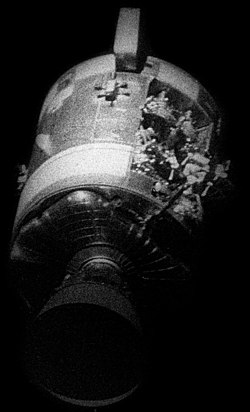
After some retesting, which did not include filling the tank with liquid oxygen, the oxygen tank shelf was re-installed in SM-109, intended for Apollo 13, in November 1968.
Image source: Apollo 13
Jul 1969
% complete
Since success was obtained in 1969 with the sixth Saturn V rocket on Apollo 11, nine rockets remained available for a hoped-for total of ten Moon landings.
Image source: Saturn V
Jul 20, 1969
% complete
The goal set by President Kennedy was achieved when Apollo 11 landed on the Moon on July 20, 1969, fulfilling the challenge of landing humans on the lunar surface.
Jul 24, 1969
% complete
The Apollo 11 mission returned to Earth on July 24, 1969, completing Kennedy's challenge of landing a man on the Moon and returning him safely to Earth.
Image source: Apollo 11
1962
% complete
Jim Lovell, a graduate of the United States Naval Academy who had been a naval aviator and test pilot, was selected for NASA's second group of astronauts in 1962.
Image source: Jim Lovell
Dec 4, 1965 - Dec 18, 1965
% complete
Jim Lovell flew with Frank Borman aboard Gemini 7 in December 1965, gaining valuable spaceflight experience that would later serve him on Apollo missions.
Image source: Gemini 7
1966
% complete
Fred Haise, who held a degree in aerospace science and had served in the Air Force and state Air National Guards as an engineering test pilot, was selected for NASA's fifth group of astronauts in 1966.
Image source: Fred Haise
Nov 11, 1966 - Nov 15, 1966
% complete
In November 1966, Jim Lovell flew alongside Buzz Aldrin on Gemini 12, the final Gemini mission, further building his experience for lunar flight.
Image source: Gemini 12
Dec 21, 1968 - Dec 27, 1968
% complete
Jim Lovell flew on Apollo 8 in December 1968, the first spacecraft to orbit the Moon, making him uniquely experienced among the Apollo 13 crew.
Image source: Apollo 8
1973
% complete
Jim Lovell retired from NASA and the Navy in 1973 and entered the private sector after his storied career as an astronaut.
1973
% complete
Jack Swigert was to have flown on the 1975 Apollo–Soyuz Test Project, the first joint mission with the Soviet Union, but was removed as part of the fallout from the Apollo 15 postal covers incident.
Image source: Jack Swigert
1977 - 1979
% complete
Fred Haise, who had been slated to command the canceled Apollo 19 mission, flew the Space Shuttle Approach and Landing Tests before retiring from NASA in 1979.
Image source: Approach and Landing Tests
1982
% complete
Jack Swigert took a leave of absence from NASA in 1973 and left the agency to enter politics, being elected to the House of Representatives in 1982, but died of cancer before he could be sworn in, aged 51.
Jun 1969 - Jul 1969
% complete
The LM stages, command module, and service module were received at Kennedy Space Center in June 1969; the portions of the Saturn V launch vehicle arrived in June and July.
Jun 1969
% complete
Service module SM-109, containing the oxygen tank later implicated in the accident, was shipped to Kennedy Space Center in June 1969 for integration into the Apollo 13 spacecraft.
Dec 15, 1969
% complete
Testing and assembly proceeded through late 1969, culminating with the rollout of the Saturn V launch vehicle, with the Apollo 13 spacecraft atop it, on December 15, 1969.
Jan 1970
% complete
Apollo 13 was originally scheduled for launch on March 12, 1970, but in January NASA announced the mission would be postponed until April 11, both to allow more planning time and to spread the Apollo missions over a longer period.
Mar 16, 1970
% complete
The Countdown Demonstration Test took place with service module SM-109 in its place near the top of the Saturn V, beginning on March 16, 1970.
Apr 11, 1970
% complete
Apollo 13, the seventh crewed mission in the Apollo space program and intended third Moon landing, was launched from Kennedy Space Center on April 11, 1970.
Apr 13, 1970
% complete
Two days into the mission, an oxygen tank in the service module exploded, disabling the craft's electrical and life-support systems and forcing the abort of the planned Moon landing.
Apr 14, 1970
% complete
At pericynthion on April 14, 1970, the crew of Apollo 13 was 400,171 kilometers (248,655 miles) from Earth, setting the record for the furthest humans from Earth until Artemis II's lunar flyby in 2026.
Apr 17, 1970
% complete
Despite the explosion that crippled the spacecraft, the Apollo 13 crew returned safely to Earth on April 17, 1970, concluding a dramatic six-day mission that became known as a 'successful failure.'
Sep 1970
% complete
Budget cuts made the decision easier, and during the pause after Apollo 13 two missions were canceled, meaning the Apollo program ended with Apollo 17 in December 1972.
Feb 5, 1971
% complete
On February 5, 1971, Apollo 14's LM Antares landed on the Moon with astronauts Alan Shepard and Edgar Mitchell aboard, near Fra Mauro, the site Apollo 13 had been intended to explore.
Image source: Apollo 14
1974
% complete
The 1974 movie Houston, We've Got a Problem, while set around the Apollo 13 incident, is a fictional drama about crises faced by ground personnel when the emergency disrupts their work schedules and places further stress on their lives.
Image source: Houston, we have a problem
Mar 1978
% complete
"We've Got a Problem" was the title of an episode of the BBC documentary series A Life At Stake, broadcast in March 1978.
Image source: A Life at Stake
1991
% complete
After Jim Lovell retired in 1991, he was approached by journalist Jeffrey Kluger about writing a non-fiction account of the mission; Swigert had died in 1982 and Haise was no longer interested in such a project.
Image source: Lost Moon
1994
% complete
The resultant book, Lost Moon: The Perilous Voyage of Apollo 13, co-authored by Jim Lovell and Jeffrey Kluger, was published in 1994.
Jul 1994
% complete
In 1994, during the 25th anniversary of Apollo 11, PBS released a 90-minute documentary titled Apollo 13: To the Edge and Back.
1995
% complete
In 1995, Apollo 13, a film adaptation of Lost Moon, was released, directed by Ron Howard and starring Tom Hanks as Lovell, Bill Paxton as Haise, Kevin Bacon as Swigert, Gary Sinise as Mattingly, Ed Harris as Kranz, and Kathleen Quinlan as Marilyn Lovell.
Image source: Apollo 13 (film)
1998
% complete
In the 1998 miniseries From the Earth to the Moon, co-produced by Tom Hanks and Ron Howard, the Apollo 13 mission is dramatized in the episode "We Interrupt This Program".
Image source: From the Earth to the Moon (miniseries)
2000
% complete
The 1995 film invented the phrase "Failure is not an option", uttered by Ed Harris as Gene Kranz; the phrase became so closely associated with Kranz that he used it for the title of his 2000 autobiography.
Image source: Gene Kranz
2020
% complete
In advance of the 50th anniversary of the mission in 2020, an Apollo in Real Time site for the mission went online, allowing viewers to follow along as the mission unfolds, view photographs and video, and listen to audio of conversations between Houston and the astronauts.
Mar 8, 2020
% complete
In 2020, the BBC World Service began airing 13 Minutes to the Moon, radio programs drawing on NASA audio from the mission as well as archival and recent interviews. Season 2 episodes began airing on March 8, 2020, with episode 1, "Time Bomb: Apollo 13", explaining the launch and the explosion.
Apr 10, 2020
% complete
Due to the COVID-19 pandemic, NASA did not hold any in-person events during April 2020 for the flight's 50th anniversary, but premiered a new documentary, Apollo 13: Home Safe, on April 10, 2020; other events were rescheduled for later in 2020.
Image source: Apollo 13
2026
% complete
Apollo 13's record for the furthest humans from Earth, set at pericynthion in 1970, stood until Artemis II's lunar flyby in 2026 surpassed it.
Image source: Artemis II
Or browse the full history timeline directory, with more than 2,000 topics.
This Apollo 13 Mission timeline was generated with the help of AI, using information found on the internet.
We work hard to keep these timelines accurate, but mistakes do get through. If you spot one, email us at [email protected] and we'll fix it for future visitors.
Generate yours with AI or build it from scratch, for free.
Export your timeline, add your own events, edit or remove AI-generated events, and much more
No credit card required.
Cancel anytime.
Cancel anytime.
You can create an unlimited number of timelines with up to 10 events on each one, customize how they look, export them to PDF, PNG, PowerPoint, CSV, and Excel, and share them with a link. Paid plans raise the event limit and add features like spreadsheet imports and collaborators.
Yes. You can cancel your subscription from your account page at any time, and you will not be charged again. Your subscription stays active for the rest of the period you already paid for.
Yes. We will email you a reminder before the annual renewal, and we will also email you a receipt.
Yes. You can email us within 15 days of any payment, and we will issue you a full refund.
Check out our pricing docs or send us an email anytime: [email protected].