-
Use Cases
-
Resources
-
Pricing
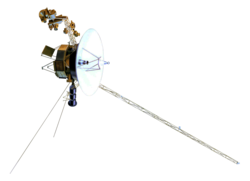
The Voyager Missions are a pair of unmanned space probes launched by NASA in 1977 to study the outer planets and beyond. Voyager 1 and Voyager 2 conducted groundbreaking flybys of Jupiter, Saturn, Uranus, and Neptune, capturing iconic images and data. Both probes have since traveled beyond the heliosphere into interstellar space, continuing to transmit scientific data decades after launch. More Less
1964
The mission originated from the Grand Tour program, conceptualized by Gary Flandro, an aerospace engineer at the Jet Propulsion Laboratory, in 1964. His analysis leveraged a rare planetary alignment occurring once every 175 years that would allow a single spacecraft to visit multiple outer planets.
Image source: Voyager program

1966
The ambitious plan to send several pairs of probes to the outer planets gained momentum in 1966 when it was endorsed by NASA's Jet Propulsion Laboratory, moving the Grand Tour concept closer to reality.
Dec 1971
In December 1971, the Grand Tour mission was canceled when funding was redirected to the Space Shuttle program, seemingly ending hopes for a multi-planet exploration mission.
1972
In 1972, a scaled-down mission featuring four planets and two identical spacecraft was proposed, utilizing a spacecraft derived from the Mariner series. The probes were initially intended to be named Mariner 11 and Mariner 12.
Mar 4, 1977
On March 4, 1977, NASA announced a competition to rename the mission, believing the existing name was not appropriate since the mission had differed significantly from previous Mariner missions.
Aug 1977 - Sep 1977
The two Voyager probes were launched in August or September 1977 to take advantage of a favorable planetary alignment occurring once every 175 years. Their main objective was to compare the characteristics of Jupiter and Saturn, such as their atmospheres, magnetic fields, particle environments, ring systems, and moons.
1989
The Voyager primary mission was completed in 1989 with the close flyby of Neptune by Voyager 2, capping a grand tour of the outer planets that had visited Jupiter, Saturn, Uranus, and Neptune.
Feb 14, 1990
Pale Blue Dot is a photograph of Earth taken on February 14, 1990, by the Voyager 1 space probe from a distance of approximately 6 billion kilometers (3.7 billion miles, 40.5 AU), as part of that day's Family Portrait series of images of the Solar System.
Image source: Pale Blue Dot

Aug 20, 1977
The Voyager spacecraft's computer systems have been running continuously since 20 August 1977. They are proprietary, custom-built computers built from CMOS and TTL medium-scale integrated circuits and discrete components, mostly from the 7400 series of Texas Instruments.
1982 - 1985
Between 1982 and 1985, the diameters of the three main parabolic dish antennas of the Deep Space Network were increased from 64 to 70 meters (210 to 230 feet), dramatically increasing their areas for gathering weak microwave signals from the distant probes.
This Voyager Missions timeline was generated with the help of AI, using information found on the internet.
We work hard to keep these timelines accurate, but mistakes do get through. If you spot one, email us at [email protected] and we'll fix it for future visitors.
Generate yours with AI or build it from scratch, for free.