-
Use Cases
-
Resources
-
Pricing
Mars exploration spans more than six decades of robotic missions, beginning with the first successful flyby by NASA's Mariner 4 in 1965. Over the years, orbiters, landers, and rovers from NASA, the Soviet Union, ESA, India, China, and the UAE have mapped the planet's surface, studied its climate, searched for signs of ancient water and life, and paved the way for future human missions to the Red Planet. More Less
1659
% completado
Dutch astronomer Christiaan Huygens made the first detailed drawing of a Martian surface feature, the dark region now known as Syrtis Major. His observations allowed the first estimates of the planet's rotation period, which proved remarkably close to modern measurements of about 24.6 hours.
Image source: Syrtis Major Planum
1877
% completado
Italian astronomer Giovanni Schiaparelli reported observing linear features on Mars, which he called 'canali' (channels). His work, later misinterpreted as artificial canals by Percival Lowell and others, fueled decades of speculation about intelligent life on Mars and inspired much early science fiction.
Image source: Martian canals
Aug 1877
% completado
American astronomer Asaph Hall discovered Mars's two small moons, Phobos and Deimos, from the US Naval Observatory in Washington, DC. Their discovery resolved long-standing speculation about Martian satellites and provided important targets for later spacecraft missions.
Image source: Moons of Mars
Jul 14, 1965
% completado
NASA's Mariner 4 became the first spacecraft to successfully fly by Mars, returning 22 close-up images of the planet's cratered surface. The images revealed a Moon-like, seemingly lifeless world, dramatically revising expectations about Mars and ending popular notions of a lush, canal-covered planet.
Image source: Mariner 4
Jul 31, 1969 - Aug 5, 1969
% completado
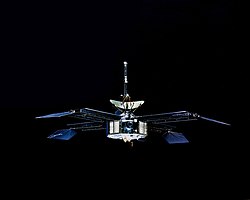
Twin NASA spacecraft Mariner 6 and Mariner 7 flew past Mars in the summer of 1969, returning nearly 200 images and measuring the planet's surface temperature, atmospheric pressure, and composition. Their data further characterized Mars as a cold, cratered desert world.
Image source: Mariner 6 and 7
Nov 14, 1971 - Oct 27, 1972
% completado
NASA's Mariner 9 arrived at Mars to become the first spacecraft to orbit another planet. Despite a global dust storm that initially obscured the surface, it went on to map about 85% of Mars, revealing giant volcanoes like Olympus Mons, the vast canyon system Valles Marineris, and evidence of ancient river channels.
Image source: Mariner 9
Sep 11, 1997 - Nov 2, 2006
% completado
NASA's Mars Global Surveyor entered Martian orbit and began a highly productive mapping campaign, returning high-resolution images that revealed layered sedimentary rocks, gullies possibly formed by liquid water, and evidence of past magnetic fields. It operated for nearly a decade before contact was lost in 2006.
Image source: Mars Global Surveyor
Sep 23, 1999
% completado
NASA's Mars Climate Orbiter was destroyed when it entered Mars's atmosphere at too low an altitude, a failure caused by a navigation error in which one team used imperial units while another used metric. The costly mishap became a famous lesson in the importance of unit consistency and communication in engineering.
Image source: Mars Climate Orbiter
Apr 7, 2001
% completado
NASA launched Mars Odyssey, an orbiter designed to map the distribution of minerals and water ice on Mars. Its gamma-ray spectrometer detected vast deposits of water ice just beneath the surface, and the spacecraft later became a crucial communications relay for landers and rovers, setting endurance records in Mars orbit.
Image source: 2001 Mars Odyssey
Jun 2, 2003
% completado
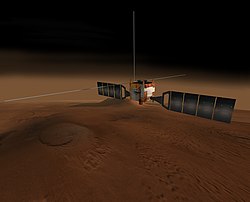
The European Space Agency launched Mars Express, its first mission to another planet, carrying the British-built Beagle 2 lander. Mars Express became Europe's first successful Mars orbiter, discovering subsurface water ice and methane traces, while Beagle 2 was declared lost after failing to communicate following its landing.
Image source: Mars Express
Mar 17, 2004
% completado
Using its OMEGA spectrometer, Mars Express confirmed the presence of water ice at Mars's south polar cap. The discovery, alongside later radar measurements, significantly advanced understanding of the planet's water inventory and its potential to have supported habitable environments in the past.
Aug 12, 2005
% completado
NASA launched the Mars Reconnaissance Orbiter (MRO), carrying the most powerful camera ever sent to Mars along with radar and spectrometers. MRO's HiRISE instrument has returned spectacular high-resolution images, tracked seasonal changes such as recurring slope lineae, and relayed communications for surface missions.
Image source: Mars Reconnaissance Orbiter
Sep 21, 2014
% completado
NASA's MAVEN (Mars Atmosphere and Volatile Evolution) spacecraft entered Mars orbit to investigate how the planet lost its early thick atmosphere. MAVEN's measurements showed that solar wind stripped away atmospheric gases over billions of years, transforming Mars from a potentially habitable world into the cold desert seen today.
Image source: MAVEN
Sep 24, 2014
% completado
India's Mars Orbiter Mission, known as Mangalyaan, successfully entered Mars orbit, making India the first nation to reach Mars on its first attempt. The low-cost mission demonstrated India's growing space capabilities and studied the Martian surface, atmosphere, and exosphere for several years.
Image source: Mars Orbiter Mission
Oct 19, 2016
% completado
The European Space Agency and Roscosmos' ExoMars Trace Gas Orbiter arrived at Mars to search for methane and other trace gases that might indicate geological or biological activity. Its Schiaparelli entry demonstrator crashed during landing, but the orbiter itself has been highly successful, also detecting water ice deposits near the equator.
Image source: Trace Gas Orbiter
Feb 9, 2021
% completado
The United Arab Emirates' Hope probe (Al Amal) entered Mars orbit, making the UAE the fifth entity to reach the red planet and the first Arab nation to do so. Hope studies the Martian atmosphere and weather, providing a global picture of how the atmosphere changes throughout the Martian day and year.
Image source: Emirates Mars Mission
Dec 2, 1971
% completado
The Soviet Union's Mars 3 lander achieved the first soft landing on the Martian surface, though it transmitted for only about 20 seconds before failing. It briefly returned a partial image of the surface and carried the first small rover, Prop-M, although it never operated.
Image source: Mars 3
Aug 20, 1975
% completado
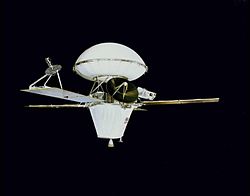
NASA launched Viking 1, consisting of an orbiter and a lander, on a mission to search for life on Mars. The spacecraft arrived in orbit in June 1976, and its lander touched down on July 20, 1976, in Chryse Planitia, becoming the first US spacecraft to land successfully on Mars.
Image source: Viking 1
Jul 20, 1976 - Nov 13, 1982
% completado
The Viking 1 lander made history's first successful US landing on Mars, touching down on the seventh anniversary of the Apollo 11 Moon landing. It returned the first clear images from the Martian surface and conducted biology experiments designed to detect signs of life, yielding ambiguous results that scientists still debate.
Sep 3, 1976 - Apr 11, 1980
% completado
The Viking 2 lander touched down in Utopia Planitia, a northern plain of Mars, complementing its twin Viking 1. Together the two landers returned over 4,500 images of the Martian surface and conducted extensive atmospheric and soil analyses, establishing a baseline of knowledge about Mars for decades to come.
Image source: Viking 2
Dec 4, 1996
% completado
NASA launched Mars Pathfinder, a low-cost mission designed to demonstrate new landing technologies and deliver a small rover to the Martian surface. Its successful airbag-assisted landing in July 1997 revitalized Mars exploration after a two-decade gap in successful landings.
Image source: Mars Pathfinder
Jul 4, 1997 - Sep 27, 1997
% completado
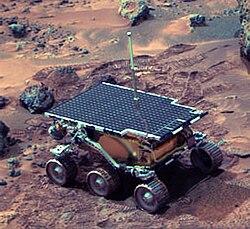
The Sojourner rover, deployed by Mars Pathfinder in Ares Vallis, became the first wheeled vehicle to operate on another planet. Weighing just 11 kilograms, it analyzed Martian rocks and soil over nearly three months, demonstrating the value of mobile exploration and paving the way for larger rovers.
Image source: Sojourner (rover)
Dec 3, 1999
% completado
NASA's Mars Polar Lander was lost when its engines shut down prematurely during descent, likely due to a software flaw that mistook landing-leg vibration for touchdown. The failure, along with the loss of the Deep Space 2 microprobes it carried, prompted a major reorganization of NASA's Mars program.
Image source: Mars Polar Lander
Jan 4, 2004 - Mar 22, 2010
% completado
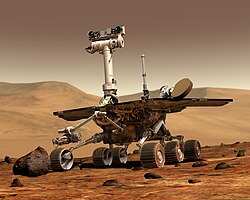
NASA's Mars Exploration Rover Spirit touched down in Gusev crater, beginning what was planned as a 90-sol mission. Spirit far exceeded expectations, operating for over six years and finding compelling evidence that Gusev crater once hosted volcanic activity altered by water, before becoming stuck in sand and falling silent in 2010.
Image source: Spirit (rover)
Jan 25, 2004 - Jun 10, 2018
% completado
NASA's Opportunity rover landed in Meridiani Planum and quickly discovered hematite 'blueberries' and sulfate salts, proving that liquid water once flowed across the region. Originally designed for a 90-sol mission, Opportunity astonishingly drove over 45 kilometers and operated for nearly 15 years until a global dust storm silenced it in 2018.
Image source: Opportunity (rover)
May 25, 2008 - Nov 2, 2008
% completado
NASA's Phoenix lander successfully touched down in the Martian arctic plains and directly confirmed the presence of water ice just below the surface. Its onboard laboratory analyzed soil chemistry, detected perchlorates, and observed snow falling from clouds, providing key insights into the planet's polar environment and habitability.
Image source: Phoenix (spacecraft)
Aug 6, 2012
% completado
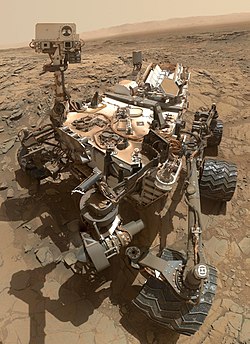
NASA's car-sized Curiosity rover landed in Gale crater using the daring sky crane maneuver, in which a rocket-powered descent stage lowered the rover on cables. Equipped with a full analytical laboratory, Curiosity found evidence that Gale crater once contained a habitable freshwater lake and continues to explore Mount Sharp today.
Image source: Curiosity (rover)
Nov 26, 2018
% completado
NASA's InSight lander touched down in Elysium Planitia to study Mars's deep interior using a seismometer and heat probe. InSight detected hundreds of marsquakes, measured the planet's crust, mantle, and core, and recorded seismic activity from meteorite impacts, revealing that Mars is seismically active.
Image source: InSight
Feb 10, 2021
% completado
China's Tianwen-1 mission entered Mars orbit in February 2021 and successfully deployed the Zhurong rover, which landed in Utopia Planitia in May 2021. China thus became the second nation to operate a rover on Mars, and the first to combine orbiting, landing, and roving in a single inaugural mission.
Image source: Tianwen-1
Feb 18, 2021
% completado
NASA's Perseverance rover landed in Jezero crater, an ancient river delta, to search for signs of ancient microbial life and cache rock samples for a future return to Earth. The rover has collected numerous samples, produced oxygen from Martian CO2 with its MOXIE instrument, and continues to explore the delta region.
Image source: Perseverance (rover)
Apr 19, 2021
% completado
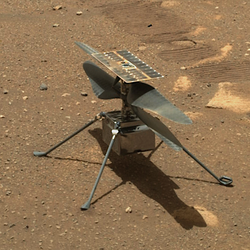
NASA's Ingenuity helicopter, carried to Mars by the Perseverance rover, achieved the first powered, controlled flight on another planet. The 39-second hop in Jezero crater's thin atmosphere proved that aerial exploration of Mars is possible, opening a new dimension of planetary exploration.
Image source: Ingenuity (helicopter)
2020
% completado
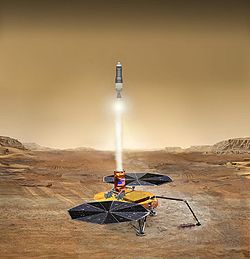
NASA and the European Space Agency formalized plans for a Mars Sample Return campaign, intended to retrieve the rock samples cached by the Perseverance rover and bring them to Earth for laboratory analysis. The multi-mission effort represents the most ambitious robotic Mars undertaking ever attempted, targeting launches in the 2020s.
Image source: Mars sample-return mission
Or browse the full history timeline directory, with more than 2,000 topics.
This Mars Exploration timeline was generated with the help of AI, using information found on the internet.
We work hard to keep these timelines accurate, but mistakes do get through. If you spot one, email us at [email protected] and we'll fix it for future visitors.
Generate yours with AI or build it from scratch, for free.
Export your timeline, add your own events, edit or remove AI-generated events, and much more
No credit card required.
Cancel anytime.
Cancel anytime.
You can create an unlimited number of timelines with up to 10 events on each one, customize how they look, export them to PDF, PNG, PowerPoint, CSV, and Excel, and share them with a link. Paid plans raise the event limit and add features like spreadsheet imports and collaborators.
Yes. You can cancel your subscription from your account page at any time, and you will not be charged again. Your subscription stays active for the rest of the period you already paid for.
Yes. We will email you a reminder before the annual renewal, and we will also email you a receipt.
Yes. You can email us within 15 days of any payment, and we will issue you a full refund.
Check out our pricing docs or send us an email anytime: [email protected].