-
Use Cases
-
Resources
-
Pricing
Deep sea exploration is the scientific investigation of ocean depths beyond the reach of sunlight. Driven by curiosity, commerce, and science, humanity has gradually developed technologies—from diving bells and submarines to remotely operated vehicles—that allow us to study the deepest, most mysterious parts of Earth's oceans. More Less
1800
% complete
French scientist Pierre-Simon Laplace investigated the average depth of the Atlantic Ocean by observing tidal motions registered on Brazilian and African coasts, marking the beginning of scientific deep-sea exploration in the late 18th or early 19th century.
Image source: Deep-sea exploration
1810 - 1827
% complete
Antoine Risso, an apothecary from Nice, published a series of papers that remained long ignored, describing and naming dozens of fish and crustacean species collected by fishermen at depths between 600 and 1,000 m in the Gulf of Genoa.
Image source: Antoine Risso
1818
% complete
British researcher Sir John Ross independently discovered that the deep sea is inhabited by life when he caught jellyfish and worms at a depth of about 2,000 m (6,562 ft) using a special device.
1840
% complete
British explorer Sir James Clark Ross fully employed the deep-sea sounding instrument to reach a depth of 3,700 m (12,139 ft), setting a significant early record for measuring ocean depth.
Image source: James Clark Ross
1843
% complete
Edward Forbes claimed that diversity of life in the deep sea is little and decreases with increasing depth, advancing the idea that life could not exist in the ocean's deepest zones, a view later refuted by explorers.
Image source: Edward Forbes
1850
% complete
Near Lofoten, Norway, Michael Sars found a rich variety of deep-sea fauna at a depth of 800 m (2,625 ft), thereby refuting the Abyssus Theory that claimed no life existed in the deep ocean.
Image source: Michael Sars
1864
% complete
Norwegian researchers Michael Sars and Georg Ossian Sars obtained a sample of a stalked crinoid at a depth of 3,109 m (10,200 ft), marking the discovery of the first deep-sea life forms.
Image source: Georg Ossian Sars
1872 - 1876
% complete
A landmark ocean study was carried out by British scientists aboard HMS Challenger, a screw corvette converted into a survey ship in 1872. Led by Charles Wyville Thomson, it was the first systematic deep-sea exploration and discovered abundant mineral resources on the ocean floor in 1873, sparking lasting interest in the deep ocean.
Image source: Challenger expedition
1890 - 1898
% complete
The first Austrian-Hungarian deep sea expedition sailed on board the ship SMS Pola, led by Franz Steindachner, exploring the eastern Mediterranean and the Red Sea.
Image source: SMS Viribus Unitis
1898 - 1899
% complete
The first German deep sea expedition on board the ship Valdivia, led by Carl Chun, found many new species from depths greater than 4,000 m (13,123 ft) in the southern Atlantic Ocean.
Image source: Valdivia Expedition
1947 - 1948
% complete
Swedish oceanographer Hans Petterson organised and led the Albatross expedition, which traveled 45,000 nautical miles around the equator in 15 months, greatly expanding knowledge of the deep oceans.
Image source: Albatross expedition
1974
% complete
Alvin (operated by Woods Hole Oceanographic Institution and the Deep Sea Place Research Center), the French bathyscaphe Archimède, and the French diving saucer CYANA, assisted by support ships and Glomar Challenger, explored the great rift valley of the Mid-Atlantic Ridge southwest of the Azores.
Image source: Project FAMOUS
1979 - 1980
% complete
In a series of dives conducted between 1979 and 1980 into the Galápagos rift off the coast of Ecuador, French, Italian, Mexican, and U.S. researchers explored deep-sea hydrothermal environments teeming with unique life.
Image source: Galápagos hotspot
1900 - 1999
% complete
In the 20th century, deep-sea exploration advanced considerably through a series of technological inventions, ranging from the sonar system, which can detect objects underwater through sound, to manned deep-diving submersibles.
1985
% complete
Argo, a towed camera system, was used in 1985 to locate the wreck of the RMS Titanic; the smaller remotely operated vehicle Jason was also used to explore the shipwreck, opening a new era of robotic deep-sea survey.
Image source: Wreck of the Titanic
Mar 25, 2012
% complete
Filmmaker James Cameron descended into the Mariana Trench in Deepsea Challenger, completing the second crewed voyage and first solo mission to the bottom of the Challenger Deep, and for the first time filmed and sampled the bottom.
Image source: Deepsea Challenger
2018
% complete
DSV Limiting Factor, piloted by Victor Vescovo, completed the first mission to the deepest point of the Atlantic Ocean, diving 8,375 m (27,477 ft) below the ocean surface to the base of the Puerto Rico Trench.
Image source: DSV Limiting Factor
2020
% complete
In 2020, mission specialists began diving on board the vessel Limiting Factor, extending crewed access to the deepest parts of the world's oceans beyond professional pilots.
Jul 15, 2024
% complete
During a July 15, 2024 expedition to the Wreck of the Titanic, magnetometers were used for the first time to provide metal detection and recover on-site artefacts, leveraging their accuracy in recognising ferromagnetic material when examining shipwrecks at such depths.
1930
% complete
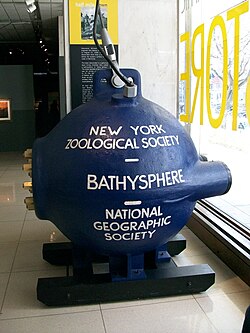
William Beebe and Otis Barton became the first humans to reach the deep sea when diving in the Bathysphere, a spherical steel pressure-resistant chamber, reaching a depth of 435 m (1,427 ft).
1934
% complete
The Bathysphere reached a depth of 923 m (3,028 ft), extending the reach of human observation into deeper waters off Bermuda.
Image source: Bathysphere
1948
% complete
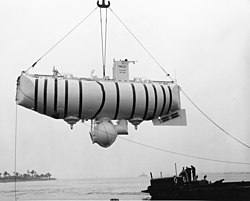
Swiss physicist Auguste Piccard tested a much deeper-diving vessel he invented called the bathyscaphe, a navigable deep-sea vessel with its gasoline-filled float and suspended chamber of spherical steel. That same year, Otis Barton set a new record, diving to 1,370 m (4,495 ft) in the bathysphere.
1953
% complete
Jacques Piccard joined in building a new and improved bathyscaphe Trieste, which dived to 3,139 m (10,299 ft) during field trials, paving the way for even deeper descents.
1954
% complete
Using his bathyscaphe, Auguste Piccard reached a depth of 4,000 m (13,123 ft), proving that vessels could descend far beyond previous manned limits.
Image source: Bathyscaphe
1958
% complete
The United States Navy acquired Trieste and equipped it with a new cabin to enable it to reach deep ocean trenches, preparing it for its historic descent into the Challenger Deep.
Image source: Trieste (bathyscaphe)
1960
% complete
Jacques Piccard and US Navy Lieutenant Donald Walsh descended in the bathyscaphe Trieste to the deepest known point on Earth — the Challenger Deep in the Mariana Trench — descending about 10,900 m and observing fish and other deep-sea organisms, making the deepest dive in history.
Image source: Mariana Trench
1964
% complete
Alvin made its first test dive in 1964 and has since performed more than 3,000 dives to average depths of 1,829 m (6,001 ft), becoming one of the most productive research submersibles in history.
Image source: DSV Alvin
1988
% complete
The Comex Hydra 8 experimental dives reached 534 metres (1,752 ft) on surface supply, a landmark achievement for saturation diving technology and human endurance underwater.
Jun 2005
% complete
As of June 2005, the scuba diving record stood at 318 m (1,043 ft), while the deepest recorded freedive as of 2012 is 253 m (830 ft), demonstrating remarkable limits of human diving capability.
Image source: Deep diving
Or browse the full history timeline directory, with more than 2,000 topics.
This History of Deep Sea Exploration timeline was generated with the help of AI, using information found on the internet.
We work hard to keep these timelines accurate, but mistakes do get through. If you spot one, email us at [email protected] and we'll fix it for future visitors.
Generate yours with AI or build it from scratch, for free.
Export your timeline, add your own events, edit or remove AI-generated events, and much more
No credit card required.
Cancel anytime.
Cancel anytime.
You can create an unlimited number of timelines with up to 10 events on each one, customize how they look, export them to PDF, PNG, PowerPoint, CSV, and Excel, and share them with a link. Paid plans raise the event limit and add features like spreadsheet imports and collaborators.
Yes. You can cancel your subscription from your account page at any time, and you will not be charged again. Your subscription stays active for the rest of the period you already paid for.
Yes. We will email you a reminder before the annual renewal, and we will also email you a receipt.
Yes. You can email us within 15 days of any payment, and we will issue you a full refund.
Check out our pricing docs or send us an email anytime: [email protected].