-
Use Cases
-
Resources
-
Pricing
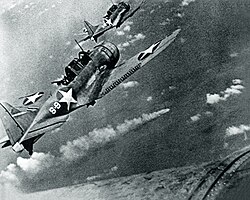
The Battle of the Coral Sea was a major World War II naval engagement fought between May 4 and 8, 1942, between Allied forces (primarily American and Australian) and the Imperial Japanese Navy in the Coral Sea near New Guinea. It was historically significant as the first battle in which opposing fleets never sighted each other, with all attacks carried out by carrier-based aircraft, halting Japan's advance toward Port Moresby. More Less
Dec 7, 1941
% complete
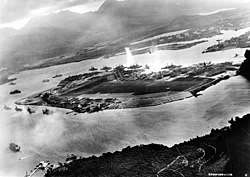
On December 7, 1941 (December 8 in Japan), Japanese forces launched a surprise attack on the US naval base at Pearl Harbor, devastating the American Pacific Fleet and setting off the chain of events that would lead to the Battle of the Coral Sea.
Image source: Attack on Pearl Harbor
Dec 8, 1941
% complete
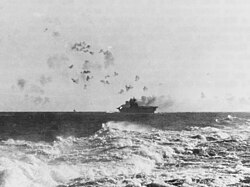
On December 8, 1941 (December 7 US time), Japan declared war on the United States and the British Empire, following its attacks on Malaya, Singapore and Hong Kong as well as Pearl Harbor.
Image source: Battle of the Coral Sea
Dec 8, 1941
% complete
As part of its opening offensives of the war, Japan attacked Malaya on December 8, 1941, beginning a campaign that would contribute to the fall of British positions in Southeast Asia.
Dec 8, 1941
% complete
Japanese forces attacked the British Crown Colony of Hong Kong on December 8, 1941, one of several simultaneous strikes that opened the Pacific War alongside the assault on Pearl Harbor.
Dec 10, 1941
% complete
During the first months of 1942, Japanese forces overran Allied territories across the Pacific including the American island of Guam, inflicting heavy losses on opposing land, naval and air forces.
Dec 23, 1941
% complete
In the early months of the war Japan seized Wake Island, part of a rapid string of conquests that included the Philippines, Singapore, the Dutch East Indies, New Britain and the Gilbert Islands.
Jan 2, 1942
% complete
Early in 1942 Japanese forces invaded and took control of the Philippines, overwhelming Allied defenses and inflicting heavy losses on American and Filipino forces during the first months of the Pacific War.
Jan 23, 1942
% complete
Japan captured New Britain in the South Pacific in early 1942, establishing Rabaul as a major forward base that would later support its push toward Port Moresby and the Coral Sea operation.
Feb 8, 1942
% complete
Among its rapid early conquests, Japan seized control of the Gilbert Islands in the central Pacific, extending its defensive perimeter eastward during the opening months of 1942.
Feb 15, 1942
% complete
Singapore fell to Japanese forces in February 1942 after attacks that had begun in December 1941, marking a major strategic victory for Japan and a heavy blow to the Allies in Southeast Asia.
Mar 1, 1942
% complete
By March 1942, the US was able to decipher up to 15% of the IJN's Ro or Naval Codebook D code (called JN-25B by the Americans), which was used by the Imperial Japanese Navy for about half of its communications.
Mar 1, 1942
% complete
In March 1942, US signals intelligence first noticed mention of the MO operation in intercepted Japanese messages, giving the Allies crucial advance warning of Japan's planned move against Port Moresby.
Image source: Operation Mo
Mar 9, 1942
% complete
By early 1942 Japanese forces had conquered the resource-rich Dutch East Indies, completing one of their key objectives in the region and securing vital oil supplies for their war effort.
Apr 1, 1942
% complete
In April 1942, the Japanese army and navy developed a plan titled Operation MO, which called for the seizure of Tulagi in the Solomon Islands and the capture of Port Moresby in New Guinea, setting the stage for confrontation in the Coral Sea.
Jan 1, 1942
% complete
War in the Pacific, Part I: The Pacific in Eruption, an episode made from the same Movietone News newsreels of 1942, documented the eruption of war in the Pacific theater including the period of the Coral Sea battle.
Jan 1, 1951
% complete
Crusade in the Pacific, Episode 5: The Navy Holds: 1942, a segment aired originally in 1951, was made from theatrical releases of Movietone News from 1942 and covered the naval stand-off of the Coral Sea era.
May 4, 1942 - May 8, 1942
% complete
From May 4 to 8, 1942, the Battle of the Coral Sea was fought between the Imperial Japanese Navy and naval and air forces of the United States and Australia. It was the first major naval engagement in which aircraft carriers never sighted or fired directly upon one another, and it checked Japan's southward advance toward Port Moresby.
May 7, 1942
% complete
Japanese carrier commander Rear Admiral Tadaichi Hara was so frustrated with the poor luck the Japanese experienced on May 7, 1942 that he later told Yamamoto's chief of staff, Admiral Matome Ugaki, he felt like quitting the navy.
Jun 4, 1942 - Jun 7, 1942
% complete
A month after Coral Sea, Japanese and US carriers faced off again at Midway, where a decisive American victory inflicted crippling losses on the Imperial Japanese Navy's carrier force.
Image source: Battle of Midway
Aug 7, 1942
% complete
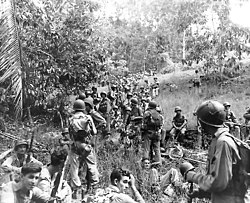
Three months after the Coral Sea, on August 7, 1942, 11,000 United States Marines landed on Guadalcanal while 3,000 Marines landed on Tulagi and nearby islands, launching the Allied counteroffensive in the Solomon Islands.
Image source: Guadalcanal campaign
Aug 24, 1942 - Aug 25, 1942
% complete
Japanese and US carriers clashed once more at the Eastern Solomons in August 1942, another carrier-versus-carrier battle in the continuing contest for control of the Solomon Islands following Coral Sea.
Image source: Battle of the Eastern Solomons
Aug 25, 1942 - Sep 7, 1942
% complete
The added Allied forces slowed, then eventually halted the Japanese advance toward Port Moresby in September 1942, and defeated an attempt by the Japanese to overpower an Allied base at Milne Bay.
Image source: Battle of Milne Bay
Sep 1, 1942
% complete
The added Allied forces slowed and eventually halted the Japanese advance towards Port Moresby in September 1942, fulfilling the strategic purpose of the Coral Sea engagement in blunting Japan's southward push.
Image source: Kokoda Track campaign
Oct 2, 1942
% complete
The delay in the advance of Japanese forces allowed the Marine Corps to land on Funafuti on October 2, 1942, where Naval Construction Battalions built airfields on three atolls of Tuvalu from which USAAF B-24 Liberator bombers operated.
Image source: Funafuti
Oct 26, 1942 - Oct 27, 1942
% complete
In October 1942 the carrier fleets met again at the Santa Cruz Islands, a costly tactical Japanese victory that nevertheless continued the attrition of Japan's irreplaceable veteran aircrews begun at Coral Sea.
Image source: Battle of the Santa Cruz Islands
Oct 31, 1942
% complete
Coral Sea started a trend which resulted in the irreparable attrition of Japan's veteran carrier aircrews by the end of October 1942, a loss of experienced pilots Japan could never fully recover from.
Nov 20, 1943
% complete
The atolls of Tuvalu acted as a staging post during preparations for the Battle of Tarawa and the Battle of Makin that commenced on November 20, 1943, implementing Operation Galvanic in the Gilbert Islands.
Image source: Battle of Tarawa
Jun 19, 1944 - Jun 20, 1944
% complete
Japanese and US carriers faced off for the last major time at the Philippine Sea in June 1944, where the devastated remnants of Japan's carrier air arm were effectively destroyed, sealing the fate foreshadowed at Coral Sea.
Image source: Battle of the Philippine Sea
Jan 1, 1972
% complete
In 1972, US Vice Admiral H. Duckworth, after reading Japanese records of the battle, commented, "Without a doubt, May 7, 1942, vicinity of Coral Sea, was the most confused battle area in world history."
Or browse the full history timeline directory, with more than 2,000 topics.
This Battle of the Coral Sea timeline was generated with the help of AI, using information found on the internet.
We work hard to keep these timelines accurate, but mistakes do get through. If you spot one, email us at [email protected] and we'll fix it for future visitors.
Generate yours with AI or build it from scratch, for free.
Export your timeline, add your own events, edit or remove AI-generated events, and much more
No credit card required.
Cancel anytime.
Cancel anytime.
You can create an unlimited number of timelines with up to 10 events on each one, customize how they look, export them to PDF, PNG, PowerPoint, CSV, and Excel, and share them with a link. Paid plans raise the event limit and add features like spreadsheet imports and collaborators.
Yes. You can cancel your subscription from your account page at any time, and you will not be charged again. Your subscription stays active for the rest of the period you already paid for.
Yes. We will email you a reminder before the annual renewal, and we will also email you a receipt.
Yes. You can email us within 15 days of any payment, and we will issue you a full refund.
Check out our pricing docs or send us an email anytime: [email protected].