-
Use Cases
-
Resources
-
Pricing
The history of Antarctic exploration spans centuries of daring expeditions to reach and understand the coldest, windiest, and driest continent on Earth. Beginning with early sightings by sealers and explorers like Captain James Cook and Fabian von Bellingshausen, Antarctic exploration reached its dramatic peak during the Heroic Age (1897–1922), when figures such as Roald Amundsen and Robert Falcon Scott raced to the South Pole. Modern exploration has shifted from conquest to science, with international research stations operating year-round under the Antarctic Treaty. More Less
Jan 17, 1773
% complete
Captain James Cook became the first person to cross the Antarctic Circle aboard HMS Resolution, penetrating further south than anyone before him and disproving the existence of a vast habitable southern continent.
Image source: Second voyage of James Cook
Jan 27, 1820
% complete
Russian explorer Fabian Gottlieb von Bellingshausen sighted the Antarctic mainland, likely becoming the first person to view the continent, as part of his circumnavigation of Antarctica.
Image source: Fabian Gottlieb von Bellingshausen
Nov 17, 1820
% complete
American sealer Nathaniel Palmer sighted the Antarctic Peninsula while hunting fur seals, independently discovering part of the Antarctic continent.
Image source: Nathaniel Palmer
Feb 20, 1823
% complete
British sealer James Weddell sailed to 74°15'S in the sea that now bears his name, a record southern latitude that stood for over 80 years.
Image source: James Weddell
Jan 1841
% complete
James Clark Ross commanded Erebus and Terror into what is now the Ross Sea, charting 500 miles of coastline and discovering the massive ice barrier later named the Ross Ice Shelf.
Image source: James Clark Ross
Feb 7, 1895
% complete
Members of the Norwegian whaling ship Antarctic, including Carsten Borchgrevink, made the first confirmed landing on the Antarctic mainland at Cape Adare.
Image source: Henrik Johan Bull
Aug 1897 - Mar 1899
% complete
Led by Adrien de Gerlache, the expedition's ship Belgica was beset by pack ice, forcing the crew to endure the first unintentional Antarctic winter, during which Frederick Cook's leadership helped combat scurvy and madness.
Image source: Belgian Antarctic Expedition
Feb 1899 - Mar 1900
% complete
Carsten Borchgrevink's Southern Cross Expedition became the first to deliberately winter on the Antarctic mainland, living in huts at Cape Adare and pioneering sledging techniques.
Image source: Southern Cross Expedition
Aug 1901 - Apr 1904
% complete
Robert Falcon Scott led the British National Antarctic Expedition aboard Discovery, establishing a base at Hut Point and setting a new southern record of 82°S with Ernest Shackleton and Edward Wilson.
Image source: Discovery Expedition
Aug 1901 - Nov 1903
% complete
Erich von Drygalski led the German Gauss expedition, which was trapped in ice near Kaiser Wilhelm II Land and conducted extensive scientific observations, including early balloon photography.
Image source: Gauss expedition
Oct 1901 - Nov 1903
% complete
Otto Nordenskjöld's expedition was marooned when its ship Antarctic sank; the party survived two winters in improvised shelters before being dramatically rescued by Argentine navy vessel Uruguay.
Image source: Swedish Antarctic Expedition
Jan 9, 1909
% complete
Ernest Shackleton's Nimrod Expedition reached 88°23'S, just 97 nautical miles from the Pole, and also achieved the first ascent of Mount Erebus, earning Shackleton a knighthood.
Image source: Nimrod Expedition
Dec 14, 1911
% complete
Roald Amundsen and four companions became the first people to reach the geographic South Pole, using skis, dog teams, and careful planning along a previously unknown route through the Axel Heiberg Glacier.
Image source: Amundsen's South Pole expedition
Mar 29, 1912
% complete
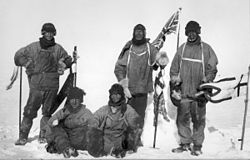
Robert Falcon Scott and his companions reached the Pole a month after Amundsen, but all five died on the return journey, their final diary entries becoming some of the most famous documents in exploration history.
Image source: Terra Nova Expedition
Dec 1912 - Feb 1913
% complete
Douglas Mawson endured an epic solo survival journey after both his companions died, starving and sledging alone back to base—a tale considered one of the greatest survival stories in polar history.
Image source: Australasian Antarctic Expedition
Nov 21, 1915
% complete
The Endurance, trapped in pack ice for months, was crushed and sank, stranding Ernest Shackleton's Imperial Trans-Antarctic Expedition on drifting floes.
Image source: Imperial Trans-Antarctic Expedition
Jan 1916 - Mar 1916
% complete
Despite losing their ship Aurora and three men, the Ross Sea party heroically laid supply depots toward the Beardmore Glacier, though the transcontinental crossing they supported never took place.
Image source: Ross Sea party
Apr 24, 1916 - May 10, 1916
% complete
Shackleton and five men sailed the tiny lifeboat James Caird 800 miles across the Southern Ocean to South Georgia, then crossed its unmapped interior to rescue their stranded crew—with no lives lost.
Image source: Voyage of the James Caird
Nov 28, 1929
% complete
Richard E. Byrd flew over the South Pole in a Ford Trimotor aircraft, ushering in the age of aviation-based Antarctic exploration.
Image source: Richard E. Byrd
Nov 23, 1935
% complete
American explorer Lincoln Ellsworth flew across the continent from Dundee Island to the Ross Ice Shelf, completing the first aerial traverse of Antarctica.
Image source: Lincoln Ellsworth
Aug 26, 1946 - Mar 1947
% complete
The United States Navy launched the largest Antarctic expedition to date, with 13 ships and thousands of personnel conducting extensive mapping and training operations.
Image source: Operation Highjump
Mar 2, 1958
% complete
Vivian Fuchs completed the first overland crossing of Antarctica via the South Pole, aided by Edmund Hillary's route-opening team arriving from the opposite direction—the first successful crossing since Shackleton's failed attempt.
Image source: Commonwealth Trans-Antarctic Expedition
Aug 1982
% complete
Ranulph Fiennes and Charles Burton completed the first pole-to-pole circumnavigation of Earth entirely overland, traversing Antarctica on foot and snowmobile between 1980 and 1982.
Nov 1989 - Feb 1990
% complete
Reinhold Messner and Arved Fuchs crossed Antarctica on foot via the South Pole without dog or motorized support, retracing much of Shackleton's intended route.
Image source: Reinhold Messner
Jan 18, 1993
% complete
Liv Arnesen (with Ann Bancroft in a separate 1993 milestone era) helped pioneer women's unsupported polar travel; Norwegian Liv Arnesen became one of the first women to ski unaided to the South Pole.
Image source: Liv Arnesen
Dec 2018
% complete
Colin O'Brady completed the first solo, unsupported, unassisted crossing of Antarctica, trekking 932 miles from Hercules Inlet to the Ross Ice Shelf in 54 days.
Image source: Colin O'Brady
Dec 1, 1959
% complete
Twelve nations signed the Antarctic Treaty, dedicating the entire continent to peaceful scientific cooperation and freezing all territorial claims—an unprecedented agreement in international diplomacy.
Image source: Antarctic Treaty System
1969
% complete
A team of American women scientists became among the first women officially deployed for research work in Antarctica, breaking decades of exclusion from polar science programs.
Image source: Women in Antarctica
Dec 18, 2010
% complete
Completed at the South Pole after years of drilling kilometers into the glacial ice, the IceCube detector began capturing neutrinos from deep space, transforming the frozen continent into a window on the universe.
Image source: IceCube Neutrino Observatory
Mar 5, 2022
% complete
An international expedition located the remarkably preserved wreck of Shackleton's ship Endurance more than 3,000 meters deep in the Weddell Sea, 107 years after it sank.
Image source: Endurance (1912 ship)
Or browse the full history timeline directory, with more than 2,000 topics.
This History of Antarctic Exploration timeline was generated with the help of AI, using information found on the internet.
We work hard to keep these timelines accurate, but mistakes do get through. If you spot one, email us at [email protected] and we'll fix it for future visitors.
Generate yours with AI or build it from scratch, for free.
Export your timeline, add your own events, edit or remove AI-generated events, and much more
No credit card required.
Cancel anytime.
Cancel anytime.
You can create an unlimited number of timelines with up to 10 events on each one, customize how they look, export them to PDF, PNG, PowerPoint, CSV, and Excel, and share them with a link. Paid plans raise the event limit and add features like spreadsheet imports and collaborators.
Yes. You can cancel your subscription from your account page at any time, and you will not be charged again. Your subscription stays active for the rest of the period you already paid for.
Yes. We will email you a reminder before the annual renewal, and we will also email you a receipt.
Yes. You can email us within 15 days of any payment, and we will issue you a full refund.
Check out our pricing docs or send us an email anytime: [email protected].