
-
Use Cases
-
Resources
-
Pricing
The Dead Sea Scrolls are a collection of nearly 1,000 ancient Jewish manuscripts discovered in caves near Qumran by the Dead Sea between 1947 and 1956. Dating from roughly the third century BCE to the first century CE, they include the oldest known copies of the Hebrew Bible as well as apocryphal texts and sectarian writings, likely associated with a Jewish community such as the Essenes. The scrolls have transformed biblical scholarship and our understanding of Second Temple Judaism and early Christianity. More Less
Nov 1946 - Feb 1947
% complete
The initial discovery of the Dead Sea Scrolls was made by Bedouin shepherd Muhammed edh-Dhib, his cousin Jum'a Muhammed, and Khalil Musa between November 1946 and February 1947, in caves near Ein Feshkha on the northern shore of the Dead Sea in the West Bank.
1947
% complete
The Bedouins and the dealers returned to the site, leaving one scroll with Kando and selling three others to a dealer for seven Jordanian pounds (approximately $28, or $404 in 2025 dollars).
1947
% complete
In 1947 the original seven scrolls caught the attention of Trever of the American Schools of Oriental Research (ASOR), who compared the script in the scrolls to the Nash Papyrus, the oldest biblical manuscript then known, and found similarities between them.
Apr 11, 1948
% complete
On 11 April 1948, Millar Burrows, head of the American Schools of Oriental Research, announced the discovery of the scrolls in a general press release, bringing them to worldwide attention.
Sep 1948
% complete
Early in September 1948, Metropolitan bishop Mar Samuel brought some additional scroll fragments that he had acquired to professor Ovid R. Sellers for examination.
Dec 31, 1948
% complete
By the end of 1948, nearly two years after the discovery of the scrolls, scholars had yet to locate the original cave where the fragments had been found.
Jan 28, 1949
% complete
In early 1949, the government of Jordan granted permission to the Arab Legion to search the area. Cave 1 was rediscovered on 28 January 1949 by Belgian United Nations observer captain Phillipe Lippens and Arab Legion captain Akkash el-Zebn.
Feb 15, 1949 - Mar 5, 1949
% complete
The rediscovery of what became known as Cave 1 at Qumran prompted the initial excavation of the site from 15 February to 5 March 1949 by the Jordanian Department of Antiquities, led by Gerald Lankester Harding and Roland de Vaux.
Nov 1951
% complete
In November 1951, Roland de Vaux and his team from the ASOR began a full excavation of the Hellenistic Jewish settlement site of Qumran in the eastern Judaean Desert.
Image source: Qumran
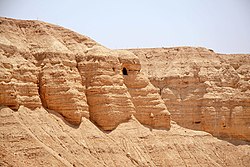
Feb 1952
% complete
By February 1952, the Bedouins had discovered 30 fragments in what was to be designated Cave 2 near Qumran.
Mar 14, 1952
% complete
On 14 March 1952, the ASOR team discovered a third cave containing fragments of Jubilees and the Copper Scroll.
Sep 1952 - Dec 1952
% complete
Between September and December 1952, the fragments and scrolls of Caves 4, 5, and 6 were discovered by the ASOR teams working around Qumran.
Sep 22, 1952 - Sep 29, 1952
% complete
Wadi Qumran Cave 4 was excavated from 22 to 29 September 1952 by Gerald Lankester Harding, Roland de Vaux, and Józef Milik, yielding a vast trove of fragments.
1953 - 1956
% complete
Between 1953 and 1956, Roland de Vaux led four more archaeological expeditions in the area to uncover additional scrolls and artefacts.
Image source: Roland de Vaux
1956
% complete
Wadi Qumran Cave 11 was discovered in 1956 and yielded 21 texts of the Dead Sea Scrolls, some of which were quite lengthy—the last fragments found in the vicinity of Qumran.
1957
% complete
Carved into the southern end of the Qumran plateau, caves 8 and 9 were excavated by archaeologists in 1957.
Feb 2017
% complete
In February 2017, Hebrew University archaeologists announced the discovery of a new 12th cave on cliffs west of Qumran, near the north-western shore of the Dead Sea.
Image source: Qumran Caves
2021
% complete
In 2021, more scrolls were discovered by Israeli authorities in a different cave near the Dead Sea called the Cave of Horrors.
Image source: Cave of Horrors
Mar 2021
% complete
In March 2021, Israeli archaeologists announced the discovery of dozens of fragments bearing biblical text, written in Greek, from the books of Zechariah and Nahum.
Image source: Dead Sea Scrolls
Feb 21, 1948
% complete
John Trever photographed three of the scrolls discovered in Cave 1 on 21 February 1948, both on black-and-white and color film, creating an important early visual record of the manuscripts.
1952
% complete
In 1952 the Jordanian Department of Antiquities assembled a team of scholars to begin examining, assembling, and translating the scrolls with the intent of publishing them.
1952 - 1967
% complete
Between 1952 and 1967, photographer Najib Albina documented the five-stage process of the sorting and assembly of the scrolls done by the curator and staff of the Palestine Archaeological Museum, using infrared photography.
1955
% complete
The initial publication, assembled by Dominique Barthélemy and Józef Milik, was published as Qumran Cave 1 in 1955, beginning the Discoveries in the Judaean Desert series by Oxford University Press.
1990 - 2009
% complete
With the appointment of Dutch-Israeli textual scholar Emanuel Tov as editor-in-chief of the Dead Sea Scrolls Publication Project in 1990, publication accelerated. His team produced five volumes covering the Cave 4 documents by 1995 and 32 volumes between 1990 and 2009.
Image source: Emanuel Tov
1991
% complete
The long-running controversy over access to unpublished scrolls ended in 1991, when the Biblical Archaeology Society published the 'Facsimile Edition of the Dead Sea Scrolls', after an intervention of the Israeli government and the IAA.
1991
% complete
In 1991, researchers Ben Zion Wacholder and Martin Abegg at Hebrew Union College in Cincinnati announced the creation of a computer program that used previously published scrolls to reconstruct the unpublished texts.
1991
% complete
In 1991, Emanuel Tov was appointed as the chairman of the Dead Sea Scrolls Foundation, and publication of the scrolls followed in the same year.
1993
% complete
Beginning in 1993, NASA used digital infrared imaging technology to produce photographs of Dead Sea Scrolls fragments, revealing text invisible to the naked eye.
Nov 2007
% complete
In November 2007 the Dead Sea Scrolls Foundation commissioned London publisher Facsimile Editions Limited to produce facsimile editions of The Great Isaiah Scroll (1QIsaa), The Order of the Community (1QS), and The Pesher to Habakkuk (1QpHab), based on 1948 photographs.
Image source: Isaiah Scroll
2009
% complete
The content of the scrolls was published in a 40-volume series by Oxford University Press between 1955 and 2009 known as Discoveries in the Judaean Desert; the final volume, Volume XL, was published in 2009.
May 2009
% complete
A further 46 sets including facsimiles of three fragments from Cave 4—Testimonia (4Q175), Pesher Isaiahb (4Q162), and Qohelet (4Q109), now in the National Archaeological Museum in Amman, Jordan—were announced in May 2009.
Sep 25, 2011
% complete
On 25 September 2011 the Israel Museum Digital Dead Sea Scrolls site went online. Since 2011, five complete scrolls have been digitized: the Great Isaiah Scroll, Community Rule Scroll, Commentary on Habakkuk Scroll, Temple Scroll, and War Scroll.
Image source: Shrine of the Book
Dec 18, 2012
% complete
On 18 December 2012 the first output of the IAA digitization project was launched together with Google on the dedicated site Deadseascrolls.org.il, making high-resolution images of the scrolls freely accessible online.
Image source: List of the Dead Sea Scrolls
Mar 1948
% complete
In March 1948 the 1948 Arab–Israeli War prompted the move of some of the scrolls to Beirut, Lebanon, for safekeeping amid the regional conflict.
Jan 1953
% complete
In early 1953, the scrolls were moved to the Palestine Archaeological Museum (commonly called the Rockefeller Museum) in Jordanian-held East Jerusalem, and through their transportation suffered more deterioration and damage.
Image source: Rockefeller Archeological Museum
Jun 1, 1954
% complete
Four of the Dead Sea Scrolls eventually went up for sale in an advertisement placed on 1 June 1954 in The Wall Street Journal.
Jul 1, 1954
% complete
On 1 July 1954, the scrolls, after delicate negotiations and accompanied by three people including Mar Samuel, arrived at the Waldorf-Astoria Hotel in New York.
Jul 1954
% complete
The scrolls were purchased by Professor Mazar and Yigael Yadin, son of Professor Sukenik, for $250,000 (approximately $3,000,000 in 2025 dollars), and brought to Jerusalem.
Image source: Yigael Yadin
Apr 1965
% complete
The majority of the Dead Sea Scrolls collection, which had been kept at the Rockefeller Museum, was moved to Jerusalem's Shrine of the Book (a part of the Israel Museum) after the building's completion in April 1965.
Nov 1966
% complete
The Palestine Archaeological Museum, which operated under an international board, was nationalized by Jordan's King Hussein in November 1966, shortly before Jordan lost control of East Jerusalem in the 1967 Arab–Israeli War.
1967
% complete
Following the 1967 Arab–Israeli War, Jordan was defeated and Israel began to occupy the West Bank and East Jerusalem, bringing the scrolls under Israeli custody—a status disputed by Jordan and the Palestinian Authority on territorial, legal, and humanitarian grounds.
Image source: Six-Day War
1992 - 2000
% complete
In 1992 a copyright case, Qimron v. Shanks, began over unauthorized publication of reconstructed scroll text. In 1993 district court Judge Dalia Dorner ruled for Elisha Qimron; in 2000 the Israeli Supreme Court under Judge Aharon Barak upheld the verdict in Qimron's favour.
Image source: Dead Sea Scrolls
2002
% complete
Since 2002, many forgeries of Dead Sea Scrolls have appeared on black markets, complicating scholarship and collecting.
Image source: Museum of the Bible
2013
% complete
Since 2013, the part of the Dead Sea Scrolls collection held by Jordan has been on display at The Jordan Museum in Amman.
Image source: Jordan Museum
2020
% complete
In 2020, the Museum of the Bible in the United States reported that all 16 purported 'Dead Sea Scroll fragments' it had acquired between 2009 and 2014 were in fact modern forgeries.
1950
% complete
The initial radiocarbon test performed in 1950 was on a piece of linen from one of the caves, providing early scientific dating evidence related to the scrolls' context.
1952
% complete
Nine tiny Tefillin strips were excavated in 1952 and then stored unopened for six decades before being rediscovered by the Israel Antiquities Authority in 2014.
1956 - 1957
% complete
Damp conditions from temporary storage of the scrolls in the Ottoman Bank vault from 1956 to 1957 led to a more rapid rate of deterioration of the scrolls.
1958
% complete
By 1958 it was noted that up to 5% of some of the scrolls had completely deteriorated, highlighting the urgent need for better conservation measures.
1979
% complete
Gerald Lankester Harding, director of the Jordanian Department of Antiquities, began working on piecing the fragments together but did not finish this work before his death in 1979.
Image source: Gerald Lankester Harding
1991
% complete
In 1991, the Israel Antiquities Authority established a temperature-controlled laboratory for the storage and preservation of the scrolls, greatly improving conservation conditions.
Image source: Israel Antiquities Authority
2014
% complete
Nine tiny Tefillin strips were rediscovered by the Israel Antiquities Authority in 2014, after they had been stored unopened for six decades following their excavation in 1952.
2020
% complete
In a paper published in 2020 in the journal Cell, researchers from Tel Aviv University showed that DNA extracted from the scrolls can be used to sort different scroll fragments based on animal species and variations in the nuclear genome of individual fragments.
2025
% complete
In 2025, a series of radiocarbon tests were carried out on samples from thirty scrolls. The study found earlier dates and coexistence of Herodian and Hasmonean scripts into the 2nd and 3rd century BCE, and possible pre-Hasmonean evidence of scribal literacy.
2025
% complete
A new study published in 2025 used artificial intelligence to analyze the scrolls. Analysis shows that the date range of the Herodian manuscripts is much wider than previously thought, proposed to extend 'from the second century CE all the way back to the second century BCE'.
Or browse the full history timeline directory, with more than 2,000 topics.
This Dead Sea Scrolls timeline was generated with the help of AI, using information found on the internet.
We work hard to keep these timelines accurate, but mistakes do get through. If you spot one, email us at [email protected] and we'll fix it for future visitors.
Generate yours with AI or build it from scratch, for free.
Export your timeline, add your own events, edit or remove AI-generated events, and much more
No credit card required.
Cancel anytime.
Cancel anytime.
You can create an unlimited number of timelines with up to 10 events on each one, customize how they look, export them to PDF, PNG, PowerPoint, CSV, and Excel, and share them with a link. Paid plans raise the event limit and add features like spreadsheet imports and collaborators.
Yes. You can cancel your subscription from your account page at any time, and you will not be charged again. Your subscription stays active for the rest of the period you already paid for.
Yes. We will email you a reminder before the annual renewal, and we will also email you a receipt.
Yes. You can email us within 15 days of any payment, and we will issue you a full refund.
Check out our pricing docs or send us an email anytime: [email protected].