
-
Use Cases
-
Resources
-
Pricing
Sherman's March to the Sea was a military campaign led by Union General William Tecumseh Sherman during the American Civil War. From November to December 1864, Sherman's forces marched from Atlanta to Savannah, Georgia, using 'total war' tactics—destroying railroads, crops, and infrastructure—to cripple the Confederacy's ability to wage war and break Southern civilian morale. More Less
1860
% complete
The 1860 United States census collected livestock and crop production data that Sherman would later use in planning his march, allowing him to lead his troops through areas of Georgia where he believed they would be able to forage most effectively.
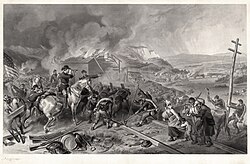
Image source: Sherman's March to the Sea
1864
% complete
Sherman's Special Field Orders No. 120 prohibited Union soldiers from entering Confederate dwellings and encouraged soldiers to appropriate Confederate horses, mules, and wagons only from 'the rich', mitigating some effects of the previous year's Lieber Code.
1864
% complete
Orders such as Special Field Orders No. 120 indicated that should guerrillas or bushwhackers molest the march, or inhabitants burn bridges or obstruct roads, army commanders should enforce a devastation more or less relentless according to the measure of such hostility.
May 1864
% complete
Union major general William T. Sherman launched the Atlanta campaign of May to September 1864, the successful operation against Confederate forces in Georgia whose capture set the stage for his subsequent March to the Sea.
Sep 1864
% complete
Sherman's successful Atlanta campaign of May to September 1864 concluded with Union forces in control of the vital rail hub of Atlanta, giving Sherman the strategic position from which he proposed to march across Georgia.
Oct 1864
% complete
In planning the march, Sherman used livestock and crop production data from the 1860 United States census to route his troops through areas of Georgia where they could forage most effectively off the land.
Nov 2, 1864
% complete
General Ulysses S. Grant trusted Sherman's assessment and on November 2, 1864 sent him a telegram stating simply, 'Go as you propose,' giving final approval for the march across Georgia toward Savannah.
Nov 15, 1864
% complete
On November 15, 1864, the 300-mile (480 km) march began as Sherman's Union armies departed the captured city of Atlanta and cut loose from their supply lines, beginning the Savannah campaign through the heart of Georgia.
Nov 15, 1864 - Dec 21, 1864
% complete
Throughout the march, Union troops sustained themselves by foraging livestock and crops from the countryside, guided by the 1860 census data Sherman had used to select routes through Georgia's most productive regions.
Nov 15, 1864 - Dec 21, 1864
% complete
Following Special Field Orders No. 120, which discouraged entering dwellings, Union soldiers appropriated Confederate horses, mules, and wagons during the march — officially only from 'the rich' — as part of the campaign's economic warfare.
Nov 15, 1864 - Dec 21, 1864
% complete
As the armies advanced through Georgia, they destroyed railroads, infrastructure, and resources supporting the Confederate war effort, inflicting damage that Sherman himself would later estimate at $100 million in destruction.
Nov 15, 1864 - Dec 21, 1864
% complete
Per Sherman's field orders, any guerrilla attacks, burned bridges, obstructed roads, or other manifestations of local hostility along the route justified a 'devastation more or less relentless according to the measure of such hostility.'
Nov 15, 1864 - Dec 21, 1864
% complete
Thousands of enslaved African Americans sought freedom behind Union lines as the armies moved through Georgia, with many risking their lives to follow the columns — an experience later commemorated by a historical marker erected in 2011.
Nov 15, 1864 - Dec 21, 1864
% complete
Union soldiers sang many songs during the March, though it was one written afterward, Henry Clay Work's 'Marching Through Georgia', that came to symbolize the campaign in American memory.
Image source: Marching Through Georgia
Dec 21, 1864
% complete
On December 21, 1864, the Savannah campaign concluded when Sherman's forces captured the port city of Savannah, Georgia, completing the 300-mile march begun six weeks earlier and presenting the city to President Lincoln as a Christmas gift.
Dec 1864
% complete
Sherman estimated that the campaign had inflicted $100 million (equivalent to about $1,038 million in 2025) in destruction, noting that roughly one fifth 'inured to our advantage' while the remainder was 'simple waste and destruction'.
1865
% complete
According to a 2022 American Economic Journal study, the capital destruction induced by the March led to a large contraction in agricultural investment, farming asset prices, and manufacturing activity in affected areas.
Apr 26, 1865
% complete
Confederate General Joseph E. Johnston surrendered his forces to Sherman in North Carolina on April 26, 1865, following Sherman's continuation of operations into the Carolinas after the fall of Savannah.
1865
% complete
Henry Clay Work wrote 'Marching Through Georgia' in 1865, and although Union soldiers had sung other songs during the March itself, this later tune came to symbolize the campaign more than any song sung at the time.
1920
% complete
A 2022 American Economic Journal study measuring the medium- and long-term economic impact of the March found that elements of the decline in agriculture persisted through 1920, demonstrating enduring economic scars from the capital destruction.
1929
% complete
In 1929, British military historian B. H. Liddell Hart published influential analysis of Sherman's campaigns, contributing to long-running assessments of the strategic significance of the March to the Sea.
1940
% complete
Written in 1865, 'Marching Through Georgia' remained widely popular among US soldiers of 20th-century wars, cementing its place as the enduring musical symbol of Sherman's campaign.
2011
% complete
In 2011, the Georgia Historical Society erected a historical marker to commemorate the African Americans who had risked so much for freedom during Sherman's March through Georgia.
2012
% complete
Authors of two 2012 studies, Brady and Nelson, argued that absolute destruction and dislocation take many forms and must ultimately be defined by the victims of war, fueling historiographical debates between scorched earth 'hard war' proponents and 'total war' mainstays.
2014
% complete
Historians noted that historiographical debates between 'hard war' and 'total war' proponents threatened to overshadow studies on the ecological devastation wrought by campaigns such as the Valley Campaigns of 1864.
2014
% complete
In a 2014 review essay, historian Daniel E. Sutherland and others highlighted neglected topics including Union soldier violations of the 'spatial and corporeal privacy' of Confederate women during the Carolinas campaign.
2022
% complete
A 2022 American Economic Journal study sought to measure the medium- and long-term economic impact of Sherman's March, finding that the capital destruction induced by the March caused large contractions in farming investment, asset prices, and manufacturing.
2023
% complete
In a 2023 encyclopedia entry on irregular civilian, southern Unionist, and guerrilla warfare, historian Matthew Stith conceded that critics of 'total war' usages in Civil War historiography were often 'heavy-handed', while debates over the war's severity still begged for attention.
2023
% complete
Recent scholarship on 'irregular warfare' exacerbated but also reconfigured challenges in counting civilians and counting combatants during the Civil War, complicating assessments of the human cost of campaigns like the March.
2023
% complete
Matthew Stith's 2023 entry observed that debates about the nature of guerrillas themselves — noble warriors or bloodthirsty criminals — beg for more attention, even if each side might consider the case closed regarding the war's severity.
Or browse the full history timeline directory, with more than 2,000 topics.
This Sherman's March to the Sea timeline was generated with the help of AI, using information found on the internet.
We work hard to keep these timelines accurate, but mistakes do get through. If you spot one, email us at [email protected] and we'll fix it for future visitors.
Generate yours with AI or build it from scratch, for free.
Export your timeline, add your own events, edit or remove AI-generated events, and much more
No credit card required.
Cancel anytime.
Cancel anytime.
You can create an unlimited number of timelines with up to 10 events on each one, customize how they look, export them to PDF, PNG, PowerPoint, CSV, and Excel, and share them with a link. Paid plans raise the event limit and add features like spreadsheet imports and collaborators.
Yes. You can cancel your subscription from your account page at any time, and you will not be charged again. Your subscription stays active for the rest of the period you already paid for.
Yes. We will email you a reminder before the annual renewal, and we will also email you a receipt.
Yes. You can email us within 15 days of any payment, and we will issue you a full refund.
Check out our pricing docs or send us an email anytime: [email protected].