-
Use Cases
-
Resources
-
Pricing
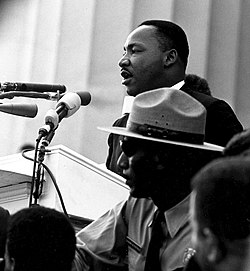
The March on Washington for Jobs and Freedom was a massive peaceful demonstration held in Washington, D.C., on August 28, 1963. Organized by civil rights, labor, and religious organizations, it drew approximately 250,000 participants and became one of the largest political rallies for human rights in U.S. history. The march is best remembered as the setting for Dr. Martin Luther King Jr.'s historic 'I Have a Dream' speech, delivered from the steps of the Lincoln Memorial. It played a crucial role in building support for the Civil Rights Act of 1964 and the Voting Rights Act of 1965. More Less
1877
% complete
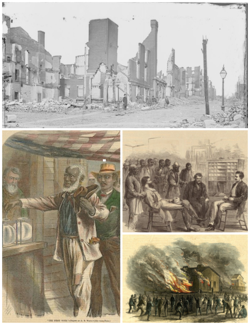
After the American Civil War, African Americans were freed from slavery under the Thirteenth Amendment, granted citizenship by the Fourteenth Amendment, and African American men gained full voting rights through the Fifteenth Amendment. However, Democrats regained power after the end of the Reconstruction era in 1877 and imposed many restrictions on people of color in the South.
Image source: Reconstruction era
1900
% complete
At the turn of the century, Southern states passed constitutions and laws that disenfranchised most black people and many poor whites, excluding them from the political system.
Image source: Disfranchisement after the Reconstruction era
1901 - 1963
% complete
During the 20th century, civil rights organizers began to develop ideas for a march on Washington, D.C., to seek justice.
Image source: March on Washington for Jobs and Freedom
Apr 9, 1939
% complete
In 1939, the Daughters of the American Revolution refused permission for Marian Anderson to sing to an integrated audience in Constitution Hall. With support from Eleanor Roosevelt, Anderson performed a critically acclaimed open-air concert on Easter Sunday, 1939, on the steps of the Lincoln Memorial.
Image source: Marian Anderson
1954
% complete
The Supreme Court ruled that segregation of public schools was unconstitutional in 1954, in Brown v. Board of Education. Immediate elimination of school segregation became one of the demands connected to the civil rights movement.
May 17, 1957
% complete
Their Prayer Pilgrimage for Freedom, held at the Lincoln Memorial on May 17, 1957, featured key leaders including Adam Clayton Powell, Martin Luther King Jr., and Roy Wilkins.
May 24, 1963
% complete
On May 24, 1963, Attorney General Robert F. Kennedy met with civil rights leaders amid growing national attention to racial inequality. There was a widespread perception that the Kennedy administration had not lived up to its promises in the 1960 election, and King described Kennedy's race policy as "tokenism".
Jun 11, 1963
% complete
On June 11, 1963, President Kennedy gave a notable civil rights address on national television and radio, announcing that he would begin to push for civil rights legislation.
Image source: Report to the American People on Civil Rights
Jun 12, 1963
% complete
That night (early morning of June 12, 1963), Mississippi activist Medgar Evers was murdered in his own driveway, further escalating national tension around the issue of racial inequality.
Image source: Medgar Evers
1941
% complete
Philip Randolph—the president of the Brotherhood of Sleeping Car Porters, president of the Negro American Labor Council, and vice president of the AFL–CIO—was a key instigator in 1941 of plans for a mass march on Washington.
Image source: A. Philip Randolph
Jun 25, 1941
% complete
Faced with a mass march scheduled for July 1, 1941, President Franklin D. Roosevelt issued Executive Order 8802 on June 25, addressing discrimination in defense industries.
Image source: Executive Order 8802
1947
% complete
Bayard Rustin, who would later administer mobilization and logistics for the 1963 march, organized the 1947 Journey of Reconciliation, the first of the Freedom Rides to test the Supreme Court ruling that banned racial discrimination in interstate travel.
Image source: Journey of Reconciliation
Dec 1961
% complete
Philip Randolph and Bayard Rustin began planning the march in December 1961, laying the groundwork for what would become the March on Washington for Jobs and Freedom.
Jan 1963
% complete
In early 1963, Randolph and Rustin called publicly for "a massive March on Washington for jobs".
May 15, 1963
% complete
On May 15, 1963, without securing the cooperation of the NAACP or the Urban League, Randolph announced an "October Emancipation March on Washington for Jobs".
Jun 1963
% complete
In June 1963, leaders from several different organizations formed the Council for United Civil Rights Leadership, an umbrella group to coordinate funds and messaging.
Image source: Council for United Civil Rights Leadership
Jul 1963 - Aug 1963
% complete
Organizers agreed that white and black people marching side by side would create a more powerful image. They promoted the march by selling buttons featuring two hands shaking, the words "March on Washington for Jobs and Freedom", a union bug, and the date August 28, 1963.
Aug 1963
% complete
The committee, notably Rustin, agreed to move the site on the condition that Reuther pay for a $19,000 (equivalent to $172,500 in 2021) sound system so that everyone on the National Mall could hear the speakers and musicians.
Aug 28, 1963
% complete
Martin Luther King Jr. delivered his famous "I Have a Dream" speech during the March on Washington. Liberals and conservatives tended to embrace the March, but focused mostly on King's speech and the legislative successes of 1964 and 1965.
Image source: I Have a Dream
Aug 28, 1963
% complete
The March on Washington for Jobs and Freedom (commonly known as the March on Washington or the Great March on Washington) was held in Washington, D.C., on August 28, 1963. It was part of the rapidly expanding Civil Rights Movement, which involved demonstrations and nonviolent direct action across the United States, and marked the 100th anniversary of the signing of the Emancipation Proclamation by President Abraham Lincoln.
Jul 2, 1964
% complete
The march is credited with helping to pass the Civil Rights Act of 1964, which was signed into law by President Lyndon B. Johnson.
Image source: Civil Rights Act of 1964
1965
% complete
The march preceded the Selma voting rights movement, when national media coverage contributed to passage of the Voting Rights Act of 1965 that same year. The 1963 March spurred political momentum for both landmark laws.
Apr 17, 1965
% complete
The 1963 March inspired later demonstrations, including the SDS-sponsored 1965 March on Washington to End the War in Vietnam.
Image source: Opposition to United States involvement in the Vietnam War
1967 - 1968
% complete
In 1967–1968, Martin Luther King Jr. organized a Poor People's Campaign to occupy the National Mall with a shantytown, building on the economic justice goals of the 1963 march.
Image source: Poor People's Campaign
Oct 14, 1979
% complete
The 1979 National March on Washington for Lesbian and Gay Rights was among the demonstrations inspired by the model of the 1963 March on Washington.
1983
% complete
The 1963 March also spurred anniversary marches that occur every five years, with the 20th and 25th being some of the most well known.
2013
% complete
In 2013, the Economic Policy Institute launched a series of reports around the theme of "The Unfinished March". Dedrick Muhammad of the NAACP writes that racial inequality of income and homeownership have increased since 1963 and worsened during the Great Recession.
Image source: Economic Policy Institute
Aug 23, 2013
% complete
For the 50th anniversary of the 1963 March, the United States Postal Service released a forever stamp that commemorated it.
Image source: United States Postal Service
Aug 28, 2013
% complete
At the 50th anniversary march in 2013, President Barack Obama conferred a posthumous Presidential Medal of Freedom on Bayard Rustin and 15 others.
Image source: Bayard Rustin
Jan 21, 2017
% complete
The 2017 Women's March on Washington was another example of large-scale demonstrations in Washington, D.C., following the tradition established by the 1963 March.
Image source: 2017 Women's March
Jul 20, 2020
% complete
On July 20, 2020, the NAACP, one of the original organizers of the 1963 march, announced that it would commemorate it by organizing another rally on the steps of the Lincoln Memorial, in which King's oldest son, Martin Luther King III, would join civil rights leaders and the families of black men and women who died as a result of police brutality. An online tie-in event was also planned, called the 2020 Virtual March on Washington.
Aug 28, 2021
% complete
On August 28, 2021, a march calling for voting rights and statehood for Washington D.C. was held, continuing the legacy of the 1963 March on Washington.
Image source: March on Washington
2023
% complete
The story of Bayard Rustin's role in the organization of the March on Washington was told in the film Rustin (2023).
Image source: Rustin (film)
Aug 26, 2023
% complete
On August 26, 2023, a march was held in Washington D.C on the 60th anniversary of the March on Washington.
Or browse the full history timeline directory, with more than 2,000 topics.
This March on Washington timeline was generated with the help of AI, using information found on the internet.
We work hard to keep these timelines accurate, but mistakes do get through. If you spot one, email us at [email protected] and we'll fix it for future visitors.
Generate yours with AI or build it from scratch, for free.
Export your timeline, add your own events, edit or remove AI-generated events, and much more
No credit card required.
Cancel anytime.
Cancel anytime.
You can create an unlimited number of timelines with up to 10 events on each one, customize how they look, export them to PDF, PNG, PowerPoint, CSV, and Excel, and share them with a link. Paid plans raise the event limit and add features like spreadsheet imports and collaborators.
Yes. You can cancel your subscription from your account page at any time, and you will not be charged again. Your subscription stays active for the rest of the period you already paid for.
Yes. We will email you a reminder before the annual renewal, and we will also email you a receipt.
Yes. You can email us within 15 days of any payment, and we will issue you a full refund.
Check out our pricing docs or send us an email anytime: [email protected].