-
Use Cases
-
Resources
-
Pricing
Washington, D.C., the capital of the United States, was established in 1790 as the result of a compromise between Alexander Hamilton and Thomas Jefferson. Built on land ceded by Maryland and Virginia along the Potomac River, the city was designed by Pierre Charles L'Enfant and has since witnessed pivotal moments in American history, including the burning of government buildings during the War of 1812, the Civil War, the March on Washington in 1963, and its evolution into a global political center. More Less
Jul 16, 1790
% complete
Congress passed the Residence Act, authorizing President George Washington to select a site along the Potomac River for the new federal capital. The compromise, brokered through the Compromise of 1790, placed the capital on the Potomac in exchange for southern support of federal assumption of state debts.
Image source: Residence Act
Mar 1791
% complete
French-born architect Pierre Charles L'Enfant created the original plan for Washington, D.C., featuring grand diagonal avenues radiating from key sites, broad boulevards, public squares, and reserved space for monumental buildings. His vision shaped the capital's distinctive layout.
Image source: Pierre Charles L'Enfant
Oct 13, 1792
% complete
The cornerstone of what became known as the White House was laid in a Freemason ceremony. Designed by James Hoban, the presidential mansion took eight years to complete and became the official residence of U.S. presidents beginning with John Adams.
Image source: White House
Sep 18, 1793
% complete
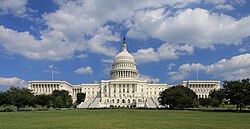
President George Washington laid the cornerstone of the Capitol building in a ceremony attended by Masonic lodges. The Capitol would become home to both houses of Congress and an enduring symbol of American democracy.
Image source: United States Capitol
Jun 11, 1800
% complete
The federal government officially relocated to Washington, D.C. when Congress convened in the partially completed Capitol. President John Adams moved into the White House later that year, making it the permanent seat of U.S. government.
Image source: History of Washington, D.C.
May 3, 1802
% complete
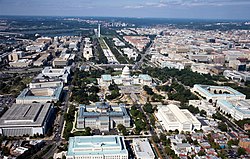
The District of Columbia was organized under a single municipal government, with Georgetown and Alexandria incorporated as part of the federal district. An appointed mayor governed the newly consolidated City of Washington.
Image source: District of Columbia Organic Act of 1801
Aug 24, 1814 - Aug 26, 1814
% complete
British troops captured Washington, D.C., setting fire to the Capitol, the White House, and other government buildings in retaliation for American destruction in York (Toronto). A sudden storm helped extinguish the flames, and the city's reconstruction began soon after.
Image source: Burning of Washington
Jul 4, 1828
% complete
President John Quincy Adams broke ground for the C&O Canal, intended to link the capital with the Ohio River Valley. Though never completed past Cumberland, Maryland, the canal boosted Washington's economy and spurred early commercial growth along the Potomac.
Image source: Chesapeake and Ohio Canal
Jul 9, 1846
% complete
Residents of Alexandria County successfully petitioned Congress to return the district's Virginia portion to Virginia. Concerns over slavery restrictions and lack of representation drove the retrocession, shrinking the district's original diamond shape.
Image source: District of Columbia retrocession
1871 - 1874
% complete
'Boss' Shepherd, head of the territorial government's Board of Public Works, oversaw massive infrastructure improvements—paving streets, laying sewers, and planting trees—that transformed Washington into a modern city, though at enormous cost that led to his removal.
Image source: Alexander Robey Shepherd
Oct 27, 1907
% complete
Union Station opened as one of the largest railroad stations in the world, designed by Daniel Burnham in the Beaux-Arts style. It transformed transportation access to the capital and anchored development around the new Mall plan.
Image source: Washington Union Station
Mar 4, 1933
% complete
Franklin D. Roosevelt's New Deal dramatically expanded the federal workforce, filling Washington with new agencies and workers. Massive federal buildings rose across the city, cementing its role as the administrative center of an activist government.
Image source: New Deal
Jan 15, 1943
% complete
Built in just sixteen months across the Potomac River in Arlington, the Pentagon housed the War Department's expanding operations during World War II. Its five-sided design became an enduring symbol of the American military establishment.
Image source: The Pentagon
Mar 27, 1976
% complete
The Washington Metro opened its first segment between Farragut North and Rhode Island Avenue, launching a rapid transit network praised for its Brutalist architecture. Metro reshaped regional commuting and spurred transit-oriented development.
Image source: Washington Metro
Apr 1848
% complete
After 77 enslaved people attempted escape aboard the schooner Pearl, pro-slavery mobs rioted in Washington, attacking abolitionist newspapers. The incident highlighted deep divisions over slavery in the capital and intensified national debate.
Image source: Pearl incident
Sep 18, 1850
% complete
As part of the Compromise of 1850, Congress abolished the slave trade within Washington, D.C., though slavery itself remained legal until the Civil War. The measure reflected growing sectional tensions over slavery in the nation's capital.
Image source: Compromise of 1850
Apr 16, 1862
% complete
Lincoln signed the D.C. Compensated Emancipation Act, freeing about 3,100 enslaved people in the capital nine months before the Emancipation Proclamation. Slaveholders received compensation, making it the first major emancipation of the war era.
Image source: District of Columbia Compensated Emancipation Act
Jan 1, 1863
% complete
President Abraham Lincoln issued the Emancipation Proclamation from the White House, declaring enslaved people in rebelling states free. The proclamation transformed the Civil War into a fight for freedom and reshaped life in wartime Washington.
Image source: Emancipation Proclamation
1868
% complete
Following the Civil War, Washington's large African American community began gaining political influence. Black residents voted in significant numbers, and by 1868 the city elected its first African American officeholders amid Reconstruction-era reforms.
Jun 17, 1932 - Jul 28, 1932
% complete
Tens of thousands of World War I veterans camped in Washington demanding payment of promised bonuses. After Congress refused, the U.S. Army forcibly evicted them, an event that damaged Herbert Hoover's reputation and influenced New Deal politics.
Image source: Bonus Army
May 17, 1954
% complete
The Supreme Court's Brown v. Board ruling accelerated school desegregation in Washington, which had been among the first cities ordered to integrate its schools. The decision marked a turning point in the civil rights struggle nationwide.
Mar 29, 1961
% complete
Ratification of the Twenty-third Amendment granted District of Columbia residents the right to vote in presidential elections, giving the capital three electoral votes—the first time D.C. citizens could participate in choosing the president.
Image source: Twenty-third Amendment to the United States Constitution
Aug 28, 1963
% complete
A quarter million people gathered at the Lincoln Memorial for the March on Washington for Jobs and Freedom, where Martin Luther King Jr. delivered his 'I Have a Dream' speech, becoming one of the largest political rallies for human rights in U.S. history.
Image source: March on Washington for Jobs and Freedom
Apr 4, 1968 - Apr 8, 1968
% complete
Following Dr. King's assassination, riots erupted along Washington's 14th Street corridor and H Street NE. Four days of unrest left twelve dead and devastated many neighborhoods, some of which took decades to recover economically.
Image source: 1968 Washington, D.C., riots
Dec 24, 1973
% complete
Congress passed the District of Columbia Self-Government and Governmental Reorganization Act, allowing residents to elect their own mayor and city council. Walter Washington became the first elected mayor in 1975, ending a century of direct congressional control over local affairs.
Dec 6, 1884
% complete
After decades of delays caused by funding shortages and the Civil War, the 555-foot obelisk honoring George Washington was completed. At the time, it was the tallest structure in the world and quickly became the capital's defining landmark.
Image source: Washington Monument
1901 - 1902
% complete
The Senate Park Commission, inspired by L'Enfant's original design, produced the McMillan Plan to restore the National Mall as a monumental green space lined with museums and memorials, extending the capital's grand Beaux-Arts aesthetic.
Image source: McMillan Plan
May 30, 1922
% complete
Dedicated before a crowd including Robert Todd Lincoln, the Lincoln Memorial featured Daniel Chester French's seated statue of Abraham Lincoln. It became a hallowed site for civil rights gatherings, most famously Martin Luther King Jr.'s 1963 speech.
Image source: Lincoln Memorial
Apr 13, 1943
% complete
On the bicentennial of Thomas Jefferson's birth, President Roosevelt dedicated the domed memorial on the Tidal Basin. The neoclassical structure honored the Declaration of Independence author amid wartime reflection on democratic ideals.
Image source: Jefferson Memorial
Nov 13, 1982
% complete
Maya Lin's minimalist black granite wall bearing the names of more than 58,000 Americans killed in Vietnam was unveiled near the Lincoln Memorial. Initially controversial, it became one of the most visited and emotionally powerful memorials in the nation.
Image source: Vietnam Veterans Memorial
Sep 21, 2004
% complete
The Smithsonian opened its museum dedicated to Native American cultures on the National Mall, completing a major expansion of museum spaces. Its curving limestone architecture marked a new era of culturally expressive design on the Mall.
Image source: National Museum of the American Indian
Sep 24, 2016
% complete
President Barack Obama dedicated the Smithsonian's newest museum, designed by David Adjaye, chronicling African American history and culture. It drew millions of visitors and became a defining addition to the National Mall.
Image source: National Museum of African American History and Culture
Or browse the full history timeline directory, with more than 2,000 topics.
This History of Washington DC timeline was generated with the help of AI, using information found on the internet.
We work hard to keep these timelines accurate, but mistakes do get through. If you spot one, email us at [email protected] and we'll fix it for future visitors.
Generate yours with AI or build it from scratch, for free.
Export your timeline, add your own events, edit or remove AI-generated events, and much more
No credit card required.
Cancel anytime.
Cancel anytime.
You can create an unlimited number of timelines with up to 10 events on each one, customize how they look, export them to PDF, PNG, PowerPoint, CSV, and Excel, and share them with a link. Paid plans raise the event limit and add features like spreadsheet imports and collaborators.
Yes. You can cancel your subscription from your account page at any time, and you will not be charged again. Your subscription stays active for the rest of the period you already paid for.
Yes. We will email you a reminder before the annual renewal, and we will also email you a receipt.
Yes. You can email us within 15 days of any payment, and we will issue you a full refund.
Check out our pricing docs or send us an email anytime: [email protected].