-
Use Cases
-
Resources
-
Pricing
The history of Washington State spans thousands of years, beginning with Indigenous peoples such as the Coast Salish, Chinook, and Yakama who inhabited the region for millennia. European exploration arrived in the late 18th century, followed by the fur trade, the Oregon Trail migrations, and the establishment of the Oregon Territory. Washington became a U.S. territory in 1853 and the 42nd state on November 11, 1889. Its economy grew through timber, fishing, agriculture, and later aerospace giants like Boeing, transforming it into a major hub of technology and commerce in the Pacific Northwest. More Less
1774
% complete
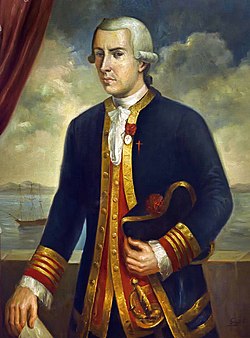
Juan José Pérez Hernández led a Spanish sailing expedition north along the Pacific coast, making early documented European contact with Indigenous peoples of what is now Washington and laying groundwork for later Spanish claims in the region.
Image source: Spanish expeditions to the Pacific Northwest
Mar 1778 - Apr 1778
% complete
Captain James Cook's third voyage reached Nootka Sound on Vancouver Island, where his crew traded for sea otter pelts. News of the lucrative fur trade with China soon drew British and American merchant ships to Pacific Northwest waters.
Image source: Third voyage of James Cook
Apr 1792 - Oct 1792
% complete
British Captain George Vancouver extensively charted Puget Sound and the Washington coast, naming many landmarks such as Mount Rainier and Puget Sound itself, producing some of the most detailed maps of the region used for decades.
Image source: Vancouver Expedition
May 11, 1792
% complete
American fur trader Robert Gray piloted his ship Columbia Rediviva across the bar of a great river he named after his vessel, becoming the first non-indigenous navigator to enter it and giving the United States a basis for claims to the Oregon Country.
Image source: Robert Gray (sea captain)
Nov 1805
% complete
The Lewis and Clark Expedition arrived at the mouth of the Columbia River, wintering at Fort Clatsop near present-day Astoria. Their journey strengthened American claims to the Oregon Country that included modern Washington.
Image source: Lewis and Clark Expedition
Jul 1811
% complete
Canadian explorer and fur trader David Thompson became the first person to travel the full length of the Columbia River, establishing trade posts for the North West Company and mapping much of the interior Pacific Northwest.
Image source: David Thompson (explorer)
1825
% complete
The Hudson's Bay Company built Fort Vancouver on the north bank of the Columbia River as headquarters of its Columbia Department. The fort became the economic hub of the Pacific Northwest, supplying fur traders and early American settlers.
Image source: Fort Vancouver
1843
% complete
Large-scale wagon migrations along the Oregon Trail brought thousands of American settlers into the Willamette Valley and lands north of the Columbia River, dramatically increasing the American population and pressure to organize political institutions.
Image source: Oregon Trail
1848 - 1855
% complete
The discovery of gold in California drew global migrants by sea routes through Puget Sound, boosting commerce, timber exports, and population in Washington's coastal settlements even before its separate territorial organization.
Image source: California gold rush
Jun 15, 1846
% complete
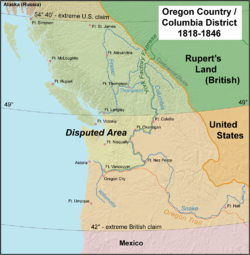
The United States and Great Britain signed the Oregon Treaty, extending the international border along the 49th parallel to Puget Sound and peacefully resolving the 'Fifty-Four Forty or Fight' dispute, placing future Washington firmly within U.S. territory.
Image source: Oregon Treaty
Nov 29, 1847
% complete
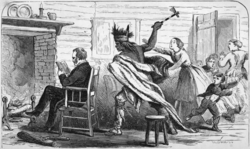
Cayuse warriors killed missionaries Marcus and Narcissa Whitman and eleven others at their mission near Walla Walla amid tensions over disease and cultural disruption, triggering violent reprisals and broader conflict between settlers and tribes.
Image source: Whitman massacre
Aug 14, 1848
% complete
Congress created the Oregon Territory encompassing all land between the Rocky Mountains and the Pacific Ocean north of California, providing formal governance for the region that would become Washington.
Image source: Oregon Territory
Mar 2, 1853
% complete
Congress carved Washington Territory out of northern Oregon Territory, naming it after President George Washington. Olympia was designated the capital, and Isaac Stevens was appointed its first governor.
Image source: Washington Territory
Dec 26, 1854 - 1855
% complete
Governor Isaac Stevens negotiated a series of treaties with Puget Sound tribes, ceding vast tribal lands in exchange for reservations and reserved fishing rights. These treaties remain legally significant today, especially regarding tribal fisheries.
Image source: Treaty of Medicine Creek
Oct 1855 - 1856
% complete
Conflict broke out between United States forces and several Puget Sound tribes resisting reservation policies. Fighting included the Battle of Seattle in January 1856, when settlers were defended by Navy gunfire during an attack on the young town.
Image source: Puget Sound War
1858
% complete
Gold discoveries in British Columbia sent thousands of prospectors through Puget Sound ports, briefly booming towns like Whatcom and Port Townsend and stimulating early commercial growth in western Washington.
Image source: Fraser Canyon Gold Rush
1858 - Sep 1858
% complete
Colonel George Wright decisively defeated Yakama, Palouse, and allied fighters in eastern Washington, ending major armed resistance in the interior and opening those lands to increased white settlement.
Image source: Yakima War
Dec 1873
% complete
The Northern Pacific Railroad selected Commencement Bay as its western terminus and founded Tacoma, transforming the tiny settlement into a major port city and accelerating immigration and investment across Washington Territory.
Image source: Northern Pacific Railway
Jun 6, 1889
% complete
A fire ignited by an overheated glue pot swept through Seattle's wooden business district, destroying over 25 blocks. The city rebuilt rapidly in brick and stone, and the ruins became part of Seattle's famous underground.
Image source: Great Seattle Fire
Nov 11, 1889
% complete
After decades as a territory, Washington entered the Union as the 42nd state with Elisha P. Ferry as its first governor and Olympia as capital. A state constitution adopted earlier that year guaranteed permanent common school funding and expansive public rights.
Image source: Washington (state)
Nov 23, 1910
% complete
Washington men voted overwhelmingly to enfranchise women, making the state the fifth in the nation with full suffrage and energizing the national movement that culminated in the Nineteenth Amendment a decade later.
Image source: Women's suffrage movement in Washington
Jul 16, 1933 - 1942
% complete
As part of New Deal public works, construction started on Grand Coulee Dam on the Columbia River. When completed, it was the largest concrete structure and hydroelectric facility in the world, powering wartime industry and irrigating central Washington.
Image source: Grand Coulee Dam
1943 - 1945
% complete
The federal government secretly built reactors at Hanford to produce plutonium, including the material used in the bomb dropped on Nagasaki. Hanford transformed the Tri-Cities region and left a lasting environmental cleanup legacy.
Image source: Hanford Site
1954 - 1958
% complete
Boeing's prototype jet airliner first flew in 1954, and the production 707 entered service in 1958, cementing Seattle's role as a global aerospace center and driving decades of economic growth in the Puget Sound region.
Image source: Boeing 707
Apr 21, 1962 - Oct 21, 1962
% complete
Seattle's World's Fair showcased science and the space age, leaving behind the Space Needle, Monorail, and Seattle Center, and rebranding the city as a modern metropolis of the Pacific Rim.
Image source: Century 21 Exposition
May 18, 1980
% complete
The volcano erupted in southwestern Washington, killing 57 people, leveling hundreds of square miles of forest, and sending ash across the nation. It remains the deadliest volcanic event in U.S. history and reshaped volcanology and forest recovery science.
Image source: 1980 eruption of Mount St. Helens
Nov 20, 1985
% complete
Redmond-based Microsoft released the first version of Windows, beginning its rise to software dominance. Alongside Boeing and later Amazon, Microsoft anchored Washington's transformation into a leading high-tech economy.
1994
% complete
Courts reaffirmed and enforced tribal treaty fishing rights from the Stevens treaties of the 1850s, guaranteeing Western Washington tribes half the harvestable salmon and affirming tribal co-management of the resource.
Image source: United States v. Washington
Nov 30, 1999 - Dec 3, 1999
% complete
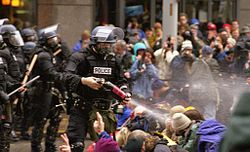
Tens of thousands of demonstrators converged on Seattle to protest globalization during the World Trade Organization conference, drawing worldwide attention and marking a defining moment in the anti-globalization movement.
Image source: 1999 Seattle WTO protests
Feb 28, 2001
% complete
A magnitude 6.8 earthquake centered near Olympia injured hundreds and damaged buildings across the Puget Sound region, prompting seismic retrofits of bridges and public buildings throughout western Washington.
Image source: 2001 Nisqually earthquake
Or browse the full history timeline directory, with more than 2,000 topics.
This History of Washington timeline was generated with the help of AI, using information found on the internet.
We work hard to keep these timelines accurate, but mistakes do get through. If you spot one, email us at [email protected] and we'll fix it for future visitors.
Generate yours with AI or build it from scratch, for free.
Export your timeline, add your own events, edit or remove AI-generated events, and much more
No credit card required.
Cancel anytime.
Cancel anytime.
You can create an unlimited number of timelines with up to 10 events on each one, customize how they look, export them to PDF, PNG, PowerPoint, CSV, and Excel, and share them with a link. Paid plans raise the event limit and add features like spreadsheet imports and collaborators.
Yes. You can cancel your subscription from your account page at any time, and you will not be charged again. Your subscription stays active for the rest of the period you already paid for.
Yes. We will email you a reminder before the annual renewal, and we will also email you a receipt.
Yes. You can email us within 15 days of any payment, and we will issue you a full refund.
Check out our pricing docs or send us an email anytime: [email protected].