-
Use Cases
-
Resources
-
Pricing
George Washington (1732–1799) was an American military leader, statesman, and Founding Father who served as Commander-in-Chief of the Continental Army during the American Revolutionary War and became the first President of the United States from 1789 to 1797. Often called the 'Father of His Country,' he played a pivotal role in establishing the new nation's government and democratic traditions. More Less
Feb 22, 1732
% complete
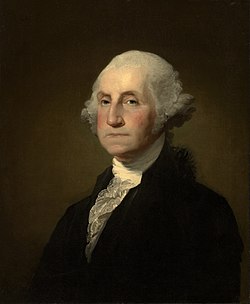
George Washington was born at Popes Creek in Westmoreland County, Virginia, the first of six children of Augustine and Mary Ball Washington. Raised on Virginia plantations, he received a limited formal education but developed strong skills in mathematics and land surveying that would shape his early career.
Image source: George Washington
Jul 20, 1749
% complete
At just seventeen years old, Washington was appointed surveyor for the newly formed Culpeper County, Virginia. His surveying work took him across the Shenandoah Valley and helped him earn money to purchase his first parcels of land, launching a lifelong interest in western expansion.
Image source: Surveying
Jul 26, 1752
% complete
The death of Lawrence Washington from tuberculosis was a pivotal moment for George. He inherited part of Mount Vernon and assumed some of his brother's responsibilities as adjutant general of the Virginia militia, opening the door to his military career.
Image source: Lawrence Washington (1718–1752)
Nov 6, 1752
% complete
Following Lawrence's death, Washington secured an appointment as a major and adjutant general of one of Virginia's four military districts. This commission began his formal military service and prepared him for the coming conflict over the Ohio Country.
Image source: Virginia Regiment
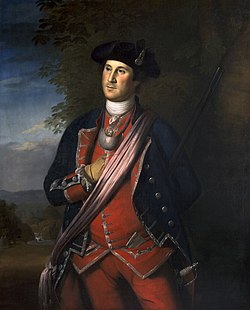
Jul 24, 1758 - May 10, 1775
% complete
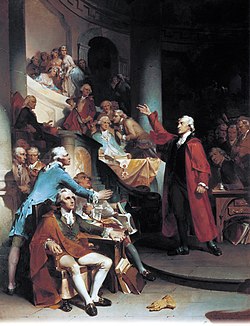
Elected to represent Frederick County and later Fairfax County, Washington served nearly seventeen years in Virginia's colonial legislature. His experience there deepened his political skills and exposed him to the growing tensions between the colonies and Great Britain.
Image source: House of Burgesses
Jan 6, 1759
% complete
Washington married the wealthy widow Martha Custis, gaining control of substantial estates and becoming one of Virginia's wealthiest planters. Though they had no children together, they raised Martha's two surviving children, John Parke Custis and Martha Parke Custis, at Mount Vernon.
Image source: Martha Washington
Dec 14, 1799
% complete
Washington died at Mount Vernon at age sixty-seven after a brief illness, likely acute epiglottitis. His death plunged the nation into mourning, with memorial services held across America and Europe, and he came to be remembered as the indispensable founder of the United States.
Image source: Death and state funeral of George H. W. Bush
Oct 31, 1753 - Jan 16, 1754
% complete
Lieutenant Governor Robert Dinwiddie sent the twenty-one-year-old Washington through the wilderness to Fort LeBoeuf to demand that the French vacate territory claimed by Britain. The French politely refused, and Washington's dangerous winter journey made him famous when his published journal circulated throughout the colonies.
May 28, 1754
% complete
Leading a small force of Virginians and Mingo warriors, Washington ambushed a French reconnaissance party under Joseph Coulon de Jumonville, who was killed in the encounter. This skirmish marked the opening shots of what became the French and Indian War and, ultimately, the global Seven Years' War.
Image source: Battle of Jumonville Glen
Jul 3, 1754
% complete
A superior French force attacked Washington's hastily built fort in the Pennsylvania wilderness during heavy rain. Outnumbered and low on supplies, Washington surrendered and signed terms written in French that he misunderstood, admitting responsibility for Jumonville's death — the only surrender of his military career.
Image source: Battle of Fort Necessity
Jul 9, 1755
% complete
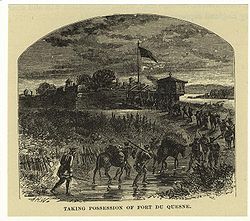
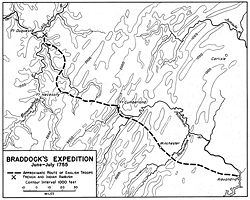
Serving as an aide-de-camp to General Edward Braddock, Washington survived the disastrous ambush near Fort Duquesne despite having two horses shot from under him and bullets piercing his coat. He helped organize the retreat after Braddock was mortally wounded, earning praise for his courage.
Image source: Braddock Expedition
Aug 14, 1755 - Dec 31, 1758
% complete
At age twenty-three Washington took command of the Virginia Regiment, defending the colony's frontier against French and Native American raids. The grueling duty taught him invaluable lessons in logistics, discipline, and leadership that he would later apply in the Revolutionary War.
Nov 25, 1758
% complete
Washington led a brigade in General John Forbes's successful campaign against Fort Duquesne, which the French abandoned without a fight. With the frontier threat removed, Washington resigned his commission later that year and retired to civilian life at Mount Vernon.
Image source: Forbes Expedition
Jul 18, 1774
% complete
Washington chaired the meeting where the Fairfax Resolves were adopted, calling for a boycott of British goods and coordination among colonies in response to the Intolerable Acts. The resolves established him as a committed leader in the resistance movement.
Sep 5, 1774 - Oct 26, 1774
% complete
Washington represented Virginia at the First Continental Congress in Philadelphia, where delegates coordinated colonial responses to British punitive measures. His military reputation and political reliability positioned him as a natural choice for future command.
Image source: First Continental Congress
Apr 19, 1775
% complete
British troops marching to seize colonial arms clashed with Massachusetts militiamen at Lexington and Concord, drawing first blood of the Revolutionary War. The fighting prompted the Continental Congress to create a unified army, and Washington appeared at the Second Congress wearing his old uniform, signaling his readiness to serve.
Image source: Battles of Lexington and Concord
Apr 19, 1775 - Mar 17, 1776
% complete
Washington transformed the undisciplined militia besieging Boston into an organized army and fortified Dorchester Heights with cannons hauled from Fort Ticonderoga. Facing overwhelming artillery, British General William Howe evacuated Boston in March 1776, delivering Washington his first great victory.
Image source: Siege of Boston
Jun 19, 1775
% complete
The Continental Congress unanimously selected George Washington as commander-in-chief of the newly formed Continental Army. Accepting the post without pay beyond expenses, he traveled to Boston to take command of the ragtag forces besieging British troops in the city.
Image source: Continental Army
Jul 4, 1776
% complete
While Washington's army defended New York City, the Continental Congress formally declared independence from Britain. Washington had the Declaration read aloud to his troops in New York on July 9, inspiring them with the cause they now fought to defend.
Image source: United States Declaration of Independence
Aug 27, 1776
% complete
British forces under General Howe routed Washington's army on Long Island in the war's largest battle. Washington executed a masterful overnight evacuation by boat across the East River, saving his army from destruction and preserving the revolutionary cause.
Image source: Battle of Long Island
Dec 25, 1776
% complete
On Christmas night, Washington led roughly 2,400 troops across the ice-choked Delaware River in a daring surprise operation. The crossing set up the next morning's attack and revived American morale after months of demoralizing retreats across New Jersey.
Image source: Washington Crossing the Delaware (1851 paintings)
Dec 26, 1776
% complete
Washington surprised Hessian mercenaries garrisoning Trenton, capturing nearly a thousand men while suffering only light casualties. The victory reinvigorated enlistment and demonstrated that the Continental Army could defeat professional European soldiers.
Image source: Battle of Trenton
Jan 3, 1777
% complete
Ten days after Trenton, Washington struck again at Princeton, defeating British regulars and driving them from much of New Jersey. Personally rallying his troops under fire, he completed the 'Trenton-Princeton campaign,' a stunning turnaround that convinced many observers the Revolution could succeed.
Image source: Battle of Princeton
Oct 4, 1777
% complete
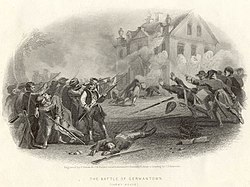
Despite a bold plan involving coordinated attacks shrouded in morning fog, Washington's assault on the British camp at Germantown failed due to confusion and stiff resistance. Though a defeat, its audacity impressed European observers, including France, which saw potential in the American army.
Image source: Battle of Germantown
Dec 19, 1777 - Jun 19, 1778
% complete
Washington's army endured a brutal winter at Valley Forge, suffering from shortages of food, clothing, and supplies while disease killed thousands. Washington held the army together through sheer perseverance, and training by Baron von Steuben transformed it into a disciplined professional force.
Image source: Valley Forge
Feb 6, 1778
% complete
Spurred partly by the American victory at Saratoga and Washington's persistence, France signed treaties of alliance and commerce with the United States, transforming the rebellion into a global war. French money, troops, and naval power would prove decisive to eventual American victory.
Image source: Franco-American alliance
Jun 28, 1778
% complete
In sweltering heat, Washington personally rallied troops retreating under General Charles Lee's faltering command and fought the British to a standstill. Monmouth demonstrated the improved professionalism of the Continental Army and ended major fighting in the North for years.
Image source: Battle of Monmouth
Sep 25, 1780
% complete
The plot of Major General Benedict Arnold to surrender West Point to the British was uncovered when British Major John André was captured carrying documents. Washington wept upon learning of Arnold's betrayal, calling him a 'traitor of the blackest dye,' though the scheme failed to cost the Americans the fortress.
Image source: Benedict Arnold's expedition to Quebec
Sep 28, 1781 - Oct 19, 1781
% complete
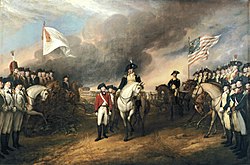
Washington, commanding combined Franco-American forces with support from the French fleet under Admiral de Grasse, trapped General Cornwallis's army at Yorktown, Virginia. After weeks of siege operations, Cornwallis surrendered more than 7,000 men, effectively ending major combat in the Revolutionary War.
Image source: Siege of Yorktown
Sep 3, 1783
% complete
British and American negotiators signed the Treaty of Paris, formally recognizing American independence and establishing generous boundaries for the new nation. The agreement vindicated eight years of struggle and Washington's leadership of the Continental Army.
Image source: Treaty of Paris (1783)
Dec 23, 1783
% complete
In a moving ceremony before Congress at Annapolis, Washington voluntarily surrendered his commission rather than seizing power like a dictator. His selfless act stunned the world, including King George III, and cemented his reputation as a modern Cincinnatus devoted to republican principles.
Image source: George Washington's resignation as commander-in-chief
May 25, 1787 - Sep 17, 1787
% complete
Washington presided over the Constitutional Convention, lending his enormous prestige to the effort to replace the weak Articles of Confederation. His steady presence behind the chair encouraged delegates to compromise and produce the United States Constitution, which he then supported for ratification.
Image source: Constitutional Convention (United States)
Feb 4, 1789
% complete
The Electoral College chose Washington unanimously as the nation's first president, the only president ever elected without opposition. He reluctantly left Mount Vernon, telling Henry Knox that he felt like a culprit going to execution as he assumed the unprecedented office.
Image source: 1788–89 United States presidential election
Apr 30, 1789
% complete
Standing on the balcony of Federal Hall in New York City, Washington took the oath of office administered by Chancellor Robert Livingston and delivered his inaugural address. As the first president, he faced the challenge of creating precedents for every aspect of executive government.
Image source: First inauguration of George Washington
Dec 15, 1791
% complete
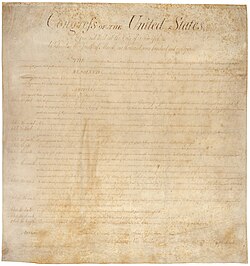
During Washington's first term, ten amendments guaranteeing fundamental rights such as speech, religion, and trial by jury were ratified as the Bill of Rights. Washington supported the additions, which eased fears about centralized federal power and strengthened public confidence in the new Constitution.
Image source: United States Bill of Rights
Jul 13, 1794 - Oct 19, 1794
% complete
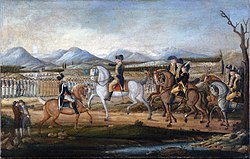
When western Pennsylvania farmers violently resisted a federal excise tax on whiskey, Washington personally led nearly 13,000 militiamen toward the region. The show of overwhelming force dissolved the uprising without bloodshed and established that the federal government could enforce its laws.
Image source: Whiskey Rebellion
Nov 19, 1794
% complete
Chief Justice John Jay negotiated a treaty resolving lingering disputes with Britain and averting another war. Though controversial and denounced by Democratic-Republicans, Washington signed the treaty in 1795, prioritizing peace and trade for the young nation.
Image source: Jay Treaty
Oct 27, 1795
% complete
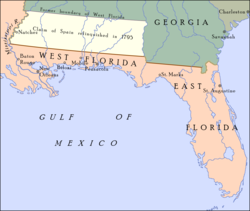
Negotiated by Thomas Pinckney with Spain, the treaty fixed the Florida border and granted Americans navigation rights on the Mississippi River and access to New Orleans. It opened the western interior to commerce and boosted Washington's popularity in frontier regions.
Image source: Pinckney's Treaty
Sep 19, 1796
% complete
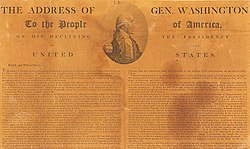
Declining a third term, Washington announced his retirement through a Farewell Address printed in newspapers. He warned against permanent foreign alliances, sectionalism, and the dangers of political factions, advice that shaped American policy for generations.
Image source: George Washington's Farewell Address
Mar 4, 1797
% complete
After eight years in office, Washington attended John Adams's inauguration and departed Philadelphia for Mount Vernon. His voluntary transfer of power to an elected successor established the precedent of peaceful transitions that defines American democracy.
Or browse the full history timeline directory, with more than 2,000 topics.
This George Washington timeline was generated with the help of AI, using information found on the internet.
We work hard to keep these timelines accurate, but mistakes do get through. If you spot one, email us at [email protected] and we'll fix it for future visitors.
Generate yours with AI or build it from scratch, for free.
Export your timeline, add your own events, edit or remove AI-generated events, and much more
No credit card required.
Cancel anytime.
Cancel anytime.
You can create an unlimited number of timelines with up to 10 events on each one, customize how they look, export them to PDF, PNG, PowerPoint, CSV, and Excel, and share them with a link. Paid plans raise the event limit and add features like spreadsheet imports and collaborators.
Yes. You can cancel your subscription from your account page at any time, and you will not be charged again. Your subscription stays active for the rest of the period you already paid for.
Yes. We will email you a reminder before the annual renewal, and we will also email you a receipt.
Yes. You can email us within 15 days of any payment, and we will issue you a full refund.
Check out our pricing docs or send us an email anytime: [email protected].