
-
Use Cases
-
Resources
-
Pricing
George Washington Carver (c. 1864–1943) was an American agricultural scientist and inventor who revolutionized Southern farming through crop rotation, promoted alternative crops like peanuts and sweet potatoes, and developed hundreds of products from them, becoming one of the most prominent Black scientists in American history. More Less
Oct 9, 1855
% complete
Moses Carver purchased George's mother Mary from William McGinnis on October 9, 1855, for $700 (approximately $18,609 in 2024 dollars), an event connected to Carver's early family history.
Image source: George Washington Carver
Jan 5, 1864
% complete
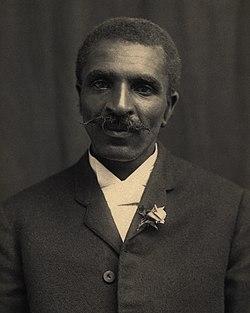
George Washington Carver was born around 1864, though the exact date is uncertain because it was before slavery was abolished in Missouri in January 1865 during the American Civil War. He would become one of the most prominent Black scientists of the early 20th century.
Aug 1886
% complete
In August 1886, Carver traveled by wagon with J. F. Beeler to continue pursuing his education, part of his long journey to obtain schooling as a young Black man in the post-Civil War era.
Jan 1888
% complete
In early 1888, Carver obtained a $300 loan (approximately $10,750 in 2025) at the Bank of Ness City to fund his education, demonstrating his determination to pursue academic studies.
1890
% complete
In 1890, Carver began studying art and piano at Simpson College in Indianola, Iowa. His best-known painting, depicting a yucca and cactus, was later displayed at the World's Columbian Exposition of 1893 in Chicago.
Image source: Simpson College
1891
% complete
When Carver began attending Iowa State Agricultural College in 1891, he was the first Black student there, breaking racial barriers in higher education.
Image source: Iowa State University
1894
% complete
Carver's bachelor's thesis for a degree in Agriculture was titled 'Plants as Modified by Man', dated 1894, marking the completion of his undergraduate studies.
1896
% complete
Carver received his MSc in 1896 from Iowa State, becoming one of the most highly educated Black Americans of his time before joining Tuskegee Institute.
1897 - 1913
% complete
James Wilson, a former dean and professor of Carver's at Iowa State, served as Secretary of Agriculture from 1897 to 1913, maintaining connections between Carver and federal agricultural leadership.
Image source: James W. Grimes
1900
% complete
In 1900, Carver complained that the physical work and the letter-writing required of him were too much, revealing strains in his demanding role at Tuskegee Institute.
1904
% complete
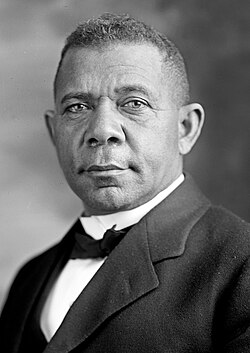
In 1904, an Institute committee reported that Carver's reports on yields from the poultry yard were exaggerated, and Booker T. Washington confronted Carver about the issue. Carver replied in writing that being branded a liar was more than he could bear and offered his resignation.
Image source: Booker T. Washington
1906
% complete
Beginning in 1906 at Tuskegee, Carver led a Bible class on Sundays for several students at their request, reflecting his deep religious faith that informed his work.
Image source: Tuskegee University
1911
% complete
In 1911, Booker T. Washington wrote a letter complaining that Carver had not followed orders to plant particular crops at the experiment station, illustrating ongoing tensions between the two men.
1911
% complete
Despite their tensions, Booker T. Washington praised Carver in his 1911 memoir, My Larger Education: Being Chapters from My Experience, acknowledging his scientific contributions.
Image source: Booker T. Washington
1911
% complete
In 1911, Carver complained that his laboratory had not received equipment which Washington had promised 11 months earlier, another point of friction in their working relationship.
1915
% complete
After Booker T. Washington died in 1915, his successor made fewer demands on Carver for administrative tasks, giving Carver more freedom to focus on research.
1923 - 1933
% complete
From 1923 to 1933, Carver toured white Southern colleges for the Commission on Interracial Cooperation, promoting interracial dialogue and understanding.
1898
% complete
Carver's first agricultural bulletin, published in 1898, was on feeding acorns to farm animals, beginning a long series of practical publications for Southern farmers.
1915 - 1923
% complete
From 1915 to 1923, Carver concentrated on researching and experimenting with new uses for peanuts, sweet potatoes, soybeans, pecans, and other crops, while having his assistants compile existing uses.
1916
% complete
Carver published 'How to Grow the Peanut and 105 Ways of Preparing it For Human Consumption' in 1916. It became his most popular bulletin and has been reprinted numerous times.
1920
% complete
Carver spoke to a national conference of the Peanut Growers Association in 1920, bringing him wide publicity and increasing renown for his peanut research.
1921
% complete
In 1921, Carver testified before Congress to support passage of a tariff on imported peanuts, alongside peanut farmers and industry representatives, which brought him national attention.
Image source: Fordney–McCumber Tariff
1922
% complete
The Fordney–McCumber Tariff was enacted in 1922 and included a duty on imported peanuts, the outcome Carver had supported through his congressional testimony.
Jan 6, 1925 - Jun 14, 1927
% complete
Three patents were issued to Carver between 1925 and 1927: US 1522176 for cosmetics (January 6, 1925), and two for paints and stains—US 1541478 (June 9, 1925) and US 1632365 (June 14, 1927). However, they were not commercially successful.
1932
% complete
In 1932, writer James Saxon Childers wrote that Carver and his peanut products were almost solely responsible for the rise in U.S. peanut production after the boll weevil devastated the cotton crop beginning about 1892. His article 'A Boy Who Was Traded for a Horse' (1932) and its 1937 Reader's Digest reprint contributed to this myth.
1933 - 1935
% complete
From 1933 to 1935, Carver worked to develop peanut oil massages to treat infantile paralysis (polio), drawing patients seeking alternative treatments to Tuskegee.
1935 - 1937
% complete
From 1935 to 1937, Carver participated in the USDA Disease Survey, contributing his botanical expertise to a national agricultural effort.
Image source: United States Department of Agriculture
1937
% complete
In 1937, Carver attended two chemurgy conferences, an emerging field in the 1930s during the Great Depression and Dust Bowl, concerned with developing new industrial products from crops.
Image source: Chemurgy
1916
% complete
In 1916, Carver was made a member of the Royal Society of Arts in England, one of only a handful of Americans at that time to receive this honor.
Image source: Royal Society of Arts
1921 - 1924
% complete
Henry Cantwell Wallace, whose son Henry A. Wallace was also connected to Carver, served as Secretary of Agriculture from 1921 to 1924; Henry A. Wallace later served as Secretary of Agriculture from 1933 to 1940 and as Roosevelt's vice president from 1941 to 1945.
Image source: Henry Cantwell Wallace
1923
% complete
In 1923, Carver received the Spingarn Medal from the NAACP, awarded annually for outstanding achievement by an African American.
Image source: NAACP
1938
% complete
In his seventies, frugal Carver established the George Washington Carver Foundation at Tuskegee in 1938 to continue agricultural research, donating nearly $60,000 (equivalent to $1,372,340 in 2025) of his savings. He also created a museum of his work.
1943
% complete
The US Congress designated January 5, the anniversary of Carver's death, as George Washington Carver Recognition Day, honoring his contributions to American agriculture.
Jan 5, 1943
% complete
Carver died January 5, 1943, at the age of 78 or 79 from complications (anemia) resulting from a fall. His final bulletin, published that year, was about the peanut.
Jul 14, 1943
% complete
On July 14, 1943, President Franklin D. Roosevelt dedicated $30,000 (approximately $433,687 in 2024) for the George Washington Carver National Monument near Diamond, Missouri, where Carver spent his childhood. The 210-acre complex includes a bust of Carver, a nature trail, a museum, the 1881 Moses Carver house, and the Carver cemetery. It opened in July 1953.
Image source: George Washington Carver National Monument
Dec 1947
% complete
In December 1947, a fire broke out in the Carver Museum at Tuskegee, and much of the collection was damaged.
Image source: The George Washington Carver Museum
1948
% complete
A 3-cent commemorative stamp honoring Carver was issued in 1948 by the United States Postal Service.
1951 - 1954
% complete
From 1951 to 1954, Carver was depicted on the commemorative Carver-Washington half dollar coin along with Booker T. Washington.
Image source: Carver-Washington half dollar
1965
% complete
The ballistic missile submarine USS George Washington Carver (SSBN-656) was launched in 1965, named in honor of the scientist.
Image source: USS George Washington Carver
1969
% complete
In 1969, Iowa State University constructed Carver Hall in honor of Carver, a distinguished graduate of the university.
1970
% complete
In 1970, Carver crater on the far side of the Moon was named after him, extending his legacy beyond Earth.
Image source: George Washington Carver
1977
% complete
In 1977, Carver was elected to the Hall of Fame for Great Americans, joining the ranks of the nation's most celebrated figures.
Image source: Hall of Fame for Great Americans
1990
% complete
In 1990, Carver was inducted into the National Inventors Hall of Fame, recognizing his innovations in agricultural science.
Image source: National Inventors Hall of Fame
1994
% complete
In 1994, Iowa State University awarded Carver a posthumous Doctor of Humane Letters degree, more than fifty years after his death.
Feb 3, 1998
% complete
A second stamp honoring Carver, of face value 32 cents, was issued on February 3, 1998, as part of the Celebrate the Century stamp sheet series.
Image source: Celebrate the Century
1999
% complete
In 1999, the USDA named a portion of its Beltsville, Maryland, campus the George Washington Carver Center, continuing institutional recognition of his scientific contributions.
2000
% complete
In 2000, Carver was a charter inductee in the USDA Hall of Heroes as the 'Father of Chemurgy', recognizing his pioneering role in developing industrial products from crops.
Sep 17, 2001
% complete
NBA star David Robinson and his wife Valerie founded an academy named after Carver; it opened on September 17, 2001, in San Antonio, Texas.
2002
% complete
In 2002, scholar Molefi Kete Asante listed George Washington Carver as one of the 100 Greatest African Americans. That same year, he received the Iowa Award, the state's highest citizen award.
2005
% complete
In 2005, Carver's research at the Tuskegee Institute was designated a National Historic Chemical Landmark by the American Chemical Society. The Missouri Botanical Garden in St. Louis also honored him that year, and a Modern Marvels episode featured his work at Iowa State's Food Sciences Building.
Image source: American Chemical Society
2019
% complete
A color film of Carver shot around 1937 by African American surgeon C. Allen Alexander was added to the National Film Registry of the Library of Congress in 2019.
Image source: National Film Registry
Aug 28, 2025 - Aug 31, 2025
% complete
In 2025, the Montgomery Biscuits took on the alternate identity of the 'Alabama Peanut Runners' for two games on August 28 and August 31, 2025, as a tribute to George Washington Carver and his pioneering work with peanuts.
Image source: Montgomery Biscuits
Or browse the full history timeline directory, with more than 2,000 topics.
This George Washington Carver timeline was generated with the help of AI, using information found on the internet.
We work hard to keep these timelines accurate, but mistakes do get through. If you spot one, email us at [email protected] and we'll fix it for future visitors.
Generate yours with AI or build it from scratch, for free.
Export your timeline, add your own events, edit or remove AI-generated events, and much more
No credit card required.
Cancel anytime.
Cancel anytime.
You can create an unlimited number of timelines with up to 10 events on each one, customize how they look, export them to PDF, PNG, PowerPoint, CSV, and Excel, and share them with a link. Paid plans raise the event limit and add features like spreadsheet imports and collaborators.
Yes. You can cancel your subscription from your account page at any time, and you will not be charged again. Your subscription stays active for the rest of the period you already paid for.
Yes. We will email you a reminder before the annual renewal, and we will also email you a receipt.
Yes. You can email us within 15 days of any payment, and we will issue you a full refund.
Check out our pricing docs or send us an email anytime: [email protected].