
-
Use Cases
-
Resources
-
Pricing
West Virginia's history spans from Native American settlement and European colonization through its unique formation as a state during the American Civil War. Originally part of Virginia, the western counties separated over issues including slavery and economic differences, achieving statehood in 1863 as the only state formed by seceding from a Confederate state. The state's development was shaped by coal mining, labor struggles, and industrial growth. More Less
1000 BC - 1500
% complete
Successive Native American cultures, including the Adena and Fort Ancient peoples, built extensive earthen mounds along the Ohio River valley, using them for burials, ceremonies, and as centers of their communities.
Image source: Mound Builders
1671
% complete
The Batts and Fallam expedition, sent from Virginia, became the first recorded European party to explore present-day West Virginia, reaching the New River and claiming the territory for the English crown.
Image source: Thomas Batts
1749
% complete
France asserted control over the Ohio Valley, including much of present-day West Virginia, prompting competition with British colonists and land companies eager to settle the fertile trans-Appalachian lands.
Image source: Ohio Company
1754 - 1763
% complete
Conflict between Britain and France over the Ohio Country engulfed the region, with young George Washington's actions in western Virginia helping spark a global war. Britain's victory in 1763 opened the area to colonial settlement.
Image source: French and Indian War
Oct 7, 1763
% complete
King George III issued the Proclamation of 1763, forbidding colonial settlement west of the Appalachian Mountains, including most of present-day West Virginia, in an attempt to stabilize relations with Native Americans.
Image source: Royal Proclamation of 1763
1768
% complete
The Iroquois ceded claims to lands south of the Ohio River, allowing settlers to legally move into present-day West Virginia. Settlers soon established communities along the Monongahela, Greenbrier, and Kanawha rivers.
Image source: Treaty of Fort Stanwix (1768)
1769
% complete
Ebenezer Zane and his brothers founded the settlement of Zanesburg, later Wheeling, on the Ohio River, which grew into a key gateway for westward migration and trade.
Image source: Wheeling, West Virginia
Oct 10, 1774
% complete
Virginia militia under Colonel Andrew Lewis defeated Shawnee forces led by Cornstalk at Point Pleasant, ending Lord Dunmore's War and securing greater settler access to the trans-Allegheny frontier.
Image source: Battle of Point Pleasant
Sep 1782
% complete
British-allied Native American forces besieged Fort Henry at Wheeling in one of the final engagements of the American Revolution east of the Appalachians; the defenders successfully held off repeated assaults.
Image source: Fort Henry (West Virginia)
1791 - 1794
% complete
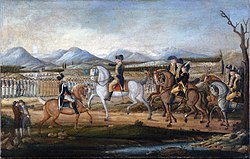
Frontier farmers in western Pennsylvania and the surrounding region, including parts of western Virginia, resisted a federal excise tax on whiskey, testing the new U.S. government's authority before it was suppressed by federal troops.
Image source: Whiskey Rebellion
1829
% complete
The Virginia Constitutional Convention of 1829–1830 highlighted deep divisions between the slaveholding Tidewater elite and western Virginians who demanded representation based on population rather than property.
Image source: History of West Virginia
Oct 16, 1859 - Oct 18, 1859
% complete
Abolitionist John Brown seized the federal armory at Harpers Ferry hoping to spark a slave uprising. His capture and execution electrified the nation and pushed the country toward civil war.
Image source: John Brown's raid on Harpers Ferry
Apr 17, 1861
% complete
Following the attack on Fort Sumter, Virginia voted to secede, but delegates from the northwestern counties opposed the decision, setting the stage for the creation of a loyal Unionist government.
Image source: Virginia in the American Civil War
May 13, 1861 - Jun 1861
% complete
Delegates from northwestern Virginia met in Wheeling to reject secession, establishing the Restored Government of Virginia and beginning the process that would lead to a new state.
Image source: Wheeling Convention
Jun 3, 1861
% complete
Union forces surprised Confederate troops at Philippi in the first organized land action of the Civil War, securing control of the vital B&O Railroad and much of northwestern Virginia early in the conflict.
Image source: Battle of Philippi (1861)
Jul 11, 1861
% complete
General George McClellan's victory at Rich Mountain secured Union control of the Kanawha Valley and cemented his reputation, while ensuring the new state movement could proceed safely.
Oct 24, 1861
% complete
A referendum held by the Reformed (Restored) Government of Virginia approved the formation of a new state from the western counties, subject to conditions regarding slavery and boundaries.
Image source: Restored Government of Virginia
Nov 26, 1861 - Feb 1862
% complete
Delegates met in Wheeling to draft a constitution for the proposed state of West Virginia, incorporating gradual emancipation provisions required for admission to the Union.
Jun 20, 1863
% complete
President Abraham Lincoln signed the proclamation admitting West Virginia to the Union as its 35th state, making it the only state formed by seceding from a Confederate state during the Civil War.
Image source: West Virginia
1808 - 1861
% complete
The Great Kanawha Salines near Charleston became one of America's leading salt producers, attracting labor, capital, and industry to the Kanawha River valley decades before coal dominated the region.
Image source: Kanawha saltworks
1828 - 1850
% complete
Efforts to link the Potomac Valley with the Ohio River spurred transportation projects through the Alleghenies, laying groundwork for later railroads that would transform the economy of the mountain counties.
Image source: Chesapeake and Ohio Canal
1852
% complete
The B&O Railroad crossed the Appalachian Mountains into western Virginia, connecting the region's resources to eastern markets and fueling growth of towns like Grafton and Martinsburg.
Image source: Baltimore and Ohio Railroad
1870 - 1920
% complete
Railroads penetrated the southern coalfields, and companies built company towns across the region. Immigrant and African American workers flocked to mines, making West Virginia a top coal producer by the early 20th century.
Image source: West Virginia coal wars
Aug 25, 1921 - Sep 2, 1921
% complete
Thousands of unionizing miners marched and fought against mine guards and police in the largest armed labor uprising in U.S. history, culminating when federal troops intervened to end the confrontation in Logan County.
Image source: Battle of Blair Mountain
1863 - 1864
% complete
Confederate cavalry under William Jones and John Imboden raided into West Virginia in spring 1863, attempting to disrupt the B&O Railroad and undermine statehood, though they failed to halt the process.
Jan 3, 1921
% complete
Fire destroyed West Virginia's wooden capitol building in Charleston, prompting construction of the grand neoclassical Capitol completed in 1932 after a bitter rivalry with Clarksburg over the capital city.
Image source: West Virginia State Capitol
1933 - 1939
% complete
Federal programs such as the WPA and CCC brought employment, roads, schools, and parks to Depression-era West Virginia, while relief efforts addressed widespread poverty in coal towns.
Image source: New Deal
1958 - 1962
% complete
The U.S. government secretly built an underground bunker beneath the Greenbrier Resort at White Sulphur Springs intended to house Congress in the event of nuclear war; its existence remained classified until 1992.
Image source: The Greenbrier
Feb 26, 1972
% complete
A coal slurry impoundment dam collapsed above Buffalo Creek in Logan County, unleashing a flood that killed 125 people and left thousands homeless, prompting scrutiny of coal industry waste practices.
Or browse the full history timeline directory, with more than 2,000 topics.
This History of West Virginia timeline was generated with the help of AI, using information found on the internet.
We work hard to keep these timelines accurate, but mistakes do get through. If you spot one, email us at [email protected] and we'll fix it for future visitors.
Generate yours with AI or build it from scratch, for free.
Export your timeline, add your own events, edit or remove AI-generated events, and much more
No credit card required.
Cancel anytime.
Cancel anytime.
You can create an unlimited number of timelines with up to 10 events on each one, customize how they look, export them to PDF, PNG, PowerPoint, CSV, and Excel, and share them with a link. Paid plans raise the event limit and add features like spreadsheet imports and collaborators.
Yes. You can cancel your subscription from your account page at any time, and you will not be charged again. Your subscription stays active for the rest of the period you already paid for.
Yes. We will email you a reminder before the annual renewal, and we will also email you a receipt.
Yes. You can email us within 15 days of any payment, and we will issue you a full refund.
Check out our pricing docs or send us an email anytime: [email protected].