-
Use Cases
-
Resources
-
Pricing
The history of Alabama spans thousands of years, beginning with indigenous cultures such as the Mississippian people. European exploration began with the Spanish in the 16th century, followed by French and British colonization. Alabama became a U.S. territory in 1817 and achieved statehood in 1819. It seceded during the Civil War as part of the Confederacy, later becoming central to both Reconstruction and the Civil Rights Movement of the 1950s and 1960s. Today, Alabama plays an important role in aerospace, automotive manufacturing, and agriculture. More Less
1540 - 1541
% complete
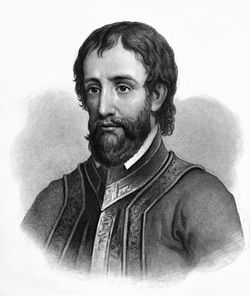
Spanish explorer Hernando de Soto led an expedition through present-day Alabama, clashing with Indigenous peoples including at the Battle of Mabila, a violent encounter that devastated local populations and introduced European diseases.
Image source: Hernando de Soto
Jan 1702
% complete
French colonists under Pierre Le Moyne d'Iberville's brother Jean-Baptiste established Fort Louis de la Mobile near present-day Mobile, marking the first significant European settlement in what would become Alabama.
Image source: Mobile, Alabama
1811 - 1813
% complete
Growing tensions between the Creek Confederacy factions and American settlers escalated as the Red Stick movement, influenced by Tecumseh, sought to resist American encroachment, leading to outbreaks of violence across the frontier.
Image source: Creek War
Aug 30, 1813
% complete
Red Stick Creek warriors attacked Fort Mims in southern Alabama, killing hundreds of settlers and militiamen. The shocking attack galvanized American forces and prompted major military campaigns against the Creeks.
Image source: Fort Mims massacre
Mar 27, 1814
% complete
Andrew Jackson led Tennessee militia, Cherokee allies, and U.S. regulars to a decisive victory over the Red Stick Creeks, effectively ending the Creek War and opening vast lands in Alabama to American settlement.
Image source: Battle of Horseshoe Bend
Aug 9, 1814
% complete
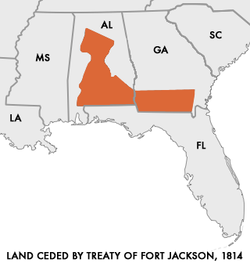
Andrew Jackson forced the Creek Nation to cede approximately 23 million acres of land, much of it in present-day Alabama, paving the way for rapid American migration into the region.
Image source: Treaty of Fort Jackson
Mar 3, 1817
% complete
Congress created the Alabama Territory from the eastern half of the Mississippi Territory, with St. Stephens serving as its first capital, setting the stage for eventual statehood.
Image source: Alabama Territory
Jul 5, 1819 - Aug 2, 1819
% complete
Delegates met in Huntsville to draft Alabama's first state constitution, establishing the framework of government as the territory prepared to join the Union.
Image source: Constitution of Alabama
Dec 14, 1819
% complete
Alabama was admitted to the Union as the 22nd state, with Huntsville briefly serving as capital before the seat of government moved to Cahaba and later Montgomery.
Image source: Alabama

1820 - 1860
% complete
Alabama's fertile Black Belt prairie lands made it a center of cotton production, driving demand for enslaved labor and making slavery central to the state's economy and society during the antebellum era.
Image source: Black Belt (region of Alabama)
1830 - 1838
% complete
Following the Indian Removal Act, the federal government forced the Choctaw, Chickasaw, Creek, and Cherokee peoples out of Alabama and neighboring states via brutal forced marches westward, with thousands dying along the way.
Image source: Trail of Tears
1846
% complete
The Alabama legislature relocated the state capital from Tuscaloosa to Montgomery, a growing river trade city that would soon gain national prominence.
Image source: Montgomery, Alabama
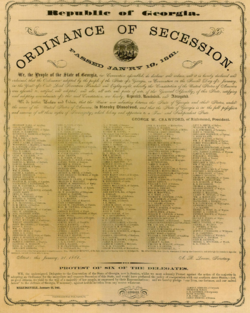
Jan 11, 1861
% complete
A state convention in Montgomery voted to secede from the United States, making Alabama one of the founding states of the Confederacy.
Image source: Ordinance of Secession
Feb 4, 1861 - May 1861
% complete
Delegates from seven seceding states met in Montgomery to form the Confederate States of America, electing Jefferson Davis as president and adopting a provisional constitution before the capital moved to Richmond.
Aug 5, 1864
% complete
Admiral David Farragut led Union naval forces to victory over Confederate defenses in Mobile Bay, famously ordering 'Damn the torpedoes, full speed ahead,' closing one of the last Confederate ports on the Gulf.
Image source: Battle of Mobile Bay
Mar 1865 - Apr 1865
% complete
Union cavalry under General James H. Wilson swept through Alabama, capturing Selma after the Battle of Selma and destroying industrial facilities, before taking Montgomery, hastening the Confederacy's collapse.
1868
% complete
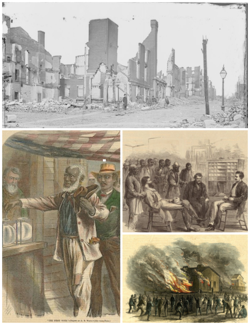
During Congressional Reconstruction, Alabama ratified a new constitution guaranteeing civil rights to freedpeople and was readmitted to the Union, with Republican control supported by African American voters and federal troops.
Image source: Reconstruction era
1871
% complete
Founded just after the Civil War at the junction of railroads near rich deposits of coal, iron ore, and limestone, Birmingham grew rapidly into the South's foremost iron and steel manufacturing center.
Image source: Birmingham, Alabama
1874
% complete
Conservative Democrats regained control of the Alabama government, marking the end of Reconstruction-era reforms and beginning decades of segregationist rule and disenfranchisement of Black Alabamians.
Image source: Redeemers
1901
% complete
Alabama adopted a new constitution using poll taxes, literacy tests, and other devices to disenfranchise most African Americans and many poor whites, entrenching Democratic one-party rule and segregation for decades.
1931
% complete
Nine Black teenagers were falsely accused of assaulting two white women on a train near Scottsboro, Alabama. Their trials, convictions, and appeals became a landmark case exposing racial injustice in the Southern legal system.
Image source: Scottsboro Boys
Jul 1, 1960
% complete
NASA activated the Marshall Space Flight Center in Huntsville, where Wernher von Braun's team developed the Saturn V rocket that carried astronauts to the Moon, transforming Huntsville into 'Rocket City.'
Image source: Marshall Space Flight Center
Jul 16, 1969
% complete
The Saturn V rocket developed at Marshall Space Flight Center in Huntsville launched Apollo 11, carrying Neil Armstrong and Buzz Aldrin to the first Moon landing, cementing Alabama's role in space exploration history.
Image source: Saturn V
1997
% complete
Mercedes-Benz opened its first U.S. passenger vehicle plant near Tuscaloosa, launching Alabama's emergence as a major automotive manufacturing hub later joined by Honda, Hyundai, and Toyota facilities.
Image source: Mercedes-Benz U.S. International
Dec 1, 1955
% complete
Rosa Parks refused to give up her seat to a white passenger on a segregated Montgomery bus, triggering a yearlong boycott led by Martin Luther King Jr. that became a defining moment of the Civil Rights Movement.
Image source: Montgomery bus boycott
Nov 13, 1956 - Dec 20, 1956
% complete
In Browder v. Gayle, the U.S. Supreme Court ruled bus segregation unconstitutional, forcing Montgomery officials to integrate public transit and marking a major victory for the boycotters.
Image source: Browder v. Gayle
May 14, 1961
% complete
Freedom Riders testing desegregation of interstate travel were brutally attacked by Klansmen in Anniston and Birmingham. The violence drew national attention and pressured the Kennedy administration to enforce federal law.
Image source: Freedom Riders
Jun 11, 1963
% complete
Governor George Wallace physically blocked the doorway of the University of Alabama's Foster Auditorium to prevent the enrollment of Vivian Malone and James Hood, before stepping aside when federalized National Guard troops arrived.
Image source: Stand in the Schoolhouse Door
Sep 15, 1963
% complete
Ku Klux Klan members bombed Birmingham's 16th Street Baptist Church, killing four young girls. The tragedy shocked the nation and helped build support for the Civil Rights Act of 1964.
Image source: 16th Street Baptist Church bombing
Mar 7, 1965 - Mar 25, 1965
% complete
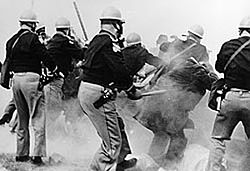
Marchers demanding voting rights were violently attacked by state troopers on the Edmund Pettus Bridge on Bloody Sunday. The final successful march to Montgomery helped spur passage of the Voting Rights Act of 1965.
Image source: Selma to Montgomery marches
Aug 6, 1965
% complete
President Lyndon Johnson signed the Voting Rights Act, prohibiting racial discrimination in voting. Events in Selma had been instrumental in building national momentum for the landmark legislation.
Image source: Voting Rights Act of 1965
Or browse the full history timeline directory, with more than 2,000 topics.
This History of Alabama timeline was generated with the help of AI, using information found on the internet.
We work hard to keep these timelines accurate, but mistakes do get through. If you spot one, email us at [email protected] and we'll fix it for future visitors.
Generate yours with AI or build it from scratch, for free.
Export your timeline, add your own events, edit or remove AI-generated events, and much more
No credit card required.
Cancel anytime.
Cancel anytime.
You can create an unlimited number of timelines with up to 10 events on each one, customize how they look, export them to PDF, PNG, PowerPoint, CSV, and Excel, and share them with a link. Paid plans raise the event limit and add features like spreadsheet imports and collaborators.
Yes. You can cancel your subscription from your account page at any time, and you will not be charged again. Your subscription stays active for the rest of the period you already paid for.
Yes. We will email you a reminder before the annual renewal, and we will also email you a receipt.
Yes. You can email us within 15 days of any payment, and we will issue you a full refund.
Check out our pricing docs or send us an email anytime: [email protected].