-
Use Cases
-
Resources
-
Pricing
The history of Colorado spans thousands of years, beginning with Paleo-Indians and Ancestral Puebloans whose cliff dwellings still stand at Mesa Verde. Spanish and French explorers claimed the region in the 16th–18th centuries before it became part of the United States through the Louisiana Purchase and Mexican Cession. The 1858 Pikes Peak Gold Rush transformed Colorado into a booming mining territory, leading to its statehood on August 1, 1876—the Centennial State. The 20th century saw a shift from mining to agriculture, tourism, and technology, shaping modern Colorado's diverse economy. More Less
1787
% complete
In 1787 Juan Bautista de Anza established the settlement of San Carlos near present-day Pueblo, Colorado, but it quickly failed.
Image source: History of Colorado
1819
% complete
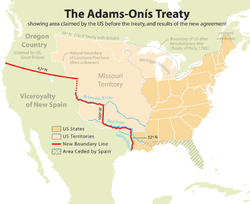
In 1819, the United States ceded its claim to the land south and west of the Arkansas River to Spain with the Adams-Onís Treaty, at the same time purchasing Florida.
Image source: Adams–Onís Treaty
Aug 24, 1821
% complete
Mexico won its independence with the Treaty of Córdoba signed on August 24, 1821, and assumed the territorial claims of Spain, including lands in present-day Colorado.
Image source: Treaty of Córdoba
1832 - 1851
% complete
These early settlements were largely unsuccessful because the Utes continued to control the land until 1851.
Image source: Ute people
1832 - 1856
% complete
During the early history of the Arkansas Valley in Colorado from 1832 to 1856, traders, trappers, and settlers established trading posts and small settlements along the Arkansas River, and on the South Platte near the Front Range.
1846 - 1848
% complete
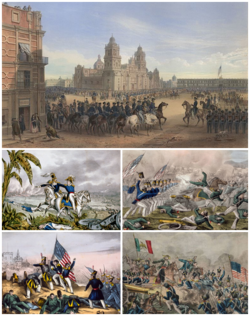
In 1846 the United States went to war with Mexico. Mexico's defeat forced the nation to relinquish its northern territories by the Treaty of Guadalupe Hidalgo in 1848.
Image source: Mexican–American War
1850 - 1854
% complete
The newly gained land was divided into the Territory of New Mexico and the Territory of Utah, both organized in 1850, and the Territory of Kansas and the Territory of Nebraska, organized in 1854.
1851
% complete
The 1851 Treaty of Fort Laramie formed a basis for relations with the local Arapaho and Cheyenne tribes.
Image source: Treaty of Fort Laramie (1851)
Apr 9, 1851
% complete
On April 9, 1851, Hispanic settlers from Taos, New Mexico, settled the village of San Luis de la Culebra, then in the New Mexico Territory, but now Colorado's first permanent European settlement.
Image source: San Luis, Colorado
1860
% complete
1863 - 1865
% complete
The Colorado War (1863–1865) was an armed conflict between the United States and a loose alliance among the Kiowa, Comanche, Arapaho, and Cheyenne nations of Native Americans.
Image source: Colorado War
Nov 1864
% complete
The Colorado War included a particularly notorious episode in November 1864 known as the Sand Creek Massacre.
Image source: Sand Creek massacre
1850 - 1853
% complete
From 1850 to 1853, several parties of gold seekers panned various streams in the South Platte River Valley, but their activity produced more rumors than gold.
Image source: Pike's Peak gold rush
1857
% complete
In the summer of 1857, a party of Mexican gold seekers worked a placer deposit along the South Platte River about 5 miles above Cherry Creek.
1858 - 1861
% complete
Participants in the Pike's Peak Gold Rush from 1858 to 1861 were called Fifty-Niners, and many of the new arrivals settled in the Denver area.
1858
% complete
By 1858 several parties of gold seekers had founded several camps which eventually conglomerated into Denver.
Image source: Denver
Jun 16, 1859
% complete
Golden City was established on June 16, 1859, along Clear Creek west of Denver during the Pike's Peak Gold Rush.
Image source: Golden, Colorado
1879
% complete
In 1879, silver was discovered in Leadville, resulting in the Colorado Silver Boom.
Image source: Colorado Silver Boom
1880
% complete
In 1880, Colorado Governor Pitkin, a Republican, declared martial law to suppress a violent mining strike at Leadville.
Image source: Leadville, Colorado
1884 - 1914
% complete
During the three decades from 1884 to 1914, more than 1,700 workers died in Colorado's coal mines.
Image source: History of coal mining
1894
% complete
Governor Davis H. Waite favored labor unions and is one of the few American state governors ever to call out the state militia to protect miners from a force raised by mine owners in the Cripple Creek miners' strike of 1894.
Image source: Cripple Creek miners' strike of 1894
1903 - 1904
% complete
Notable labor disputes between hard rock miners and mine operators included the Cripple Creek strike of 1894 and the Colorado Labor Wars of 1903–04.
Image source: Colorado Labor Wars
Sep 1913 - Apr 1914
% complete
The Colorado Coalfield War, centered around the 1913-1914 United Mine Workers of America strike against the Rockefeller-owned Colorado Fuel and Iron company, saw dozens die in battles on the Southern Colorado coalfields.
Image source: Colorado Coalfield War
1927
% complete
Another coal strike in 1927 is best known for Colorado's first Columbine massacre.
Image source: Columbine Mine massacre
1927 - May 1928
% complete
From 1927 to 1928, a statewide coal strike occurred shutting down all mines. The strike ended with a significant victory for the union in May 1928, with an increase in wages and the return of organized labor in the state's coal industry.
1933
% complete
In 1933, federal legislation for the first time allowed all Colorado coal miners to join unions without fear of retaliation by instituting penalties for mine owners who obstructed collective bargaining.
1864
% complete
Statehood was regarded as fairly imminent, as during the run-up to the 1864 presidential election the Republican-controlled Congress was eager to get two more Republican senators and three more electoral votes for President Lincoln's re-election bid.
Image source: Colorado
1865
% complete
At the end of 1865, territorial ambitions for statehood were thwarted again, this time by a veto by President Andrew Johnson.
Image source: Andrew Johnson
Mar 3, 1875
% complete
The United States Congress passed an enabling act on March 3, 1875, specifying the requirements for the Territory of Colorado to become a state.
Aug 1, 1876
% complete
On August 1, 1876, just 28 days after the Centennial of the United States, President Ulysses S. Grant admitted Colorado as a state, maintaining its territorial borders.
1892 - 1900
% complete
The 19th century ended with a difficult law-and-order situation in some places, most notably Creede, Colorado, where gunmen like Robert Ford (the assassin of Jesse James) and con artists like Soapy Smith reigned.
Image source: Creede, Colorado
Nov 7, 1893
% complete
Women won the right to vote in Colorado via referendum on November 7, 1893.
Image source: Women's suffrage in Colorado
1967
% complete
In 1967, Governor John A. Love served as governor of Colorado, guiding the state through a period of significant growth and change.
Image source: John A. Love
1972
% complete
In 1972, Colorado became the only state to reject the award of hosting the Olympic Games after they had been granted. When Representative Lamm led a successful movement to reject a bond issue for expenses related to hosting the event, the International Olympic Committee relocated the 1976 Winter Olympics to Innsbruck, Austria.
Image source: 1976 Winter Olympics
Apr 20, 1999
% complete
In 1999, the Columbine High School massacre became the most devastating high-school massacre in United States history until the Marjory Stoneman Douglas High School shooting in 2018.
Image source: Columbine High School massacre
2007
% complete
Reports of the revival of molybdenum mining in 2007 resulted in ambivalent responses, with Leadville welcoming the opening of the mine at Climax, but strong opposition in Crested Butte over proposed operations at Mount Emmons.
Image source: Climax, Colorado
Jul 20, 2012
% complete
On July 20, 2012, not far from Columbine High School, 12 people were killed and 70 injured when James Eagan Holmes opened fire on moviegoers at an Aurora Cinemark theater during a midnight showing of The Dark Knight Rises.
Image source: 2012 Aurora theater shooting
Jul 2014
% complete
As of July 2014, six months after recreational shops began sales of marijuana in Colorado, the state enjoyed $45 million in tax revenue, with $98 million expected by the end of the calendar year.
Image source: Cannabis in Colorado
Jul 2020
% complete
As of July 9, 2020, the COVID-19 pandemic had affected over 35,000 people in Colorado and killed 1,544.
Image source: COVID-19 pandemic in Colorado
Aug 2022
% complete
As of August 2022, over 1.6 million cases of COVID-19 had been reported in Colorado with over 13,000 deaths.
Or browse the full history timeline directory, with more than 2,000 topics.
This History of Colorado timeline was generated with the help of AI, using information found on the internet.
We work hard to keep these timelines accurate, but mistakes do get through. If you spot one, email us at [email protected] and we'll fix it for future visitors.
Generate yours with AI or build it from scratch, for free.
Export your timeline, add your own events, edit or remove AI-generated events, and much more
No credit card required.
Cancel anytime.
Cancel anytime.
You can create an unlimited number of timelines with up to 10 events on each one, customize how they look, export them to PDF, PNG, PowerPoint, CSV, and Excel, and share them with a link. Paid plans raise the event limit and add features like spreadsheet imports and collaborators.
Yes. You can cancel your subscription from your account page at any time, and you will not be charged again. Your subscription stays active for the rest of the period you already paid for.
Yes. We will email you a reminder before the annual renewal, and we will also email you a receipt.
Yes. You can email us within 15 days of any payment, and we will issue you a full refund.
Check out our pricing docs or send us an email anytime: [email protected].