
-
Use Cases
-
Resources
-
Pricing
The history of Idaho spans thousands of years, beginning with Indigenous peoples such as the Nez Perce, Shoshone, and Coeur d'Alene. European exploration began with the Lewis and Clark Expedition in 1805, followed by fur traders, missionaries, and gold seekers. Idaho became a U.S. territory in 1863 and achieved statehood on July 3, 1890, later growing into an agricultural and technological hub known for its potatoes, mountains, and natural resources. More Less
Aug 12, 1805
% complete
The Lewis and Clark expedition entered present-day Idaho on August 12, 1805, at Lemhi Pass in the Bitterroot Mountains, marking the first official American exploration of the region.
Image source: Lewis and Clark Expedition
1810
% complete
Andrew Henry of the Missouri Fur Company first entered the Snake River plateau in 1810, becoming one of the earliest American fur men to explore present-day Idaho.
1811 - 1812
% complete
It is believed that the first 'European descent' expedition to enter southern Idaho was a group led in 1811 and 1812 by Wilson Price Hunt, which navigated the Snake River while attempting to blaze an all-water trail westward from St. Louis.
Jan 18, 1812
% complete
The company proceeded down the lower Snake River and Columbia River by canoe, and were the first of the Overland Astorians to reach Fort Astoria, on January 18, 1812.
Image source: Fort Astoria
1959
% complete
Earlier excavations in 1959 at Wilson Butte Cave near Twin Falls revealed evidence of human activity, including arrowheads, that rank among the oldest dated artifacts in North America, demonstrating that humans inhabited the region thousands of years ago.
1809
% complete
In 1809, Kullyspell House, the first white-owned establishment and first trading post in Idaho, was constructed on the shore of Lake Pend Oreille by fur traders of the North West Company.
1816 - 1818
% complete
Out of Fort George in Astoria, Mackenzie led fur brigades up the Snake River in 1816-1817 and up the lower Snake in 1817-1818, extending the fur trade deep into present-day Idaho.
Jun 1816
% complete
The North West Company's interior department of the Columbia was created in June 1816, with Donald Mackenzie assigned as its head, organizing the fur trade across the Columbia basin including Idaho.
Image source: North West Company
1818 - 1819
% complete
The expedition of 1818-1819 explored the Blue Mountains and traveled down the Snake River to the Bear River, approaching the headwaters of the Snake.
Jul 1818
% complete
Fort Nez Perce, established in July 1818 at the confluence of the Walla Walla and Columbia rivers, became the staging point for Mackenzie's Snake brigades operating in Idaho.
1819
% complete
In 1819 Mackenzie sought to establish a navigable route up the Snake River from Fort Nez Perce to the Boise area, and held the first rendezvous in the region on the Boise River.
1824
% complete
Ashley and Jedediah Smith expanded the Saint Louis fur trade into Idaho in 1824, bringing American trappers into competition with British fur companies in the Rocky Mountain region.
1832
% complete
The 1832 trapper's rendezvous at Pierre's Hole, held at the foot of the Three Tetons in modern Teton County, was followed by an intense battle between the Gros Ventre and a large party of American trappers aided by their Nez Perce and Flathead allies.
1836
% complete
In 1836, the Reverend Henry H. Spalding established missionary work among the Nez Perce in present-day Idaho, founding one of the earliest permanent American settlements in the Pacific Northwest.
1842
% complete
In 1842, Father Pierre-Jean De Smet, working among the Coeur d'Alene people, founded the mission that would later become the Cataldo Mission.
1846
% complete
The mission was moved a short distance away in 1846, as the original location was subject to flooding along the Coeur d'Alene River.
1850
% complete
In 1850, Antonio Ravalli designed a new mission building, and Indians affiliated with the church effort built the mission without nails using the wattle and daub method. The structure still stands today as the oldest standing building in Idaho.
1846
% complete
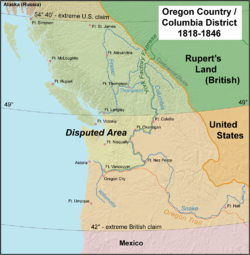
The United States gained undisputed jurisdiction over the region in the Oregon Treaty of 1846, which set the border with British North America at the 49th parallel, although the area had been under de facto jurisdiction of the Provisional Government of Oregon from 1843 to 1849.
Image source: Oregon Treaty
Aug 14, 1848
% complete
The original boundaries of Oregon Territory in 1848 included all three of the present-day Pacific Northwest states and extended eastward to the Continental Divide, encompassing all of present-day Idaho.
Image source: Oregon Territory
1853
% complete
In 1853, areas north of the 46th Parallel became Washington Territory, splitting what is now Idaho in two between Washington Territory and Oregon Territory.
Image source: Washington Territory
1855
% complete
The Church of Jesus Christ of Latter-Day Saints missionaries founded Fort Lemhi in 1855 in eastern Idaho near present-day Tendoy, but the settlement did not last and was abandoned after conflict with local tribes.
1859
% complete
The future state was reunited in 1859 after Oregon became a state and the boundaries of Washington Territory were redrawn, placing all of present-day Idaho within Washington Territory.
Apr 1860
% complete
The first organized town in Idaho was Franklin, settled in April 1860 by Mormon pioneers who believed they were in Utah Territory; although a later survey determined they had crossed the border into what would become Idaho.
Mar 4, 1863
% complete
On March 4, 1863, President Abraham Lincoln signed an act creating Idaho Territory from portions of Washington Territory and Dakota Territory, with its capital at Lewiston.
Image source: Idaho Territory
Dec 24, 1864
% complete
Boise was becoming a growing area after gold was found nearby, so on December 24, 1864, Boise City was made the final destination of the capital for the Territory of Idaho, replacing Lewiston.
Image source: Boise, Idaho
1868
% complete
In 1868, Idaho Territory assumed the boundaries of the modern state after Wyoming Territory was carved out of its eastern lands, setting the stage for eventual statehood.
1870
% complete
Chinese immigrants came through San Francisco in the mid-19th century to work on railroads and open businesses. By 1870 there were over 4,000 Chinese in Idaho, comprising almost 30% of the population. They suffered discrimination from groups like the Anti-Chinese League, which sought to limit their rights and opportunities.
1860 - 1866
% complete
From 1860 to 1866 Idaho produced 19% of all gold in the United States, or 2.5 million ounces, fueling rapid settlement and economic development across the territory.
Image source: Idaho
1860
% complete
In 1860, the first of several gold rushes in Idaho began at Pierce in present-day Clearwater County, drawing prospectors north from the Clearwater River country.
1862
% complete
By 1862, settlements in both the north and south of present-day Idaho had formed around the mining boom, including boomtowns in the Boise Basin and Clearwater regions.
1896
% complete
Idaho proved receptive to the progressive agenda, embracing women's suffrage in 1896 and statewide prohibition in 1916 before either became federal law, making it one of the more progressive states of the era.
Image source: Progressive Era
1905
% complete
Milner Dam on the Snake River, completed in 1905, allowed for the formation of many agricultural communities in the Magic Valley region, which had previously been nearly unpopulated desert.
1919 - 1925
% complete
In 1919, the Idaho legislature passed an Act legalizing the forced sterilization of some persons institutionalized in the state. In 1925 it passed a revised eugenics act tailored to avoid earlier legal objections. Between 1932 and 1964, a total of 30 women and eight men were sterilized under this law.
Image source: Eugenics in the United States
1972
% complete
Idaho's forced sterilization law, part of the eugenics movement of the early 20th century, was formally repealed in 1972, ending decades of legally sanctioned involuntary sterilization.
1889 - Nov 5, 1889
% complete
Governor Stevenson called for a constitutional convention in 1889. The convention approved a constitution on August 6, 1889, and voters approved the constitution on November 5, 1889, clearing the path for Idaho statehood.
1890 - 1895
% complete
Willis Sweet, a Republican, was Idaho's first congressman, serving from 1890 to 1895 representing the state at-large. In 1896 he supported the Silver Republican Party instead of the regular Republican nominee William McKinley, reflecting silver mining interests in his district.
Jul 3, 1890
% complete
Idaho was admitted as a state on July 3, 1890, when the territory became the 43rd state of the Union. At the time of statehood, the population was 88,548.
1892
% complete
In 1892, miners called a strike which developed into a shooting war between union miners and company guards in the Coeur d'Alene mining district. The violence committed by union miners was answered with a brutal response by authorities.
1899
% complete
Hostilities erupted again at the Bunker Hill facility in 1899, when seventeen union miners were fired for having joined the union. The resulting uprising was put down forcefully by Governor Frank Steunenberg, who had been elected on a pro-labor platform.
Dec 30, 1905
% complete
The labor struggle culminated in the December 1905 assassination of former Governor Frank Steunenberg by Harry Orchard (also known as Albert Horsley), a member of the Western Federation of Miners. Orchard was allegedly incensed by Steunenberg's efforts to suppress the 1899 miner uprising.
1907
% complete
In 1907, WFM Secretary Treasurer 'Big Bill' Haywood and two other WFM leaders were tried in Boise on charges of conspiracy to murder Steunenberg, with Orchard testifying against them as part of a deal made with detective James McParland. Haywood and the others were ultimately acquitted.
1936
% complete
Some former mining towns reinvented themselves as resort communities, most notably in Blaine County, where the Sun Valley ski resort opened in 1936 as America's first destination ski resort.
1992
% complete
In 1992, a deadly stand-off occurred between federal agents and the Weaver family at Ruby Ridge in northern Idaho, drawing national attention to anti-government movements and leading to scrutiny of federal law enforcement tactics.
Image source: Ruby Ridge
2001
% complete
In 2001, the Aryan Nations compound located in Hayden Lake, Idaho, was confiscated as a result of a court case brought after a violent incident involving security guards, and the organization moved out of state.
Image source: Aryan Nations
Mar 13, 2020
% complete
On March 13, 2020, officials from the Idaho Department of Health and Welfare announced the first confirmed case of the novel coronavirus COVID-19 within the state of Idaho, beginning the pandemic's impact on the state.
Or browse the full history timeline directory, with more than 2,000 topics.
This History of Idaho timeline was generated with the help of AI, using information found on the internet.
We work hard to keep these timelines accurate, but mistakes do get through. If you spot one, email us at [email protected] and we'll fix it for future visitors.
Generate yours with AI or build it from scratch, for free.
Export your timeline, add your own events, edit or remove AI-generated events, and much more
No credit card required.
Cancel anytime.
Cancel anytime.
You can create an unlimited number of timelines with up to 10 events on each one, customize how they look, export them to PDF, PNG, PowerPoint, CSV, and Excel, and share them with a link. Paid plans raise the event limit and add features like spreadsheet imports and collaborators.
Yes. You can cancel your subscription from your account page at any time, and you will not be charged again. Your subscription stays active for the rest of the period you already paid for.
Yes. We will email you a reminder before the annual renewal, and we will also email you a receipt.
Yes. You can email us within 15 days of any payment, and we will issue you a full refund.
Check out our pricing docs or send us an email anytime: [email protected].