-
Use Cases
-
Resources
-
Pricing
Indiana's history spans thousands of years, beginning with ancient Native American civilizations such as the Mound Builders. French fur traders arrived in the 17th century, followed by British and American control. Indiana became the 19th U.S. state on December 11, 1816, and grew rapidly through agriculture, the National Road, and later industrialization centered on steel production in Gary. Today, Indiana is known for its manufacturing economy, sports culture, and Midwestern heritage. More Less
1000 - 1450
% complete
The Mississippian culture built a large, complex settlement at Angel Mounds near present-day Evansville. The site featured platform mounds, palisades, and extensive agricultural fields, representing one of the most sophisticated pre-Columbian societies in the Ohio River Valley.
Image source: Angel Mounds
1679
% complete
French explorer René-Robert Cavelier de La Salle traveled through the region now known as Indiana during his expeditions in the Great Lakes and Mississippi Valley, marking some of the earliest European contact with the area's Miami and other Native American peoples.
Image source: René-Robert Cavelier, Sieur de La Salle
1732
% complete
The French founded a fur trading post at Vincennes on the Wabash River, making it one of the oldest permanent European settlements in Indiana. It became a key center of French influence and trade with Native American tribes.
Image source: Vincennes, Indiana
Feb 23, 1779
% complete
American militia led by George Rogers Clark captured British-held Fort Sackville at Vincennes during the Revolutionary War. The victory secured the Illinois country for the United States and was one of the most significant western engagements of the war.
Image source: Siege of Fort Vincennes
Jul 13, 1787
% complete
Congress created the Northwest Territory under the Northwest Ordinance, which included present-day Indiana. The ordinance established a framework for governance and prohibited slavery in the territory, setting the path toward future statehood.
Image source: Northwest Territory
Jul 4, 1800
% complete
Congress carved the Indiana Territory out of the Northwest Territory, with William Henry Harrison appointed as its first governor. The new territory included much of the modern Midwest and had its capital at Vincennes.
Image source: Indiana Territory
Nov 7, 1811
% complete
Governor William Henry Harrison led U.S. forces against the Shawnee leader Tecumseh's confederacy near Prophetstown on the Tippecanoe River. Harrison's forces prevailed, weakening the pan-Indian resistance movement and paving the way for increased American settlement.
Image source: Battle of Tippecanoe
Sep 1812
% complete
Native American forces allied with Britain besieged Fort Harrison near present-day Terre Haute early in the War of 1812. A small American garrison successfully defended the fort, marking one of the first American victories of the war.
Image source: Fort Harrison
Dec 24, 1814
% complete
The Treaty of Ghent ended the War of 1812, diminishing British support for Native American resistance in the Old Northwest. This opened the door to accelerated American migration into the Indiana Territory.
Image source: Treaty of Ghent
Dec 11, 1816
% complete
Indiana achieved statehood with Corydon serving as its first capital. The new state adopted a constitution banning slavery and began building institutions of government amid rapid population growth from settlers arriving via the National Road and Ohio River.
Image source: History of Indiana
1821
% complete
Indianapolis was platted specifically to serve as Indiana's new capital due to its central location. It officially replaced Corydon as the capital in 1825 and grew into the state's dominant political, economic, and cultural center.
Image source: Indianapolis
1832
% complete
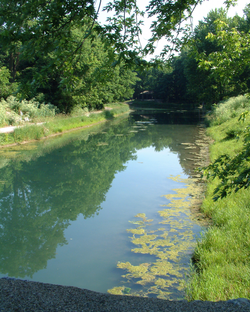
Construction began on the Wabash and Erie Canal, an ambitious project to connect the Great Lakes to the Ohio River. Though it boosted commerce for a time, financial troubles and the rise of railroads ultimately doomed the canal venture.
Image source: Wabash and Erie Canal
1847
% complete
Indiana's first operating railroad line opened, ushering in a transportation revolution. Railroads soon crisscrossed the state, replacing canals and dramatically accelerating agricultural expansion, industrialization, and population growth.
Image source: Indiana
1850
% complete
By mid-century, Indiana's population exceeded one million residents as waves of migrants from the eastern states and immigrants from Europe settled its farmland. Agriculture, particularly corn and pork production, dominated the state economy.
Apr 1861 - Apr 1865
% complete
Indiana contributed roughly 200,000 soldiers to the Union Army during the Civil War. Hoosiers fought in nearly every major campaign, while the home front supported the war effort through agriculture, manufacturing, and care for wounded soldiers.
Image source: Indiana in the American Civil War
Jul 1863
% complete
Confederate cavalry under John Hunt Morgan crossed the Ohio River and raided southern Indiana communities, including Corydon and Salem. The raid caused panic but little lasting damage, and Morgan was captured before returning south.
Image source: Morgan's Raid
May 6, 1869
% complete
Indiana established Purdue University in West Lafayette as its land-grant institution under the Morrill Act, funded partly by philanthropist John Purdue. It became a leading center for engineering, agriculture, and scientific education.
Image source: Purdue University
1886 - 1919
% complete
The discovery of vast natural gas fields near Anderson and Muncie triggered an industrial boom. Factories producing glass, steel, and machinery flocked to the region, fueling rapid growth until the gas supply was largely depleted within decades.
Image source: Indiana gas boom
Nov 6, 1888
% complete
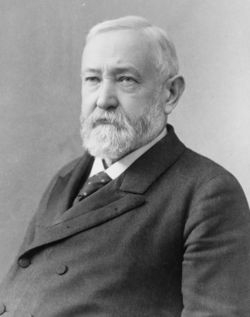
Indianapolis lawyer Benjamin Harrison defeated incumbent Grover Cleveland to become the 23rd president of the United States, the only president elected from Indiana. His administration pursued tariff reform, veterans' affairs, and naval expansion.
Image source: Benjamin Harrison
1890 - 1920
% complete
A circle of Impressionist painters known as the Hoosier Group, including T.C. Steele and William Forsyth, brought national recognition to Indiana art. Their landscapes celebrated the state's rural beauty and helped establish Indianapolis as a cultural hub.
Image source: Hoosier Group
1906
% complete
U.S. Steel founded the city of Gary along Lake Michigan to house workers for its massive new steel mills. Gary became an industrial powerhouse and attracted tens of thousands of immigrant and African American workers seeking jobs in the mills.
Image source: Gary, Indiana
Aug 1909
% complete
The Indianapolis Motor Speedway opened west of Indianapolis, hosting the first Indianapolis 500 in 1911. It quickly earned the nickname 'The Brickyard' and grew into one of the most famous racing venues in the world, cementing Indiana's automotive heritage.
Image source: Indianapolis Motor Speedway
1916 - 1970
% complete
Hundreds of thousands of African Americans moved north during the Great Migration, with many settling in Indianapolis, Gary, and other industrial cities in search of factory work. Their arrival reshaped urban demographics and culture despite facing segregation and discrimination.
Image source: Great Migration (African American)
1920 - 1927
% complete
The Ku Klux Klan gained enormous political power in Indiana in the 1920s, influencing elections and public policy before collapsing after Grand Dragon D.C. Stephenson was convicted of murder in 1925. The scandal discredited the organization statewide.
Image source: Indiana Klan
1929 - 1939
% complete
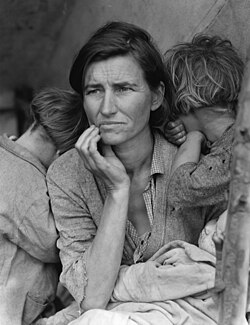
The Great Depression hit Indiana hard, shuttering factories and farms alike. New Deal programs such as the WPA built schools, roads, and public works across the state while providing relief to struggling families.
Image source: Great Depression in the United States
1941 - 1945
% complete
During World War II, Indiana factories converted to produce aircraft engines, munitions, and vehicles. Hundreds of thousands of Hoosiers served in the armed forces, and wartime demand pulled the state fully out of the Depression.
Image source: United States home front during World War II
1950 - 1970
% complete
After World War II, Indiana experienced rapid suburban growth, highway construction, and economic diversification. Cities like Indianapolis expanded outward while interstate highways transformed travel and commerce throughout the state.
Image source: Suburbanization
Jan 1, 1970
% complete
Indianapolis merged city and county governments under the Unigov legislation championed by Mayor Richard Lugar. The consolidation streamlined services and spurred downtown revitalization, making Indianapolis a model for urban governance.
Image source: Unigov
1980 - 1989
% complete
Pharmaceutical giant Eli Lilly and Company drove Indianapolis's emergence as a major life sciences hub, pioneering insulin production and later breakthrough drugs like Prozac, anchoring the state's modern knowledge-based economy.
Image source: Eli Lilly and Company
Aug 2008
% complete
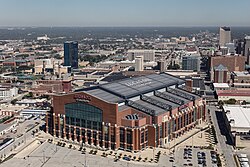
Lucas Oil Stadium opened as the home of the Indianapolis Colts and hosted Super Bowl XLVI in 2012. Its construction reflected Indianapolis's continued investment in sports tourism and downtown development as economic drivers.
Image source: Lucas Oil Stadium
Or browse the full history timeline directory, with more than 2,000 topics.
This History of Indiana timeline was generated with the help of AI, using information found on the internet.
We work hard to keep these timelines accurate, but mistakes do get through. If you spot one, email us at [email protected] and we'll fix it for future visitors.
Generate yours with AI or build it from scratch, for free.
Export your timeline, add your own events, edit or remove AI-generated events, and much more
No credit card required.
Cancel anytime.
Cancel anytime.
You can create an unlimited number of timelines with up to 10 events on each one, customize how they look, export them to PDF, PNG, PowerPoint, CSV, and Excel, and share them with a link. Paid plans raise the event limit and add features like spreadsheet imports and collaborators.
Yes. You can cancel your subscription from your account page at any time, and you will not be charged again. Your subscription stays active for the rest of the period you already paid for.
Yes. We will email you a reminder before the annual renewal, and we will also email you a receipt.
Yes. You can email us within 15 days of any payment, and we will issue you a full refund.
Check out our pricing docs or send us an email anytime: [email protected].