-
Use Cases
-
Resources
-
Pricing
The history of Iowa traces its development from Native American habitation through European exploration, American settlement, and statehood in 1846, to its rise as a leading agricultural state. Key themes include westward expansion, the Louisiana Purchase, farming innovation, and Iowa's evolving cultural and economic landscape. More Less
500 AD - 1300
The Effigy Mounds culture built thousands of earthen mounds across northeastern Iowa between about 500 and 1300 AD, many shaped like animals such as bears and birds. These mounds served ceremonial and burial purposes, and Effigy Mounds National Monument today preserves over 200 of them.
Image source: Effigy Mounds National Monument

Jun 1673
French explorers Jacques Marquette and Louis Joliet became the first Europeans to record visiting what is now Iowa when they descended the Mississippi River in 1673. Their expedition opened the region to French fur trade and further exploration.
Image source: Jacques Marquette

1762
Following its defeat in the Seven Years' War, France secretly ceded Louisiana, including the lands west of the Mississippi that would become Iowa, to Spain in 1762. Spanish rule was largely indirect, and French traders continued operating throughout the region.
Image source: Louisiana (New France)

1788
In 1788, Julien Dubuque received permission from the Meskwaki people to mine lead near present-day Dubuque, establishing one of the first permanent European settlements in Iowa. The city of Dubuque, founded later, bears his name.
Image source: Julien Dubuque

Dec 20, 1803
The United States purchased the Louisiana Territory from France in 1803, bringing most of present-day Iowa under American control. This acquisition opened the trans-Mississippi West to American settlement and expansion.
Image source: Louisiana Purchase

Aug 1804 - Sep 1804
In August and September 1804, the Lewis and Clark expedition traveled along Iowa's western border on the Missouri River, holding council with Native Americans at Calumet Bluff and burying Sergeant Charles Floyd near present-day Sioux City, the only expedition member to die en route.
Image source: Lewis and Clark Expedition

Aug 1805
Lieutenant Zebulon Pike led an expedition up the Mississippi River in 1805, purchasing land for military posts including a site near present-day Fort Madison. His explorations helped assert U.S. authority over the upper Mississippi Valley, including eastern Iowa.
Image source: Zebulon Pike

1808 - 1813
The United States Army built Fort Madison in 1808, the first American military post in present-day Iowa. It endured attacks by Sauk warriors allied with the British during the War of 1812 before being abandoned and burned in 1813.
Image source: Fort Madison, Iowa

Sep 21, 1832
Following the Black Hawk War, the defeated Sauk and Meskwaki signed the Black Hawk Purchase in September 1832, ceding a fifty-mile-wide strip of land in eastern Iowa to the United States. The treaty opened eastern Iowa to rapid white settlement beginning in June 1833.
Image source: Black Hawk Purchase

1834
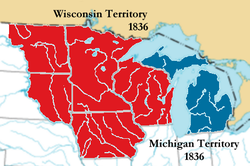
In 1834, Congress attached lands west of the Mississippi, including present-day Iowa, to Michigan Territory as the 'Iowa District.' Two years later these lands were transferred to the newly created Wisconsin Territory.
Image source: Michigan Territory
This History of Iowa timeline was generated with the help of AI, using information found on the internet.
We work hard to keep these timelines accurate, but mistakes do get through. If you spot one, email us at [email protected] and we'll fix it for future visitors.
Generate yours with AI or build it from scratch, for free.