-
Use Cases
-
Resources
-
Pricing
Delaware, known as 'The First State,' has a rich history spanning thousands of years. Originally inhabited by Lenape and Nanticoke peoples, it was colonized by Swedes and Dutch settlers in the early 1600s before coming under English control. Delaware played a pivotal role in American history by becoming the first state to ratify the U.S. Constitution on December 7, 1787, earning its famous nickname. More Less
1497
% complete
The Delaware watershed was claimed by the English based on the explorations of John Cabot in 1497, Captain John Smith, and others, and was given the name of the title held by Thomas West, 3rd Baron De La Warr, governor of Virginia from 1610 until 1618.
1609
% complete
The Dutch believed they also had a claim to the Delaware region based on the 1609 explorations of Henry Hudson, setting up competing European claims with the English.
1624
% complete
Under the auspices of the Dutch West India Company, the Dutch were the first Europeans to occupy the land, establishing the trading post of Fort Wilhelmus in 1624 at 'Hooghe Eyland' (High Island), now Burlington Island, opposite Burlington, New Jersey.
Image source: Fort Wilhelmus
1626
% complete
The Dutch established another trading post, Fort Nassau, near present-day Gloucester City, New Jersey, in 1626 as part of their expanding presence along the Delaware River.
1631
% complete
The Dutch founded a settlement at Zwaanendael, now Lewes, Delaware, in 1631. The colony was soon destroyed in a war with Native Americans, though the Dutch never gave up their claim to the area.
Image source: Zwaanendael Colony
1638
% complete
Delaware is made up of three counties established in 1638, before the time of William Penn.
1638
% complete
The Swedish South Company was formed to settle the territory of New Sweden, and following much negotiation, a group led by Peter Minuit arrived under the flag of Sweden at the Delaware River in 1638, founding Fort Christina.
Image source: New Sweden

1644
% complete
By 1644, Swedish and Finnish settlers were living along both sides of the Delaware River from Fort Christina to the Schuylkill River, forming the core of the New Sweden colony.
1651
% complete
Although the Dutch settlement at Zwaanendael had been destroyed, the Dutch never gave up their claim to the area, and in 1651 built Fort Casimir, now New Castle, under the leadership of Peter Stuyvesant.
Image source: Fort Casimir
1654
% complete
In 1654, Johan Risingh, the Swedish governor of New Sweden, captured Fort Casimir from the Dutch, a move that would provoke a strong Dutch response.
Image source: Johan Risingh
1655
% complete
In the summer of 1655, an enraged Stuyvesant led a Dutch expedition to the Delaware River, attacked all the Swedish communities and forcibly ended the New Sweden colony, incorporating the whole area back into the New Netherland colony.
1664
% complete
In 1664, James, the Duke of York and brother of King Charles II, outfitted an expedition that easily ousted the Dutch from both the Delaware and Hudson rivers, leaving the Duke of York proprietary authority over the entire area.
1682
% complete
In 1682, Penn arrived in New Castle with two documents: a charter for the Province of Pennsylvania and a lease for what became known as 'the Lower Counties on the Delaware', beginning Pennsylvania's governance of the Delaware territory.
1682
% complete
In William Penn's Frame of Government of 1682, he established a combined assembly for his domain by providing for equal membership from each county and requiring legislation to have the assent of both the Lower Counties and the Upper Counties of Chester, Philadelphia and Bucks.
Image source: Frame of Government of Pennsylvania
1704
% complete
In 1704, members of the two regions mutually agreed to meet and pass laws separately from then on, giving the Lower Counties on the Delaware their own distinct legislature.
1763 - 1767
% complete
Large parts of southern and western Delaware had been thought to be in Maryland until the legal battles were settled when the heirs agreed to the survey performed by Charles Mason and Jeremiah Dixon between 1763 and 1767.
Image source: Mason–Dixon line
1776
% complete
The Delaware Constitution of 1776 changed the name of the polity from The Counties of New Castle, Kent and Sussex upon Delaware, also known as the Lower Counties, to The Delaware State.
Jun 15, 1776
% complete
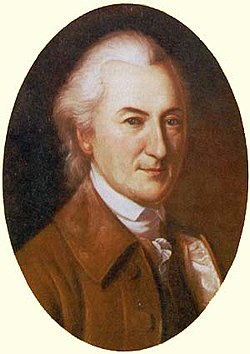
The American Revolutionary War began in April 1775, and on June 15, 1776, the Delaware Assembly voted to break all ties with Great Britain and simultaneously with Pennsylvania.
Image source: John Dickinson
Aug 30, 1777
% complete
The engagement began August 30, 1777, about two miles south of Cooch's Bridge, located in present-day Newark, Delaware, during the British campaign toward Philadelphia.
Image source: Battle of Cooch's Bridge
Apr 1778
% complete
Delaware had a Loyalist insurrection in April 1778 called the Clow Rebellion, reflecting internal divisions within the state during the Revolutionary War.
Image source: Clow Rebellion
1783
% complete
In 1783, the independence of the United States and therefore Delaware was confirmed in the Treaty of Paris, formally ending the American Revolutionary War.
Image source: Treaty of Paris (1783)
1800
% complete
Éleuthère Irénée du Pont arrived from France in 1800, beginning the du Pont family's long association with Delaware that would shape its economy for centuries.
Image source: Du Pont family
1802 - 1829
% complete
The construction of the Chesapeake and Delaware Canal between 1802 and 1829 brought significant shipping interests to Delaware, expanding the state's commercial opportunities.
Image source: Chesapeake & Delaware Canal
1804
% complete
In 1804 Éleuthère Irénée du Pont established the largest gunpowder factory in the United States on the banks of the Brandywine River just north of Wilmington.
Image source: Éleuthère Irénée du Pont
1810
% complete
Opposition to slavery in Delaware, imported from Quaker-dominated Pennsylvania, led many slaveowners to free their slaves; half of the state's black population was free by 1810, and more than 90% were free by 1860.
Image source: History of slavery in Delaware
1813
% complete
The oldest black church in the country was chartered in Delaware by former slave Peter Spencer in 1813 as the 'Union Church of Africans', which is now known as the A.U.M.P. Church.
Image source: African Union Methodist Protestant Church
1814
% complete
The Big August Quarterly, which began in 1814, is still celebrated today and is the oldest such cultural festival in the country.
1861 - 1865
% complete
Despite its small size, with a population of only 112,000 in 1860, Delaware supplied more than 12,000 men for the Union army, and the DuPont powder mills in Wilmington were an essential source of gunpowder for the Northern war effort.
Image source: Delaware in the American Civil War
Jan 3, 1861
% complete
During the secession crisis of late 1860 to early 1861, Southern states sent commissioners to try to convince Delaware to join them in leaving the Union, but the state legislature voted against holding a state secession convention on January 3, 1861.
Feb 8, 1865
% complete
On February 8, 1865, two months before the end of the Civil War, Delaware voted to reject the Thirteenth Amendment to the United States Constitution and so voted to continue slavery beyond the Civil War. However, the gesture proved futile when other states ratified the amendment, which took effect in December 1865 and thereby ended slavery in Delaware.
Image source: Thirteenth Amendment to the United States Constitution
1866
% complete
The Delaware legislature declared blacks to be second-class citizens in 1866 and restricted their voting rights despite the Fifteenth Amendment, ensuring continued Democratic success in the state throughout most of the nineteenth century.
1875
% complete
Fearful that the 1875 Civil Rights Act passed by Congress might establish social equality, Delaware legislators passed Jim Crow laws that mandated racial segregation in public facilities and effectively codified the state's tradition of white supremacy.
1921
% complete
A small dispute lingered until 1921 over an area known as the Wedge, where the Mason-Dixon line and the Twelve-Mile Circle left a fragment of land claimed by both Pennsylvania and Delaware.
Image source: Delaware Wedge
1954
% complete
Board of Education was the 1954 decision of the United States Supreme Court which found racial segregation in United States public schools to be unconstitutional, directly affecting Delaware's segregated school system.
1954
% complete
Only 456 out of 1,562 students attended the next day in Milford, and the movement gained traction in the nearby town of Lincoln, where 116 of the 146 pupils in the local elementary school boycotted in solidarity.
Oct 1954
% complete
A mass meeting in Milford in October 1954 attracted a crowd of 3,000 people opposed to school integration following the Brown decision.
Sep 1955
% complete
The Attorney General later took action to revoke the NAAWP's corporate charter in September 1955, curbing the organization behind the anti-integration movement.
1967
% complete
School segregation in the state would not end until 1967, thirteen years after the Supreme Court declared segregated public schools unconstitutional.
Or browse the full history timeline directory, with more than 2,000 topics.
This History of Delaware timeline was generated with the help of AI, using information found on the internet.
We work hard to keep these timelines accurate, but mistakes do get through. If you spot one, email us at [email protected] and we'll fix it for future visitors.
Generate yours with AI or build it from scratch, for free.
Export your timeline, add your own events, edit or remove AI-generated events, and much more
No credit card required.
Cancel anytime.
Cancel anytime.
You can create an unlimited number of timelines with up to 10 events on each one, customize how they look, export them to PDF, PNG, PowerPoint, CSV, and Excel, and share them with a link. Paid plans raise the event limit and add features like spreadsheet imports and collaborators.
Yes. You can cancel your subscription from your account page at any time, and you will not be charged again. Your subscription stays active for the rest of the period you already paid for.
Yes. We will email you a reminder before the annual renewal, and we will also email you a receipt.
Yes. You can email us within 15 days of any payment, and we will issue you a full refund.
Check out our pricing docs or send us an email anytime: [email protected].