-
Use Cases
-
Resources
-
Pricing
The history of Hawaii spans from the arrival of Polynesian voyagers around 1,500 years ago through the rise of the Kingdom of Hawaii under King Kamehameha I, European contact led by Captain James Cook in 1778, the overthrow of Queen Liliuokalani in 1893, U.S. annexation in 1898, and statehood on August 21, 1959. Today, Hawaii is the only U.S. state located in Oceania and the only one with a royal palace, blending Native Hawaiian traditions with multicultural influences. More Less
1300 - 1500
% complete
Hawaiians organized land into wedge-shaped divisions called ahupuaa, running from mountain to sea, enabling sustainable resource management and a complex social structure governed by chiefs and kapu laws.
Image source: Ahupuaʻa
1400 - 1600
% complete
A second wave of migration associated with the kahiki tradition introduced new chiefly lines and religious practices, including the ku cult and human sacrifice, shaping Hawaiian hierarchy for centuries.
Jan 20, 1778
% complete
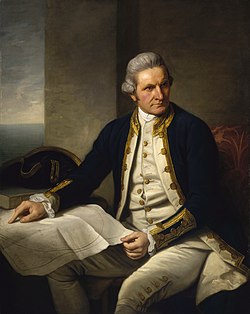
British explorer Captain Cook became the first European documented to reach Hawaii, landing at Waimea Bay, Kauai. He named the archipelago the Sandwich Islands and opened sustained contact with Europeans.
Image source: James Cook
Feb 14, 1779
% complete
Cook was killed in a violent clash with Hawaiians at Kealakekua Bay on Hawaii Island after tensions escalated during his return visit, marking a turbulent start to Western contact.
Image source: Death of James Cook
1782
% complete
Kamehameha I defeated his cousin Kiwalao in this battle on Hawaii Island, sparking years of warfare that began his campaign to unite all the Hawaiian Islands under one rule.
Image source: Battle of Mokuʻōhai
1795
% complete
After conquering Maui, Oahu, and Molokai, Kamehameha I completed his conquest with the surrender of Kauai's king Kaumualii by agreement in 1810, establishing the unified Kingdom of Hawaii.
Image source: Kamehameha I
Apr 19, 1820
% complete
Congregationalist missionaries from New England arrived aboard the Thaddeus at Kailua-Kona, introducing Christianity, literacy, and Western education, profoundly transforming Hawaiian society.
Image source: American Board of Commissioners for Foreign Missions
Oct 8, 1840
% complete
Under King Kamehameha III, Hawaii promulgated its first written constitution, creating a constitutional monarchy with a house of representatives and formalizing the kingdom's government.
Feb 25, 1843 - Jul 31, 1843
% complete
British captain Lord George Paulet seized Hawaii in February, but Queen Victoria's government repudiated the action, restoring King Kamehameha III to power in July, celebrated as Restoration Day.
Image source: Paulet affair

Jan 27, 1848 - Mar 7, 1848
% complete
King Kamehameha III enacted sweeping land reforms dividing land among the crown, chiefs, and commoners. The privatization of land led, over time, to significant foreign ownership of Hawaiian acreage.
Image source: Great Māhele
Aug 30, 1849
% complete
French admiral Louis Tromelin seized the fort in Honolulu and destroyed property after disputes over Catholic persecution and trade duties, though he did not occupy the islands permanently.
Image source: French invasion of Honolulu
Feb 12, 1874
% complete
David Kalakaua ascended the throne and championed a cultural renaissance, reviving hula, chant, and surfing while promoting modernization and the Merrie Monarch legacy.
Image source: Kalākaua
1875
% complete
The treaty gave Hawaiian sugar duty-free access to American markets, fueling explosive growth of the sugar plantation economy and deepening economic ties between Hawaii and the United States.
Image source: Reciprocity Treaty of 1875
Jul 6, 1887
% complete
Armed white businessmen and reformers forced King Kalakaua to sign a constitution stripping the monarchy of much power, disenfranchising many Native Hawaiians and Asian residents, and ceding Pearl Harbor to the US.
Image source: 1887 Constitution of the Hawaiian Kingdom
Jul 30, 1889
% complete
Robert Wilcox led an armed uprising seeking to restore powers to the monarchy under King Kalakaua; the revolt failed and Wilcox was tried and acquitted by a local jury.
Image source: Wilcox rebellion of 1889
Oct 1, 1890
% complete
The tariff removed preferential treatment of Hawaiian sugar, crippling the plantation economy and intensifying planter interest in annexation by the United States.
Image source: McKinley Tariff
Jan 29, 1891
% complete
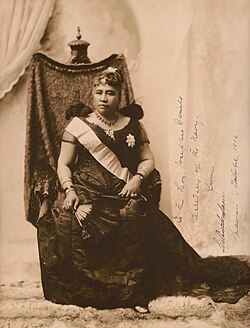
Following Kalakaua's death, his sister Liliuokalani became Hawaii's first and only reigning queen, vowing to restore monarchical authority and draft a new constitution.
Image source: Liliʻuokalani
1852 - 1924
% complete
Plantations recruited hundreds of thousands of laborers from Japan, China, Portugal, the Philippines, Korea, and Puerto Rico, transforming Hawaii into one of the world's most multicultural societies.
Image source: Plantation economy
1893
% complete
President Cleveland's special commissioner James Blount concluded the overthrow was illegal and conducted with US complicity; Cleveland withdrew the annexation treaty from Congress.
Image source: Blount Report
Jan 17, 1893
% complete
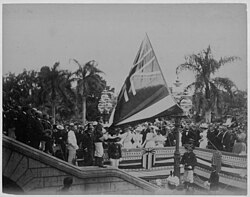
A committee of mostly American and European businessmen, backed by US Marines from the USS Boston, deposed Queen Liliuokalani, abolishing the monarchy and installing a provisional government.
Image source: Overthrow of the Hawaiian Kingdom
Jul 4, 1894 - Jul 4, 1900
% complete
The provisional government proclaimed the Republic of Hawaii with Sanford Dole as president, seeking eventual annexation by the United States and suppressing a counter-revolution in 1895.
Image source: Republic of Hawaii
Jan 24, 1895
% complete
After a royalist uprising failed, the queen was arrested, tried by military tribunal, imprisoned in Iolani Palace, and formally abdicated in exchange for pardons of her supporters.
Image source: 1895 Wilcox rebellion
Jul 7, 1898
% complete
President McKinley signed the Newlands Resolution annexing Hawaii via joint resolution, amid the Spanish-American War, making it US territory two years later.
Image source: Newlands Resolution
Jan 20, 1900 - Apr 1900
% complete
Efforts to control bubonic plague through controlled burns went awry, destroying most of Honolulu's Chinatown and displacing thousands of residents.
Image source: Chinatown, Honolulu
Apr 30, 1900
% complete
The Organic Act created the US territorial government, granting US citizenship to residents and establishing an elected legislature, though governors were appointed federally.
Image source: Territory of Hawaii
Dec 7, 1941
% complete
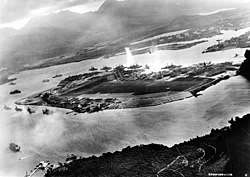
Japan launched a surprise attack on the US Pacific Fleet at Pearl Harbor, killing more than 2,400 Americans and drawing the United States into World War II. Martial law was imposed in Hawaii until 1944.
Image source: Attack on Pearl Harbor
Dec 7, 1941 - Oct 24, 1944
% complete
The US Army governed Hawaii throughout World War II, imposing curfews, censorship, and blackouts; Japanese Americans faced suspicion, while many Nisei served heroically in the 442nd Regimental Combat Team.
Image source: Martial law in the United States
1954
% complete
Labor organizing and voter mobilization ended decades of Republican planter elite dominance, ushering in Democratic control that shaped modern Hawaii politics.
Image source: Hawaii Democratic Revolution of 1954
Aug 21, 1959
% complete
After a referendum in which roughly 94% of voters approved statehood, President Eisenhower signed the proclamation admitting Hawaii as the 50th state, the only majority-minority state at the time.
Image source: Hawaii Admission Act
Nov 14, 1959 - Dec 20, 1959
% complete
Months after statehood, spectacular fountains of lava erupted from Kilauea Iki crater, reaching 1,900 feet high and drawing international attention to Hawaii Volcanoes National Park.
Image source: Kīlauea Iki
1963
% complete
Established in Hilo to honor King Kalakaua, the annual weeklong festival grew into the world's premier celebration of hula, catalyzing the Hawaiian cultural renaissance.
Image source: Merrie Monarch Festival
1976
% complete
Beginning with the Hokulea voyage recreating ancient Polynesian navigation, a broad movement revived Hawaiian language immersion schools, music, and traditional practices.
Nov 23, 1993
% complete
Congress passed Public Law 103-150 apologizing to Native Hawaiians for the illegal overthrow of the kingdom 100 years earlier and acknowledging the deprivation of self-determination rights.
Image source: Apology Resolution
Or browse the full history timeline directory, with more than 2,000 topics.
This History of Hawaii timeline was generated with the help of AI, using information found on the internet.
We work hard to keep these timelines accurate, but mistakes do get through. If you spot one, email us at [email protected] and we'll fix it for future visitors.
Generate yours with AI or build it from scratch, for free.
Export your timeline, add your own events, edit or remove AI-generated events, and much more
No credit card required.
Cancel anytime.
Cancel anytime.
You can create an unlimited number of timelines with up to 10 events on each one, customize how they look, export them to PDF, PNG, PowerPoint, CSV, and Excel, and share them with a link. Paid plans raise the event limit and add features like spreadsheet imports and collaborators.
Yes. You can cancel your subscription from your account page at any time, and you will not be charged again. Your subscription stays active for the rest of the period you already paid for.
Yes. We will email you a reminder before the annual renewal, and we will also email you a receipt.
Yes. You can email us within 15 days of any payment, and we will issue you a full refund.
Check out our pricing docs or send us an email anytime: [email protected].