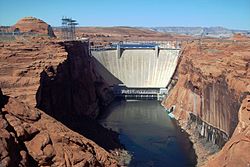
-
Use Cases
-
Resources
-
Pricing
The Colorado River is one of North America's most vital waterways, flowing roughly 1,450 miles from the Rocky Mountains in Colorado through Utah, Arizona, Nevada, California, and Mexico. Its history spans thousands of years of Indigenous habitation, Spanish exploration in the 16th century, the legendary John Wesley Powell expeditions of 1869, massive dam-building projects like Hoover Dam (completed 1936), landmark legal agreements such as the Colorado River Compact of 1922, and ongoing challenges including drought, over-allocation, and conservation in the 21st century. More Less
1,000 CE - 1300
% complete
Ancestral Puebloan peoples established agricultural communities along the Colorado River and its tributaries, farming with irrigation in the arid Southwest before abandoning the region around 1300, likely due to prolonged drought.
Image source: Ancestral Puebloans
1539
% complete
Spanish explorer Francisco de Ulloa reached the head of the Gulf of California, becoming one of the first Europeans to encounter the delta of the Colorado River during his coastal expedition of western Mexico.
Image source: Francisco de Ulloa
1540
% complete
Spanish explorer Melchior Díaz reached the lower Colorado River and named it the 'Rio del Tizón' (River of Firebrands), observing the practice of local Yuma peoples carrying burning firewood. The river was later renamed the Colorado for its reddish silt-laden waters.
Image source: Melchor Díaz
Aug 26, 1540
% complete
Sailing up the Gulf of California in support of Coronado's expedition, Hernando de Alarcón became the first European to navigate a substantial distance up the Colorado River, traveling as far as present-day Yuma, Arizona.
Sep 1540
% complete
A Spanish scouting party under García López de Cárdenas became the first known Europeans to view the Grand Canyon from its South Rim, though they were unable to descend to the Colorado River below due to its sheer cliffs.
Image source: Grand Canyon
1776
% complete
Fray Silvestre Vélez de Escalante and Francisco Atanasio Domínguez led an expedition from Santa Fe seeking a route to Monterey, crossing the upper Colorado River basin and providing some of the earliest detailed accounts of the region.
Image source: Domínguez–Escalante expedition
1848
% complete
The Treaty of Guadalupe Hidalgo ended the Mexican-American War and ceded most of the Colorado River's watershed to the United States, opening the region for American exploration, settlement, and development.
Image source: Treaty of Guadalupe Hidalgo
May 24, 1869 - Aug 30, 1869
% complete
One-armed Civil War veteran John Wesley Powell led the first successful boat expedition down the Colorado River through the Grand Canyon. His journey provided the first scientific survey of the river's canyons and captured the public imagination.
Image source: Powell Geographic Expedition of 1869
1878
% complete
Powell's influential report warned that the arid West could not be settled under traditional water laws and urged careful planning of irrigation, foreshadowing decades of conflict over Colorado River water allocation.
Image source: Report on the Lands of the Arid Region of the United States
1904
% complete
The U.S. Reclamation Service's Yuma Project was among the first federal efforts to harness the Colorado River for irrigation, diverting water to farms in Arizona and California and demonstrating the valley's agricultural potential.
Image source: Yuma Project
1905 - 1907
% complete
Mismanaged diversion of the Colorado River into the Alamo Canal allowed the entire river to flood into the Salton Sink for nearly two years, creating the Salton Sea and exposing the need for engineered control of the river.
Image source: Salton Sea
1909
% complete
Laguna Dam near Yuma became the first dam built across the Colorado River, diverting water for irrigation while marking the start of large-scale federal engineering works on the river.
1913
% complete
Completion of the Los Angeles Aqueduct demonstrated the enormous growth possible when cities import distant water, inspiring Southern California leaders to pursue Colorado River water for their booming metropolis.
Image source: Los Angeles Aqueduct
Dec 21, 1928
% complete
Congress passed the Boulder Canyon Project Act, funding construction of a massive dam at Black Canyon on the Colorado and apportioning Lower Basin water among California, Arizona, and Nevada, clearing legal hurdles for Hoover Dam.
Image source: Hoover Dam
Apr 20, 1931
% complete
Thousands of workers converged on Black Canyon during the Great Depression to build what was then the world's largest dam. Construction claimed the lives of more than 100 workers while transforming the Southwest's economy.
Feb 1, 1935
% complete
With Hoover Dam completed and gates closed, the Colorado began filling Lake Mead, the largest reservoir in the United States, storing floodwaters for irrigation, municipal supply, and hydroelectric power.
Image source: Lake Mead
Sep 30, 1935
% complete
President Roosevelt dedicated the completed Hoover Dam, hailing it as an engineering marvel that would control floods, generate power, and enable the growth of the desert Southwest.
1942
% complete
The All-American Canal, running entirely within the United States from Imperial Dam to California's Imperial Valley, became the largest irrigation canal in the world, sustaining agriculture in one of America's most productive farm regions.
Image source: All-American Canal
Sep 13, 1963
% complete
Glen Canyon Dam near Page, Arizona, impounded the Colorado to create Lake Powell, enabling Upper Basin storage obligations but also drowning scenic Glen Canyon and drawing lasting criticism from environmentalists like Edward Abbey.
Image source: Glen Canyon Dam
1968
% complete
Congress authorized the Central Arizona Project, a massive canal system delivering Colorado River water across Arizona to Phoenix and Tucson. Its completion in the 1990s transformed Arizona's urban growth and water security.
1911
% complete
California farmers organized the Imperial Irrigation District to manage diversions from the Colorado River, growing it into the largest single user of the river's water and a powerful voice in later water negotiations.
Image source: Imperial Irrigation District
Nov 24, 1922
% complete
Representatives of seven basin states, chaired by Commerce Secretary Herbert Hoover, divided the Colorado River between an Upper Basin (Colorado, Wyoming, Utah, New Mexico) and Lower Basin (California, Arizona, Nevada), allocating 7.5 million acre-feet per year to each based on overestimated flows.
Image source: Colorado River Compact
1934
% complete
Arizona challenged California's claims to Lower Basin water, launching decades of litigation and political conflict over each state's share of the Colorado River, culminating in the landmark case Arizona v. California.
Image source: Arizona v. California
1963
% complete
After years of litigation, the U.S. Supreme Court affirmed the Secretary of the Interior's authority to apportion Lower Basin water, granting Arizona 2.8 million acre-feet annually and resolving a bitter interstate dispute.
Aug 30, 1973
% complete
The United States and Mexico agreed to guarantee salinity standards for water delivered to Mexico at Morelos Dam, easing tensions over degraded Colorado River water reaching Mexican farms.
Image source: Colorado River Delta
Oct 16, 2003
% complete
California agencies finalized agreements quantifying their shares of Colorado River water and funding transfers from farms to cities, enabling California to live within its 4.4 million acre-foot apportionment.
Image source: Quantification Settlement Agreement
Feb 26, 1919
% complete
Congress established Grand Canyon National Park along the Colorado River, protecting the canyon's spectacular landscapes and ensuring public access to the river corridor, which later became central to debates over dams and recreation.
Image source: Grand Canyon National Park
1968
% complete
Intense environmental opposition led by conservation groups blocked proposals to build two additional dams within the Grand Canyon, marking a turning point in American environmental politics and preserving the canyon's free-flowing reaches.
Image source: Marble Canyon Dam
Jun 24, 1974
% complete
Responding to Mexican complaints about salty deliveries, Congress funded salinity control programs throughout the basin, addressing water quality issues caused by irrigation return flows and natural salt deposits.
1989
% complete
Congress required a comprehensive environmental review of Glen Canyon Dam operations, leading to new flow regimes designed to protect beaches, fish habitat, and cultural resources downstream in the Grand Canyon.
Oct 1992
% complete
This federal law directed dam managers to operate Glen Canyon Dam using adaptive management to protect the Grand Canyon's natural, recreational, and cultural resources while still meeting water delivery obligations.
2000
% complete
Beginning in 2000, sustained drought reduced runoff across the basin, shrinking Lake Mead and Lake Powell dramatically and prompting scientists to describe the period as potentially the worst in centuries.
May 20, 2019
% complete
Seven basin states, tribes, and Mexico signed Drought Contingency Plans committing to voluntary cuts in water use if reservoir levels fell further, aiming to stabilize Lakes Mead and Powell amid worsening shortages.
Image source: Colorado River Compact
Aug 16, 2021
% complete
The U.S. Bureau of Reclamation declared the first Tier 1 shortage on the Colorado River, triggering mandatory cutbacks to Nevada, Arizona, and Mexico as Lake Mead hit record lows amid climate change-driven aridification.
Or browse the full history timeline directory, with more than 2,000 topics.
This History of the Colorado River timeline was generated with the help of AI, using information found on the internet.
We work hard to keep these timelines accurate, but mistakes do get through. If you spot one, email us at [email protected] and we'll fix it for future visitors.
Generate yours with AI or build it from scratch, for free.
Export your timeline, add your own events, edit or remove AI-generated events, and much more
No credit card required.
Cancel anytime.
Cancel anytime.
You can create an unlimited number of timelines with up to 10 events on each one, customize how they look, export them to PDF, PNG, PowerPoint, CSV, and Excel, and share them with a link. Paid plans raise the event limit and add features like spreadsheet imports and collaborators.
Yes. You can cancel your subscription from your account page at any time, and you will not be charged again. Your subscription stays active for the rest of the period you already paid for.
Yes. We will email you a reminder before the annual renewal, and we will also email you a receipt.
Yes. You can email us within 15 days of any payment, and we will issue you a full refund.
Check out our pricing docs or send us an email anytime: [email protected].