-
Use Cases
-
Resources
-
Pricing
The history of Arkansas spans thousands of years, beginning with indigenous cultures such as the Caddo, Osage, and Quapaw peoples. European exploration began with Hernando de Soto in 1541, followed by French settlement. Arkansas became a U.S. territory in 1819 and the 25th state in 1836. It later experienced secession during the Civil War, Reconstruction struggles, the Civil Rights-era Little Rock Nine crisis of 1957, and growth into a modern economy anchored by figures like Bill Clinton and companies such as Walmart. More Less
800 - 1700
% complete
Caddo-speaking peoples established agricultural villages and ceremonial centers in southwestern Arkansas, building burial mounds and developing extensive trade networks. Their descendants remain a federally recognized tribe today.
Image source: Caddo
900 - 1600
% complete
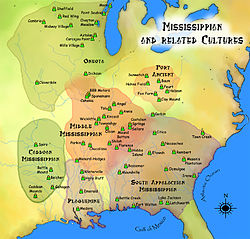
Mississippian peoples built large platform mounds, developed intensive agriculture based on corn, beans, and squash, and established complex chiefdoms along the Mississippi River. The Parkin site and Nodena site are notable archaeological remnants of this sophisticated culture.
Image source: Mississippian culture
1500
% complete
The Quapaw people migrated down the Ohio River valley and settled near the confluence of the Arkansas and Mississippi rivers. They would become one of the most significant tribes in early Arkansas history, later ceding their lands to the United States through a series of treaties.
Jun 1541
% complete
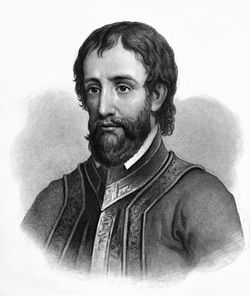
Spanish explorer Hernando de Soto crossed the Mississippi River into Arkansas in 1541, becoming the first European to explore the region. His expedition encountered Quapaw and Caddo communities before de Soto's death on the Mississippi River in 1542.
Image source: Hernando de Soto
1673
% complete
French explorers Jacques Marquette and Louis Joliet descended the Mississippi River to the mouth of the Arkansas River in 1673, meeting the Quapaw and claiming the region for France. Their voyage opened the way for French colonization of the lower Mississippi Valley.
Image source: Jacques Marquette

1686
% complete
French explorer Henri de Tonti established Arkansas Post near the confluence of the Arkansas and White rivers, making it the first permanent European settlement in Arkansas. It served as a fur trading post, military garrison, and administrative center for over a century.
Image source: Arkansas Post
Nov 1762
% complete
As part of the Treaty of Fontainebleau, France secretly transferred Louisiana west of the Mississippi, including Arkansas Post, to Spain. Spanish rule brought new trade regulations but little change to daily life in the sparsely populated territory.
Image source: Louisiana (New France)
Apr 30, 1803
% complete
The United States purchased the Louisiana Territory from France, bringing Arkansas under American control. The acquisition doubled U.S. territory and set the stage for American migration into the region west of the Mississippi River.
Image source: Louisiana Purchase
1804 - 1805
% complete
Scientists William Dunbar and George Hunter led the first scientific expedition into the Louisiana Purchase after Lewis and Clark, exploring the Ouachita River region of southern Arkansas and documenting its natural resources and hot springs.
Image source: Ouachita River
Dec 1811 - Feb 1812
% complete
A series of powerful earthquakes centered near New Madrid struck the region, dramatically altering the landscape of northeastern Arkansas. The quakes created Reelfoot Lake and were felt across much of North America.
Image source: 1811–1812 New Madrid earthquakes
1812 - 1819
% complete
After the Orleans Territory became the state of Louisiana, the remaining Louisiana Purchase lands were organized as Missouri Territory, which included present-day Arkansas until it was separated out as its own territory.
Image source: Missouri Territory
Jul 4, 1819
% complete
Congress created the Arkansas Territory from the southern portion of Missouri Territory, with Arkansas Post briefly serving as capital before Little Rock was designated the seat of government in 1821.
Image source: Arkansas Territory
Oct 1821
% complete
Little Rock, named for a small rock formation on the south bank of the Arkansas River, was chosen as the territorial capital, spurring growth and establishing it as the political center of the future state.
Image source: Little Rock, Arkansas
May 6, 1828
% complete
The Western Cherokee signed a treaty ceding their lands in northwestern Arkansas in exchange for territory west of the border in Indian Territory, clearing the way for white settlement across the Ozarks.
1838 - 1839
% complete
Thousands of Cherokee and other Native Americans forcibly removed from their homelands traveled through northern Arkansas on the Trail of Tears, suffering tremendous hardship and loss of life en route to Indian Territory in present-day Oklahoma.
Image source: Trail of Tears
Jun 15, 1836
% complete
Arkansas entered the Union as the 25th state with a constitution permitting slavery, joining alongside Michigan as part of a compromise balancing free and slave states. Its population had grown rapidly through cotton plantations and land speculation.
Image source: Admission to the Union
May 6, 1861
% complete
After Fort Sumter fell and Lincoln called for troops to suppress the rebellion, Arkansas joined the Confederacy, becoming the ninth state to secede despite initial hesitation by its convention.
Image source: Arkansas in the American Civil War
Mar 7, 1862 - Mar 8, 1862
% complete
Union forces under General Samuel Curtis defeated Confederate troops led by Earl Van Dorn at Pea Ridge in northwestern Arkansas, securing Union control of Missouri and northern Arkansas in one of the decisive western theater battles of the war.
Image source: Battle of Pea Ridge
Dec 7, 1862
% complete
A fierce but indecisive battle in northwest Arkansas ended with Union forces holding the field, cementing federal control of the region and preventing further Confederate offensives toward Missouri.
Image source: Battle of Prairie Grove
Sep 10, 1863
% complete
Union General Frederick Steele captured Little Rock, forcing the Confederate state government to relocate to Washington, Arkansas. The fall of the capital marked a major turning point in Union control of the state.
Apr 30, 1864
% complete
Retreating Union forces fought off pursuing Confederates at the Saline River swamps, ending the failed Camden Expedition. The battle was among the bloodiest fought in Arkansas during the Civil War.
Jun 22, 1868
% complete
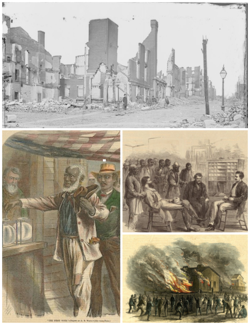
After ratifying the Fourteenth Amendment and adopting a new constitution granting rights to African Americans, Arkansas was readmitted to representation in Congress, beginning the turbulent Reconstruction period under Republican governor Powell Clayton.
Image source: Reconstruction era
Apr 15, 1874 - May 15, 1874
% complete
Two rival factions of the Republican Party fought a brief armed conflict over the disputed gubernatorial election between Joseph Brooks and Elisha Baxter, ending only when President Grant intervened on behalf of Baxter.
Image source: Brooks–Baxter War
1871
% complete
Founded as the First District Agricultural School in Jonesboro, Arkansas State University grew from an agricultural school into a major public university serving northeastern Arkansas.
Image source: Arkansas State University
1906
% complete
John Huddleston found diamonds on his farm near Murfreesboro, revealing the only diamond-bearing site open to the public in the world. The area later became Crater of Diamonds State Park, where visitors can keep any gems they find.
Image source: Crater of Diamonds State Park
Mar 4, 1921
% complete
The thermal springs of Hot Springs, long protected as a federal reservation since 1832, became Hot Springs National Park, preserving the historic bathhouses that made the city a famed resort destination.
Image source: Hot Springs National Park
Aug 19, 1946
% complete
William Jefferson Clinton was born in Hope, Arkansas, and would rise from governor of Arkansas to the 42nd President of the United States, serving two terms and bringing national attention to his home state.
Image source: Bill Clinton
Sep 1957
% complete
Nine African American students attempted to integrate Central High School, facing mobs and resistance from Governor Orval Faubus. President Eisenhower sent the 101st Airborne Division to protect the students, making Little Rock a defining moment of the civil rights movement.
Image source: Little Rock Nine
1962
% complete
Sam Walton opened his first Walmart store in Rogers, Arkansas in 1962, building the company into the world's largest retailer from its Bentonville headquarters and profoundly reshaping northwest Arkansas's economy.
Image source: Walmart
Nov 7, 1978
% complete
At age 32, Bill Clinton won election as the youngest governor in the nation. He would serve multiple terms, championing education reform including the landmark 1983 standards that transformed Arkansas schools.
Image source: Governorships of Bill Clinton
Nov 3, 1992 - Jan 20, 2001
% complete
Arkansas's governor won the presidency, defeating incumbent George H. W. Bush. Clinton served two terms, presiding over economic expansion while frequently drawing attention to Arkansas culture, cuisine, and politics.
Jan 22, 1872
% complete
Established under the Morrill Land-Grant Act as Arkansas Industrial University, the institution opened its doors to students in Fayetteville, becoming the state's flagship university and later renamed the University of Arkansas.
Image source: University of Arkansas
Or browse the full history timeline directory, with more than 2,000 topics.
This History of Arkansas timeline was generated with the help of AI, using information found on the internet.
We work hard to keep these timelines accurate, but mistakes do get through. If you spot one, email us at [email protected] and we'll fix it for future visitors.
Generate yours with AI or build it from scratch, for free.
Export your timeline, add your own events, edit or remove AI-generated events, and much more
No credit card required.
Cancel anytime.
Cancel anytime.
You can create an unlimited number of timelines with up to 10 events on each one, customize how they look, export them to PDF, PNG, PowerPoint, CSV, and Excel, and share them with a link. Paid plans raise the event limit and add features like spreadsheet imports and collaborators.
Yes. You can cancel your subscription from your account page at any time, and you will not be charged again. Your subscription stays active for the rest of the period you already paid for.
Yes. We will email you a reminder before the annual renewal, and we will also email you a receipt.
Yes. You can email us within 15 days of any payment, and we will issue you a full refund.
Check out our pricing docs or send us an email anytime: [email protected].