-
Use Cases
-
Resources
-
Pricing
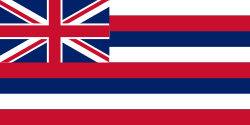
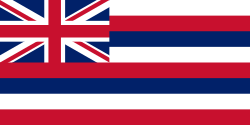
The Hawaiian Kingdom was a sovereign nation established in 1795 when King Kamehameha I unified the Hawaiian Islands. It developed into a modern constitutional monarchy with international recognition, but its independence ended with the overthrow of Queen Liliuokalani in 1893, followed by annexation by the United States in 1898. More Less
1778 - 1920
% complete
The native Hawaiian population fell from approximately 128,000 in 1778 to 71,000 in 1853, reaching a low of 24,000 in 1920 through cataclysmic losses caused by imported diseases.
Image source: Hawaiian Kingdom
1819 - 1824
% complete
During Liholiho's reign as Kamehameha II (1819–1824), the arrival of Christian missionaries and whalers accelerated changes in the kingdom.
Image source: Kamehameha II
1819
% complete
When Kamehameha died in 1819 he left his son Liholiho (Kamehameha II) a large arsenal with tens of thousands of soldiers and many warships. This helped put down the revolt at Kuamoʻo later in 1819 and Humehume's rebellion on Kauaʻi in 1824.
1819
% complete
The kapu system was abolished in 1819, ending regular priestly visits to Nīhoa and Necker Island, which had been integral parts of the kingdom since its beginning.
1824 - 1832
% complete
Kauikeaouli's reign as Kamehameha III began as a young ward of Queen Kaʻahumanu, primary wife of Kamehameha the Great, who ruled as Queen Regent and Kuhina Nui (Prime Minister) until her death in 1832.
Image source: Kamehameha III
1827
% complete
Foreigners within the lands of Hawaii thought themselves unprosecutable, so a unitary state along with a constitutional monarchy replaced the previous system in 1827 to have uniformity across the entire country.
1839
% complete
In 1839, King Kamehameha III created the Chief's Children's School (Royal School) and selected the 16 highest-ranking aliʻi to be eligible to rule, giving them the highest education and proper etiquette. The eligible princes and chiefs were officially declared by King Kamehameha III in 1844.
Image source: Royal School (Hawaii)
1840
% complete
Kamehameha III promulgated the first Constitution of the Hawaiian Kingdom in 1840, followed by its successor in 1852.
1848
% complete
In 1848, the Great Māhele was promulgated by King Kamehameha III, enacting a sweeping redistribution of land that transformed land tenure in the kingdom.
Image source: Great Māhele
1850 - 1899
% complete
Missionary-led education led to high levels of literacy in Hawaiʻi, above 90 percent in the latter half of the 19th century.
1850 - 1900
% complete
Americans set up plantations after 1850. Between 1850 and 1900, some 200,000 contract laborers from China, Japan, the Philippines, Portugal and elsewhere worked in Hawaiʻi under fixed term contracts, typically for five years. By 1908 about 180,000 Japanese workers had arrived.
1873 - 1874
% complete
Dynastic rule by the Kamehameha family ended in 1872 with the death of Kamehameha V. From 1872 to 1873 several relatives of the Kamehameha line were nominated. In the monarchical election of 1873, a ceremonial popular vote and a unanimous legislative vote elected William C. Lunalilo, a member of the House of Kamehameha through his mother.
Image source: Lunalilo
Sep 1873
% complete
The royal guards were disbanded under Lunalilo after a barracks revolt in September 1873. A small army was later restored under King Kalākaua but failed to stop the 1887 Rebellion by the Missionary Party.
1874
% complete
The 1874 election was a nasty campaign in which both candidates resorted to mudslinging and innuendo. David Kalākaua won, beginning the Kalākaua dynasty that would rule until 1893.
Image source: 1884 Hawaiian legislative election
Jan 29, 1891
% complete
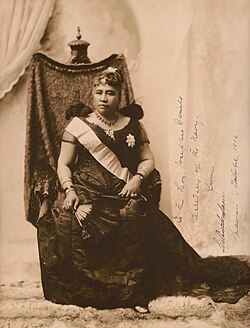
In 1891, Kalākaua died and his sister Liliʻuokalani assumed the throne. She wanted to restore power to the monarch by abrogating the 1887 Constitution.
Image source: Liliʻuokalani
1778
% complete
Captain James Cook was the first European to encounter the Hawaiian Islands, on his third Pacific voyage (1776–1780).
Feb 14, 1779
% complete
Cook was killed at Kealakekua Bay on Hawaiʻi Island in 1779 in a dispute over the taking of a longboat.
Image source: Death of James Cook
1831
% complete
Under Queen Kaʻahumanu's rule, Catholicism was illegal in Hawaiʻi, and in 1831 French Catholic priests were deported.
Image source: Edict of toleration
Jul 17, 1839
% complete
Under the threat of war from French captain Laplace, King Kamehameha III signed the Edict of Toleration on July 17, 1839, agreeing to Laplace's demands regarding religious freedom.
Apr 8, 1842
% complete
Timoteo Haʻalilio, William Richards and Sir George Simpson were commissioned as joint ministers plenipotentiary on April 8, 1842, to seek international recognition of Hawaiian independence.
Image source: Haʻalilio
Dec 19, 1842
% complete
President John Tyler recognized the independence of the Hawaiian Kingdom on December 19, 1842.
Feb 13, 1843 - Jul 31, 1843
% complete
On February 13, 1843, Lord George Paulet seized the Hawaiian Kingdom. Rear Admiral Richard Darton Thomas arrived at Honolulu harbor on July 26, 1843, apologized to Kamehameha III for Paulet's actions, and restored Hawaiian sovereignty on July 31, 1843.
Image source: Paulet affair
Mar 17, 1843
% complete
On March 17, 1843, King Louis Philippe of France recognized Hawaiian independence at the urging of King Leopold I of Belgium.
Nov 28, 1843
% complete
On November 28, 1843, at the Court of London, the British and French governments formally recognized Hawaiian independence.
1849
% complete
In 1849 the United States formally recognized Hawaiian independence.
Aug 1849
% complete
In August 1849, French admiral Louis Tromelin arrived in Honolulu Harbor with La Poursuivante and Gassendi, and the invasion sacked Honolulu. Afterward, Kamehameha III sought defense treaties with the United States and Britain.
Image source: French invasion of Honolulu
1856
% complete
The Stewart Islands (Sikaiana Atoll) near the Solomon Islands were ceded to Hawaiʻi in 1856 by their residents, but the cession was never formalized.
Image source: Sikaiana
1873
% complete
In 1873 the Hawaiian Kingdom was represented at the World's Fair in Vienna.
Image source: 1873 Vienna World's Fair
1875
% complete
The Reciprocity Treaty of 1875 gave Hawaiian exporters an advantage in trade to the United States, which lasted until the tariff changes of 1890 rescinded it.
Image source: Reciprocity Treaty of 1875
1886
% complete
In 1886, King Kalākaua sought to consolidate control of the Northwestern Hawaiian Islands by annexing Kure Atoll, and entered negotiations with the United States to transfer Midway Atoll, which the US had previously claimed, to the Hawaiian Kingdom.
Image source: Kure Atoll
1886 - 1887
% complete
In 1886, Kalākaua's minister of Foreign Affairs, Murray Gibson, sent a delegation to Samoa to meet with King Malietoa Laupepa to negotiate a peaceful resolution to the First Samoan Civil War. The delegation met Malietoa in 1887 and signed a treaty establishing a Polynesian confederacy including Hawaii and Samoa. Gibson also sent the 'homemade battleship' Kaimiloa to Samoa in 1887.
Image source: Walter M. Gibson
1782
% complete
In 1782, the warrior chief who became Kamehameha the Great started a military campaign to unite the islands that would last 15 years.
Image source: Kamehameha I
1795 - 1819
% complete
Under Kamehameha (1795–1819), sandalwood was exported to China, reshaping the islands' economy.
1795
% complete
The Hawaiian Kingdom was established in 1795 when Kamehameha I conquered Oʻahu, Maui, Molokaʻi, and Lānaʻi with the help of western weapons and advisors such as John Young and Isaac Davis. The Battle of Nuʻuanu unified all main islands except Kauaʻi and Niʻihau under one government.
Image source: Battle of Nuʻuanu
1810
% complete
In 1810, the Hawaiian Islands were fully unified when Kauaʻi's chief Kaumualiʻi voluntarily swore allegiance to Kamehameha, joining Niʻihau to the Hawaiian Kingdom.
1822
% complete
In 1822, Kaumualiʻi and his wife Queen Kaʻahumanu traveled with Captain William Sumner to find Nīhoa, as their generation had only known of it through songs and myths.
Image source: Nīhoa
1858 - 1862
% complete
King Kamehameha IV expanded the kingdom's territorial claims beyond the archipelago by commissioning Captain Samuel Allen to annex Johnston Atoll in 1858, and commissioning Captain Zenas Bent to annex Palmyra Atoll in 1862. He also annexed Nihoa, Laysan and Lisianski Island in 1857.
Jul 6, 1887
% complete
In 1887, King Kalākaua was forced to accept a new constitution after a coup d'état by the Honolulu Rifles, a volunteer military unit recruited from American settlers. Drafted by Lorrin A. Thurston, the constitution empowered citizens to elect members of the House of Nobles and increased property requirements to vote above the Constitution of 1864.
Image source: 1887 Constitution of the Hawaiian Kingdom
1890
% complete
By rescinding the Reciprocity Treaty of 1875, the new McKinley Tariff eliminated the previous advantage Hawaiian exporters enjoyed in trade to the U.S., devastating the sugar economy.
Image source: McKinley Tariff
1893 - 1894
% complete
From 1893 to 1894, royalists organized political resistance. While lobbying continued during 1894, supporters of the monarchy formed a sustained effort to restore Liliʻuokalani to the throne, called the Hawaiian royalist movement.
Image source: Hawaiian rebellions (1887–1895)
Jan 1893
% complete
In 1893, local businessmen and politicians, composed of six non-native Hawaiian Kingdom subjects, five American nationals, one British national, and one German national, all living in Hawaiʻi, formed the Committee of Safety.
Image source: Committee of Safety (Hawaii)
Jan 1893
% complete
Queen Liliʻuokalani proposed a new constitution to abrogate the 1887 Constitution, but it was never ratified by the legislature. Many who had forced Kalākaua to sign the 'Bayonet Constitution' became alarmed when three cabinet members informed them the queen planned to unilaterally proclaim her new constitution.
Jan 16, 1893
% complete
U.S. forces took up positions at the Legation, Consulate and Arion Hall on the afternoon of January 16, 1893, supporting the coup against the queen.
Image source: Overthrow of the Hawaiian Kingdom
Jan 17, 1893
% complete
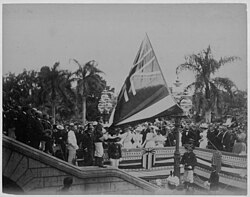
On January 17, 1893, Liliʻuokalani, believing the U.S. would side with her, yielded her authority. She was overthrown in a coup engineered by the Committee of Safety, mostly of American descent and supported by the U.S., ending the monarchy.
Jul 17, 1893
% complete
On July 17, 1893, Sanford B. Dole's Provisional Government faced President Cleveland's investigation into the overthrow. The Republic of Hawaii was requested to wait for the end of President Cleveland's second term before annexation.
Image source: Provisional Government of Hawaii
Dec 14, 1893 - Jan 11, 1894
% complete
Between December 14, 1893, and January 11, 1894, a standoff known as the Black Week occurred between the United States, the Empire of Japan and the United Kingdom against the Provisional Government to pressure them into returning the Queen.
Image source: Black Week (Hawaii)
Jul 4, 1894
% complete
Despite royalist resistance, the provisional government was reorganized as the Republic of Hawaii in 1894, further consolidating power and excluding royalist influence.
Jan 6, 1895
% complete
Tensions culminated in January 1895 with an armed royalist uprising led by Robert Wilcox. The failure of the 1895 rebellion effectively ended major royalist resistance.
Image source: 1895 Wilcox rebellion
Jan 24, 1895
% complete
On January 24, 1895, while under house arrest, Liliʻuokalani was forced to sign a five-page declaration as 'Liliuokalani Dominis', not written by her, which states that she formally abdicated the throne.
Jul 7, 1898
% complete
The Republic of Hawaii remained in control until 1898, when it was dissolved and the Hawaiian Islands were annexed by the United States via the Joint Resolution known as the Newlands Resolution, signed July 7, 1898.
Image source: Newlands Resolution
1993
% complete
In 1993, the United States Senate passed the Apology Resolution, apologizing 'for the overthrow of the Kingdom of Hawaii on January 17, 1893 with the participation of agents and citizens of the United States' and acknowledging that indigenous Hawaiians never directly relinquished their claims to inherent sovereignty over their national lands.
Image source: Apology Resolution
Or browse the full history timeline directory, with more than 2,000 topics.
This Hawaiian Kingdom timeline was generated with the help of AI, using information found on the internet.
We work hard to keep these timelines accurate, but mistakes do get through. If you spot one, email us at [email protected] and we'll fix it for future visitors.
Generate yours with AI or build it from scratch, for free.
Export your timeline, add your own events, edit or remove AI-generated events, and much more
No credit card required.
Cancel anytime.
Cancel anytime.
You can create an unlimited number of timelines with up to 10 events on each one, customize how they look, export them to PDF, PNG, PowerPoint, CSV, and Excel, and share them with a link. Paid plans raise the event limit and add features like spreadsheet imports and collaborators.
Yes. You can cancel your subscription from your account page at any time, and you will not be charged again. Your subscription stays active for the rest of the period you already paid for.
Yes. We will email you a reminder before the annual renewal, and we will also email you a receipt.
Yes. You can email us within 15 days of any payment, and we will issue you a full refund.
Check out our pricing docs or send us an email anytime: [email protected].