-
Use Cases
-
Resources
-
Pricing
The Zulu Kingdom was a powerful monarchy in southern Africa founded by King Shaka in 1816. Under Shaka's innovative military reforms, the Zulu expanded rapidly across what is now KwaZulu-Natal, South Africa. The kingdom famously resisted British colonization during the Anglo-Zulu War of 1879, achieving a stunning victory at Isandlwana before ultimately being defeated and later absorbed into colonial Natal. More Less
1787
% complete
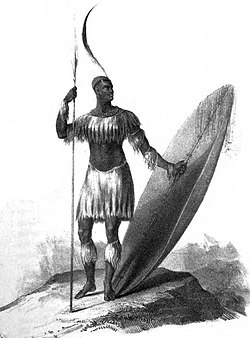
Shaka, who would become one of the most influential monarchs in southern African history and the founder of the Zulu Kingdom, was born around 1787. His early life was marked by hardship and exile, but he would later rise to power and transform the Zulu into a dominant military force in the region.
Image source: Shaka
1816
% complete
After Dingiswayo's death at the hands of Zwide, king of the Ndwandwe, around 1816, Shaka assumed leadership of the entire Mthethwa alliance. This marked a pivotal moment in his rise to power, giving him command over a powerful confederation of chiefdoms and setting the stage for the expansion of the Zulu Kingdom.
1818
% complete
The alliance under Shaka's leadership survived Zwide's first assault at the Battle of Gqokli Hill in 1818. This successful defense demonstrated the effectiveness of Shaka's innovative military tactics, including his disciplined regiments and encirclement strategies, against a numerically superior enemy.
Image source: Battle of Gqokli Hill
1820
% complete
Within two years of Gqokli Hill, Shaka had defeated Zwide at the Battle of Mhlatuze River in 1820 and broken up the Ndwandwe alliance. This decisive victory eliminated the greatest rival power in the region and cemented Zulu dominance over the territory between the Pongola and Tugela rivers.
Image source: Battle of Mhlatuze River
1822
% complete
By 1822, Shaka had conquered an empire covering an area of around 80,000 square miles (210,000 km²), stretching from the Pongola to the Tugela Rivers. His military reforms and conquests triggered widespread migrations and upheavals across southern Africa known as the Mfecane.
Image source: Zulu Kingdom
1828
% complete
Shaka was murdered in 1828 by his half-brothers Dingane and Mhlangana, who conspired with Mbopa, an induna. Following the assassination, Dingane took the throne and began consolidating his own rule over the Zulu Kingdom, marking the end of Shaka's transformative reign.
1828
% complete
Shaka was succeeded by his half-brother Dingane, who had conspired with Mhlangana and Mbopa to murder him. Dingane ruled the Zulu Kingdom for over a decade, during which he faced growing pressure from both the expanding Voortrekker settlers and the British colonial presence in southern Africa.
Image source: Dingane
1836
% complete
In the Cape Colony, increasing tensions between some Dutch settlers and the British colonial authorities led to a wave of Boer (Voortrekker) migration northwards from 1836 onwards, in order to establish autonomous Boer states independent of British control. This migration brought the Voortrekkers into direct conflict with the Zulu Kingdom.
Image source: Great Trek
Oct 1837
% complete
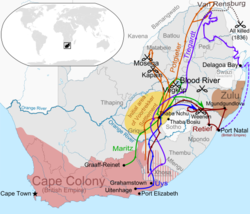
In October 1837, the Voortrekker leader Piet Retief visited Dingane at his royal kraal to negotiate a land deal for the Voortrekkers. Dingane agreed to grant them land on the condition that they recover cattle stolen by a rival chief, a task that Retief and his men undertook.
Image source: Piet Retief
1838
% complete
The remaining Voortrekkers elected a new leader, Andries Pretorius, following the deaths of Piet Retief and other leaders. Pretorius organized an armed commando to defend the Voortrekker position against the Zulu forces, setting the stage for the confrontation at Blood River.
Image source: Andries Pretorius
Feb 3, 1838
% complete
Having recovered the cattle, Retief and his men returned to Dingane's kraal on 3 February 1838. During a ceremony, Dingane ordered his warriors to kill Retief and his delegation, an act that ignited open warfare between the Zulu and the Voortrekkers and led to further attacks on Voortrekker settlements.
Image source: Weenen massacre
Dec 16, 1838
% complete
On 16 December 1838, 15,000 Zulu impis attacked a group of 470 Voortrekker settlers led by Andries Pretorius at the Ncome River. Using fortified laager formations and superior firepower, the Voortrekkers successfully repelled the assault, inflicting heavy casualties on the Zulu army while suffering almost no losses themselves.
Image source: Battle of Blood River
1839
% complete
Following their campaign against Dingane, the Voortrekkers under Pretorius formed the Boer republic of Natalia in 1839, south of the Tugela River and west of the British settlement of Port Natal (now Durban). This new state established a permanent European presence on territory adjacent to the Zulu Kingdom.
Image source: Natalia Republic
1842
% complete
In 1842, war broke out between the British and the Boers, resulting in the British annexation of Natalia. The British takeover of Natal placed a major colonial power directly on the borders of the Zulu Kingdom, increasing diplomatic and military pressures on the Zulu monarchy.
Image source: Colony of Natal
1843
% complete
In 1843, King Mpande ordered a purge of perceived dissidents within his kingdom. Many of those targeted fled into Natal, where they came under British protection, creating ongoing friction between the Zulu Kingdom and the neighboring British colony.
Image source: Mpande kaSenzangakhona
1852
% complete
Mpande began raiding the surrounding areas, culminating in the invasion of Swaziland in 1852. These campaigns reflected Mpande's efforts to expand Zulu influence and secure resources, though they also drew criticism and concern from neighboring colonial powers.
1856
% complete
A civil war erupted in the mid-19th century within the Zulu Kingdom, culminating in the 1856 Battle of Ndondakusuka between the brothers Cetshwayo and Mbuyazi. The battle left Mbuyazi dead and established Cetshwayo as the dominant power in the kingdom, effectively sidelining his father Mpande.
Image source: Battle of Ndondakusuka
1882
% complete
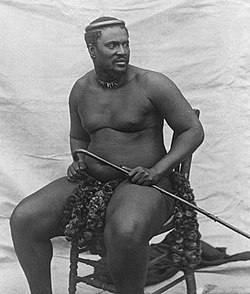
After the war, the British divided Zululand into subkingdoms, and conflict soon erupted between them. In 1882, Cetshwayo was allowed to visit England, where he met Queen Victoria and appealed for restoration, generating considerable public sympathy for his cause among the British public.
Image source: Cetshwayo
1883
% complete
In 1883, Cetshwayo was put back in place as king over a buffer reserve territory, much reduced from his original kingdom. His restoration was opposed by rival chiefs such as Zibhebhu, leading to renewed internal conflict and civil war within the fragmented Zululand.
1884 - 1897
% complete
The academic Roberto Breschi notes that Zululand had a flag from 1884 to 1897, but this is pure conjecture, as contemporary documentation is lacking. If it existed, the flag would have represented Zululand during its final years of nominal independence before full British annexation.
1884
% complete
Dinuzulu allied with Boer mercenaries to defeat the rival chief Zibhebhu in 1884. In return for their support, the Boers were granted large tracts of land in northern Zululand, where they proclaimed the New Republic, further diminishing Zulu territorial control.
Image source: Dinuzulu KaCetshwayo
Feb 1884
% complete
Cetshwayo died in February 1884, possibly poisoned. His death removed the last unifying figure of the old Zulu Kingdom and left his son Dinuzulu to navigate the turbulent politics of a divided Zululand amid competition between rival chiefs, Boers, and the British.
1887
% complete
The British then annexed Zululand in 1887, ending its existence as an independent kingdom. The territory was brought under direct colonial administration, and traditional Zulu authority was subordinated to British magistrates and officials.
1906
% complete
In 1906, Dinuzulu was accused of being behind the Bambatha Rebellion, an uprising of Zulu people against British taxation policies in Natal. Although his exact role remained disputed, the accusation gave the colonial authorities grounds to move against him and suppress the revolt harshly.
Image source: Bambatha Rebellion
1909
% complete
In 1909, Dinuzulu was sentenced to ten years' imprisonment on St Helena island. His conviction for treason effectively ended any remaining political power of the Zulu monarchy under colonial rule, though he retained symbolic significance for the Zulu people.
1872
% complete
When Mpande died of old age in 1872, Cetshwayo took over as ruler of the Zulu Kingdom. He worked to rebuild and strengthen the Zulu army, reviving the regimental system, which alarmed British colonial officials who viewed the resurgent Zulu Kingdom as a threat to their plans for a confederation of southern African states.
Dec 1878
% complete
British forces crossed the Tugela river at the end of December 1878, beginning the Anglo-Zulu War. The invasion launched a multi-pronged British advance into Zululand, initiating one of the most famous colonial conflicts of the Victorian era.
Image source: Anglo-Zulu War
Dec 11, 1878
% complete
On 11 December 1878, with the intent of instigating a war with the Zulu, Sir Henry Bartle Frere, on his own initiative and without the approval of the British government, presented an ultimatum to King Cetshwayo with terms he could not possibly comply with: that the Zulu army be disbanded and the Zulus accept a British resident.
Jan 22, 1879
% complete
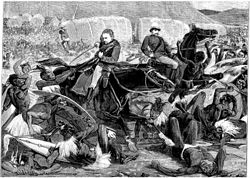
Initially, the British suffered a heavy defeat at the Battle of Isandlwana on 22 January 1879, where the Zulu army killed more than 1,000 British soldiers in a single day. It was one of the worst defeats ever inflicted on the British Army by an indigenous force and remains a celebrated moment in Zulu history.
Image source: Battle of Isandlwana
1913
% complete
When the Union of South Africa was formed, Louis Botha became its first prime minister and arranged for his old ally Dinuzulu to return to South Africa and live in exile on a farm in the Transvaal, where he died in 1913. His death passed the royal mantle to his son Solomon.
1923
% complete
In 1923, King Solomon founded the organisation Inkatha YaKwaZulu to promote his royal claims. The movement became moribund but was later revived in the 1970s by Mangosuthu Buthelezi, chief minister of the KwaZulu bantustan, becoming a significant force in South African politics.
Image source: Inkatha Freedom Party
Dec 1951
% complete
In December 1951, Solomon's son Cyprian Bhekuzulu kaSolomon was officially recognised as the Paramount Chief of the Zulu people. However, real power over ordinary Zulu people lay with South African government officials working through local chiefs who could be removed from office for failure to cooperate.
Image source: Cyprian Bhekuzulu
1980
% complete
The capital of the KwaZulu bantustan was moved from Nongoma to Ulundi in 1980. Ulundi, the site of the final battle of the Anglo-Zulu War, became the administrative center of the bantustan and later a symbol of Zulu political identity.
Image source: KwaZulu-Natal
1994
% complete
The KwaZulu bantustan, led until its abolition in 1994 by Chief Mangosuthu Buthelezi of the Zulu royal family and head of the Inkatha Freedom Party (IFP), was dissolved with the advent of democratic South Africa. Its territory was incorporated into the new province of KwaZulu-Natal, closing a chapter on the institutional legacy of the Zulu Kingdom.
Or browse the full history timeline directory, with more than 2,000 topics.
This Zulu Kingdom timeline was generated with the help of AI, using information found on the internet.
We work hard to keep these timelines accurate, but mistakes do get through. If you spot one, email us at [email protected] and we'll fix it for future visitors.
Generate yours with AI or build it from scratch, for free.
Export your timeline, add your own events, edit or remove AI-generated events, and much more
No credit card required.
Cancel anytime.
Cancel anytime.
You can create an unlimited number of timelines with up to 10 events on each one, customize how they look, export them to PDF, PNG, PowerPoint, CSV, and Excel, and share them with a link. Paid plans raise the event limit and add features like spreadsheet imports and collaborators.
Yes. You can cancel your subscription from your account page at any time, and you will not be charged again. Your subscription stays active for the rest of the period you already paid for.
Yes. We will email you a reminder before the annual renewal, and we will also email you a receipt.
Yes. You can email us within 15 days of any payment, and we will issue you a full refund.
Check out our pricing docs or send us an email anytime: [email protected].