-
Use Cases
-
Resources
-
Pricing
The Three Kingdoms Period was an era of Chinese history following the collapse of the Han Dynasty, during which the kingdoms of Wei, Shu, and Wu competed for control of China. Marked by legendary warfare, political intrigue, and iconic figures such as Zhuge Liang and Guan Yu, this turbulent age ended with the reunification of China under the Jin Dynasty. The period has been romanticized in literature, most famously in the novel 'Romance of the Three Kingdoms.' More Less
184 - 185
% complete
The Yellow Turban Rebellion, led by Zhang Jiao and his followers, erupted across China in 184, driven by widespread famine, corruption, and discontent with the Han dynasty. The rebellion severely weakened the central government, forcing it to rely on regional warlords to suppress the uprising, which set the stage for the fragmentation of imperial power.
Image source: Yellow Turban Rebellion
189
% complete
Following Emperor Ling's death, warlord Dong Zhuo seized the capital Luoyang, deposed Emperor Shao, and installed the young Emperor Xian as a puppet ruler. His tyrannical rule alienated officials and warlords alike, prompting a coalition of eastern warlords to rise against him in 190.
Image source: Dong Zhuo
190 - 191
% complete
A coalition of regional warlords, including Cao Cao and Yuan Shao, was formed to overthrow Dong Zhuo. Though the campaign failed to decisively defeat him, it exposed the weakness of the Han court and accelerated the collapse of central authority as warlords pursued their own ambitions.
Image source: Campaign against Dong Zhuo
200
% complete
The Battle of Guandu saw Cao Cao defeat the much larger forces of Yuan Shao through superior tactics, including a daring raid on Yuan's supply depot at Wuchao. This victory cemented Cao Cao's dominance over northern China and marked his emergence as the most powerful warlord of the era.
Image source: Battle of Guandu
208 - 209
% complete
The Battle of Red Cliffs was a decisive engagement in which allied forces of Sun Quan and Liu Bei defeated Cao Cao's massive invasion fleet on the Yangtze River. A fire attack destroyed Cao Cao's ships, halting his attempt to unify China and establishing the tripartite division that would define the Three Kingdoms era.
Image source: Battle of Red Cliffs
217 - 219
% complete
Liu Bei fought Cao Cao for control of the strategic Hanzhong region, which served as a gateway between Sichuan and the Wei River valley. Liu Bei's victory forced Cao Cao to withdraw and allowed Liu Bei to declare himself King of Hanzhong, marking the peak of his territorial expansion.
Image source: Hanzhong Campaign
222
% complete
Seeking revenge for Guan Yu's death, Liu Bei invaded Eastern Wu but suffered catastrophic defeat at Yiling when Wu commander Lu Xun used fire attacks against his encamped army along the Yangtze. The disaster devastated Shu's military strength and permanently fixed the borders among the three kingdoms.
Image source: Battle of Xiaoting
212 - 214
% complete
Liu Bei invaded the rich province of Yizhou (Sichuan), defeating its governor Liu Zhang after a two-year campaign. Securing Yizhou gave Liu Bei a stable territorial base, allowing him to establish himself as a major power alongside Cao Wei and Eastern Wu.
219
% complete
General Guan Yu launched an offensive against Cao Cao's forces at Fancheng, achieving early success and even flooding the enemy armies. However, his overextension left Jing Province vulnerable to a surprise attack by Eastern Wu.
Image source: Battle of Fancheng
May 15, 221
% complete
Declaring himself the legitimate continuation of the Han dynasty, Liu Bei proclaimed himself emperor in Chengdu, founding the state of Shu-Han. His claim rested on his distant imperial lineage and opposition to Cao Pi's usurpation of the Han throne.
Image source: Shu Han
223
% complete
Following Liu Bei's death, Zhuge Liang sent Deng Zhi to negotiate peace with Sun Quan, restoring the alliance between Shu-Han and Eastern Wu. This diplomatic realignment allowed both states to coordinate their efforts against the dominant power of Cao Wei.
Image source: Zhuge Liang's Northern Expeditions
223
% complete
Broken by his defeat at Yiling, Liu Bei died at Baidicheng after entrusting his son Liu Shan and the kingdom to Chancellor Zhuge Liang. Zhuge Liang thereafter became regent and devoted himself to preserving Shu-Han and pursuing the dream of restoring the Han dynasty.
Image source: Liu Bei
225
% complete
Zhuge Liang led a military expedition south to subdue the rebellious Nanman tribes of the Nanzhong region. His victory secured Shu-Han's southern flank, gained valuable resources and manpower, and enabled him to focus on campaigns against Wei in the north.
Image source: Zhuge Liang's Southern Campaign
228
% complete
Zhuge Liang launched the first of five northern expeditions against Cao Wei, aiming to seize the Guanzhong region. Although initially successful, the campaign failed after the loss of Jieting, where young officer Ma Su's errors forced a strategic withdrawal.
234 - 253
% complete
After Zhuge Liang's death, Jiang Wan and later Fei Yi governed Shu-Han, adopting a more defensive posture and focusing on internal consolidation rather than aggressive northern campaigns. Their stewardship maintained stability for roughly two decades before Jiang Wei resumed large-scale offensives.
Image source: Jiang Wan
219 - 220
% complete
Sun Quan's general Lü Meng launched a stealth invasion of Jing Province while Guan Yu campaigned in the north. The capture severed Guan Yu's retreat, and he was captured and executed by Sun Quan's forces, shattering the Sun-Liu alliance and triggering future conflict.
Image source: Lü Meng's invasion of Jing Province
229
% complete
Sun Quan declared himself emperor at Jianye (modern Nanjing), formally establishing the state of Eastern Wu. With all three rulers now claiming imperial titles, the tripartite structure of the Three Kingdoms became official, though the balance of power favored Wei.
21 May 252
% complete
Sun Quan, the longest-reigning monarch of the Three Kingdoms era, died at age 70 after ruling Eastern Wu for over fifty years. His passing initiated a period of political turmoil and succession struggles within Wu that gradually eroded the state's stability.
Image source: Sun Quan
280
% complete
Jin launched a massive multi-pronged invasion of Eastern Wu, sending fleets down the Yangtze while land forces advanced from multiple directions. The last Wu emperor, Sun Hao, surrendered in 280, ending the Three Kingdoms period and reuniting China under the Jin dynasty.
Image source: Conquest of Wu by Jin
Mar 15, 220
% complete
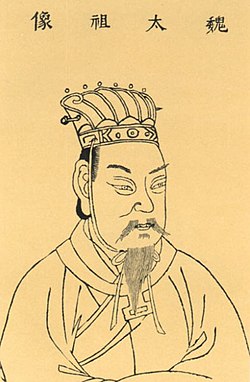
Cao Cao, the de facto ruler of northern China, died at age 65 in Luoyang. His death transferred power smoothly to his son Cao Pi, who soon usurped the Han throne, transforming the family's hegemony into the formal dynasty of Cao Wei.
Image source: Cao Cao
Dec 11, 220
% complete
After Cao Cao's death, his son Cao Pi compelled the last Han emperor, Xian, to abdicate in his favor. Cao Pi proclaimed himself emperor of the state of Cao Wei, formally ending the Han dynasty after four centuries and ushering in the Three Kingdoms period.
Image source: End of the Han dynasty
222 - 223
% complete
Cao Pi took advantage of the conflict between Shu and Wu to launch a three-pronged invasion of Eastern Wu. Despite initial gains, Wei forces were repelled by determined Wu defenses under commanders like Zhu Ran, demonstrating Wu's formidable riverine warfare capabilities.
249
% complete
Sima Yi staged a sudden coup against regent Cao Shuang while the young emperor Cao Fang visited the Gaoping Tombs. Seizing control of the capital and eliminating the Cao clan faction, Sima Yi laid the foundation for the Sima family's eventual usurpation of the Wei throne.
Image source: Incident at the Gaoping Tombs
263
% complete
Wei forces under Zhong Hui and Deng Ai invaded Shu-Han in a coordinated campaign. Deng Ai's audacious march through the Yinping mountains bypassed Shu defenses and reached Chengdu, forcing Liu Shan to surrender and ending the Shu-Han state after forty-three years.
Image source: Conquest of Shu by Wei
265
% complete
Sima Yan forced the last Wei emperor, Cao Huan, to abdicate and proclaimed the Jin dynasty with himself as Emperor Wu. With Wei absorbed into Jin, only Eastern Wu remained outside Sima control, setting the stage for reunification.
Image source: Jin dynasty (266–420)
Or browse the full history timeline directory, with more than 2,000 topics.
This Three Kingdoms Period timeline was generated with the help of AI, using information found on the internet.
We work hard to keep these timelines accurate, but mistakes do get through. If you spot one, email us at [email protected] and we'll fix it for future visitors.
Generate yours with AI or build it from scratch, for free.
Export your timeline, add your own events, edit or remove AI-generated events, and much more
No credit card required.
Cancel anytime.
Cancel anytime.
You can create an unlimited number of timelines with up to 10 events on each one, customize how they look, export them to PDF, PNG, PowerPoint, CSV, and Excel, and share them with a link. Paid plans raise the event limit and add features like spreadsheet imports and collaborators.
Yes. You can cancel your subscription from your account page at any time, and you will not be charged again. Your subscription stays active for the rest of the period you already paid for.
Yes. We will email you a reminder before the annual renewal, and we will also email you a receipt.
Yes. You can email us within 15 days of any payment, and we will issue you a full refund.
Check out our pricing docs or send us an email anytime: [email protected].